Struggling with off-grid water access?
The wrong pump voltage can lead to inefficiency and system failure.
Choosing correctly is key to a reliable water supply for your farm or home.
The main difference lies in power and efficiency. A 24V solar pump operates at a higher voltage, allowing it to handle more demanding tasks like deeper wells and higher flow rates with greater efficiency and less power loss over long distances compared to a 12V pump.
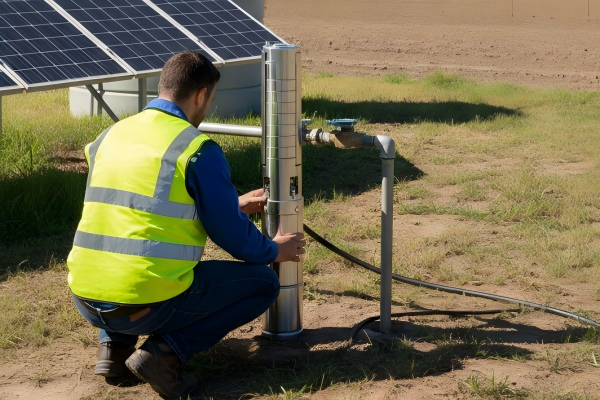
Understanding this core difference is the first step.
But how do you know which system is the right investment for your specific needs?
The details in voltage, wiring, and application will determine your success.
Let's explore these factors to ensure you make the best choice for a consistent water supply.
Understanding Voltage and Power Fundamentals
Feeling confused by electrical terms like volts and watts?
This confusion can lead to buying a pump system that is either too weak or unnecessarily powerful.
Getting the basics right ensures you design a perfectly matched system.
Voltage (V) is the electrical pressure, while power (Watts, W) is the total work the pump can do. A higher voltage pump can deliver the same amount of power with less current (Amps, A), making it more efficient for demanding jobs and reducing energy loss in wiring.
To truly grasp the difference between 12V and 24V systems, we need to look at the basic science.
Electricity has a few key measurements.
Think of it like water in a pipe.
The Power Equation: Volts x Amps = Watts
Voltage (V) is like the water pressure.
It's the force pushing the electricity through the wires.
A higher voltage means more "push."
Current, measured in Amperes (Amps or A), is like the flow rate of the water.
It's the volume of electricity moving through the wire.
Power, measured in Watts (W), is the total work being done.
It's the combination of pressure and flow.
The formula is simple: Voltage (V) × Amperage (A) = Wattage (W).
This equation is crucial.
A 120-watt pump could be a 12V pump drawing 10 amps (12V x 10A = 120W).
Or, it could be a 24V pump drawing only 5 amps (24V x 5A = 120W).
They both have the same power output, but the 24V system does it with half the current.
This lower current is the key to higher efficiency, as we will see later.
Why Lower Amps Matter
High amperage creates more heat in the wires.
This heat is wasted energy, a phenomenon known as resistive loss or I²R loss.
By doubling the voltage from 12V to 24V, you halve the amperage for the same power output.
This reduces the energy wasted as heat by a factor of four.
This means more of the sun's energy captured by your panels actually goes into pumping water.
It's a significant efficiency gain, especially with long wire runs from the solar panels to the pump.
| Electrical Term | Unit | Simple Analogy | Role in Solar Pumps |
|---|---|---|---|
| Voltage | Volt (V) | Water Pressure | The "push" that drives the motor |
| Current | Amp (A) | Water Flow Rate | The amount of electricity used |
| Power | Watt (W) | Total Water Moved | The pump's actual work capacity |
| Resistance | Ohm (Ω) | Pipe Narrowness | Causes energy loss (heat) in wires |
12V Solar Pumps: The Compact and Simple Choice
Need a simple water solution for a small-scale project?
A complex setup can be expensive and difficult to install for basic needs.
A 12V pump offers a straightforward solution for smaller applications.
12V solar pumps are ideal for low-volume, low-lift applications like small garden irrigation, livestock watering, or providing water for an RV. Their main advantage is simplicity and compatibility with standard 12V batteries and small solar panels, making them very cost-effective for smaller setups.
The 12-volt system is the classic entry-point into solar water pumping.
It's a common voltage for many DC applications, from automotive to off-grid lighting.
This makes finding compatible components like batteries and charge controllers relatively easy and often cheaper.
Ideal Applications for 12V Systems
12V solar pumps truly excel in specific scenarios.
They are perfect for situations where water demand is not massive.
Think about:
- Small-scale drip irrigation for a backyard garden.
- Providing drinking water for a few livestock animals.
- Powering a small water feature or pond circulation pump.
- Supplying water to an RV or a small, off-grid cabin with minimal water needs.
In these cases, the total volume of water needed per day is low.
The "lift," or the vertical distance the water needs to be pumped, is also usually minimal.
A 12V pump provides more than enough power without the complexity of a larger system.
Their lower initial cost makes them an attractive option for budget-conscious projects, with some systems seeing a 15-20% lower upfront cost for the pump and controller.
The Challenge of Voltage Drop
The primary weakness of a 12V system is voltage drop.
As electricity travels along a wire, it loses some of its voltage due to the wire's resistance.
This problem is significantly worse at lower voltages and higher amperages.
For a 12V system, which runs at a higher amperage for the same power, this loss can be substantial.
If the distance between your solar panels and your pump is long (e.g., over 30 meters or 100 feet), the voltage drop could be severe enough to reduce your pump's performance or prevent it from starting at all.
To combat this, you must use a much thicker, more expensive copper wire.
This can sometimes offset the initial cost savings of the pump itself.
| Cable Run Distance | Recommended Wire Gauge (AWG) for 10A @ 12V (3% Loss) |
|---|---|
| 10 feet / 3 meters | 12 AWG |
| 25 feet / 7.5 meters | 8 AWG |
| 50 feet / 15 meters | 6 AWG |
| 100 feet / 30 meters | 2 AWG |
As you can see, the required wire thickness increases dramatically with distance.
This makes 12V systems best suited for compact installations where components are close together.
24V Solar Pumps: The Efficiency Powerhouse
Do you have a deep well or need to move a lot of water?
A 12V pump will struggle, run inefficiently, and likely fail to meet your demands.
A 24V solar pump is engineered for these tougher, high-performance jobs.
A 24V solar pump is the superior choice for high-demand applications. These include drawing water from deep wells, moving large volumes for agriculture, or supplying water for a full-time residence. Its higher voltage leads to greater efficiency, less power loss, and better overall performance.
When your water needs are serious, a 24V system becomes the logical and more efficient choice.
Operating at a higher voltage provides fundamental advantages that are critical for larger-scale projects.
The benefits directly address the limitations of a 12V system.
Why Higher Voltage Means Higher Efficiency
As we discussed earlier, power (Watts) is a product of voltage and current (Amps).
To get 240 watts of power, a 12V system must draw 20 amps.
A 24V system needs only 10 amps to do the same work.
This 50% reduction in current is the key.
Lower current means significantly less energy is lost as heat in the wiring.
This efficiency gain can be substantial, often in the range of 10-15% over the entire system.
This means more of the solar power is converted into pumped water, especially over longer distances.
With a 24V system, you can use thinner, less expensive wiring for the same distance compared to a 12V system, or you can run the wire much further without a critical performance drop.
This wire cost saving can be significant, sometimes negating the slightly higher cost of the 24V pump itself.
Common Uses for 24V Pumps
A 24V pump is built for more demanding tasks where power and reliability are paramount.
Typical applications include:
- Deep Well Pumping: When you need to lift water from depths greater than 20-30 meters (65-100 feet), a 24V pump has the necessary power.
- Agricultural Irrigation: For irrigating multiple acres of crops or large-scale gardens, the higher flow rates of 24V pumps are essential.
- Off-Grid Homes: Supplying all the water for a household, including showers, laundry, and kitchens, demands the consistent performance of a 24V system.
- Livestock Operations: Providing water for large herds of cattle or other animals requires the high volume and reliability that 24V pumps deliver.
12V vs. 24V Performance at a Glance
| Feature | 12V Solar Pump System | 24V Solar Pump System |
|---|---|---|
| Ideal Application | Small-scale, low lift, low volume (gardens, RVs) | Large-scale, deep wells, high volume (farms, homes) |
| Current (Amps) | High (for a given power level) | Low (for a given power level) |
| System Efficiency | Lower, especially with long wires | Higher, less energy lost to heat in wires |
| Wire Requirement | Thicker, more expensive wire needed for distance | Thinner, less expensive wire can be used |
| Component Cost | Pump and controller may be cheaper | Pump and controller may be slightly more expensive |
| Typical Max Head | Up to 30 meters (100 feet) | Often 30 meters (100 feet) and above |
Essentially, the choice to go with a 24V system is an investment in efficiency and capability.
Key Factors in Your Decision: 12V vs. 24V
Ready to buy a pump but worried about making the wrong choice?
Guessing can lead to a system that underperforms or costs too much to operate.
A systematic evaluation ensures you select the perfect pump for your exact needs.
The decision between 12V and 24V hinges on three factors: your Total Dynamic Head (TDH), your daily water volume requirement, and your budget for the total system cost, including wiring. A careful calculation of these factors will point clearly to the most effective voltage.
You can't choose the right pump based on voltage alone.
You need to analyze your specific situation.
By breaking down your requirements, the right choice becomes clear.
Let's walk through the essential calculations you need to make.
Calculating Your Total Dynamic Head (TDH)
Total Dynamic Head (TDH) is the most critical factor.
It's the total equivalent height that the water has to be moved.
It includes three components:
- Static Head: The vertical distance from the water level in your well or source to the highest point in your plumbing (e.g., the top of your storage tank).
- Drawdown: The distance the water level in the well drops while the pump is running.
- Friction Loss: The pressure lost due to friction as water moves through pipes, fittings, and valves. This increases with pipe length, flow rate, and the number of bends.
TDH = Static Head + Drawdown + Friction Loss
A 12V pump is typically suited for a lower TDH, often under 30 meters (100 feet).
If your TDH calculation is higher, a 24V pump is almost always the necessary and more efficient choice.
Accurately calculating your TDH is the first and most important step.
Assessing Your Daily Water Needs
How much water do you need per day?
This is measured in Liters per Day (LPD) or Gallons per Day (GPD).
Make a list of all water uses and estimate their consumption.
- Household Use: ~250 liters per person per day
- Garden Irrigation: ~5 liters per square meter per day
- Livestock: Cattle ~50 liters/day, Sheep ~10 liters/day
Once you have your total daily volume, you need to consider your region's "peak sun hours."
This is the number of hours per day your solar panels will produce their rated power (usually 4-6 hours).
Required Flow Rate (Liters per Minute) = Total Daily Volume / (Peak Sun Hours x 60)
A higher required flow rate often pushes you toward a more powerful 24V pump, which is designed to move more water per minute.
Factoring in System Cost and Component Availability
Finally, consider the total system budget.
- 12V Systems: Often have a lower upfront cost for the pump and controller. However, they may require much more expensive, thicker wiring if there's any significant distance, which can eliminate the initial savings.
- 24V Systems: May have a slightly higher cost for the pump itself. But they save you a significant amount on wiring costs and are over 10% more efficient, meaning you get more water for your investment in solar panels.
Also, consider what components you may already have.
If you have an existing 12V battery bank and solar setup for an RV or cabin, sticking with a 12V pump might be more practical.
If you are starting fresh for a demanding application, starting with a 24V system is the more forward-thinking and efficient long-term solution.
Conclusion
Your choice depends on your needs.
Use 12V for small, simple jobs with short distances.
Choose 24V for deep wells, high water needs, and greater efficiency.
FAQs
Can I run a 12V pump on a 24V system?
No, connecting a 12V pump directly to a 24V power source will overload and destroy the pump's motor.
You must use a voltage converter to step down the voltage.
Is a 24V system more powerful than a 12V system?
Not necessarily.
Power is measured in watts.
A 120W 12V pump and a 120W 24V pump have the same power, but the 24V pump achieves it more efficiently.
How far can you run a 12V solar pump?
It depends on the wire gauge, but performance drops quickly.
For minimal power loss, it's best to keep the distance under 15 meters (50 feet) without using very thick, expensive wire.
Can I use a car battery for a solar pump?
You can, but it is not ideal.
Car batteries are designed for short, high-power bursts, while deep-cycle batteries are needed for the steady, continuous draw of a solar power system.
Do I need a charge controller for a solar pump?
Yes, a charge controller is essential if you are using a battery.
It protects the battery from overcharging by the solar panels and from being overly drained by the pump.
Can I wire two 12V solar panels for a 24V pump?
Yes.
By connecting two identical 12V panels in series (positive of the first to the negative of the second), you combine their voltage to create a 24V output for your pump.
Which is better for off-grid living, 12V or 24V?
For a full-time off-grid home with significant water needs, a 24V system is almost always better due to its higher efficiency and ability to power larger pumps for wells.
What size solar panel do I need for a 12V water pump?
You generally need a solar panel with a wattage that is at least 1.25 times the pump's wattage.
For a 100W pump, you would want at least a 125W panel.