Are you struggling with weak showers or inconsistent water delivery in your building?
This common frustration often stems from a misunderstanding of your plumbing system’s core physics.
The key to solving these issues lies in grasping the critical link between water pressure and flow rate.
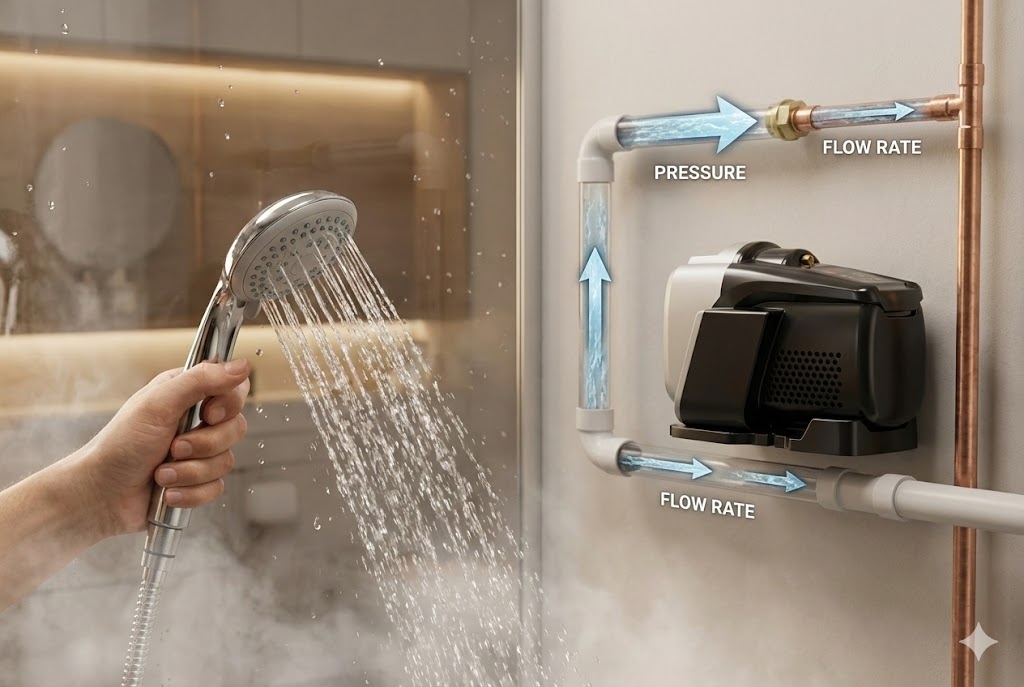
Water pressure and flow rate are directly related; higher pressure usually results in a higher flow rate. However, factors like pipe diameter, friction, and system blockages heavily influence this relationship. Flow rate is the ultimate outcome of pressure working against the total resistance in a system.
That simple answer is just the tip of the iceberg.
The true interaction between these two forces is far more dynamic and is the secret to engineering a truly efficient and reliable water system.
Understanding these details can transform how you manage water delivery, turning frustrating problems into optimized performance.
Let's explore the essential principles that govern how water moves through your pipes, empowering you with the knowledge to create a superior water experience.
How They Are Related
Do you assume that cranking up the pressure is the only way to get more water?
Many people believe this, only to find the problem persists or new issues like pipe strain appear.
Let's clarify the fundamental difference between these two concepts to build a solid foundation of understanding.
Pressure is the force that pushes water, while flow rate is the volume of water that moves through a pipe over a specific time. In an ideal and simple system, increasing the force (pressure) directly increases the volume being moved (flow rate), establishing a direct correlation between them.
To truly master water systems, we must move beyond the simple correlation and examine the factors that define this relationship in the real world.
The physics at play involve more than just a simple push.
Resistance, demand, and system design all have a significant impact on the final performance you experience at the tap.
A high-pressure reading doesn't always guarantee a powerful flow if other elements in the system are creating a bottleneck.
Distinguishing Force from Volume
It's essential to first separate the concepts of pressure and flow.
Think of pressure as the potential or the "push."
It is measured in units like Pounds per Square Inch (PSI) or Bar.
This force exists in the pipes even when no water is moving, such as when all your taps are closed.
Flow rate, conversely, is the "action" or the actual amount of water delivered.
It's measured in units like Gallons Per Minute (GPM) or Liters Per Minute (LPM).
Flow rate is zero when the taps are closed, regardless of how high the static pressure is.
It's the result of pressure being released and put to work.
| Concept | What it is | Measured in | Analogy |
|---|---|---|---|
| Pressure | The force pushing the water | PSI, Bar, Pascals (Pa) | The stored energy in a compressed spring. |
| Flow Rate | The volume of moving water over time | GPM, LPM, m³/s | How fast a car is moving. |
The Real-World Impact of Obstacles
In a perfect, frictionless world, pressure and flow would have a simple, linear relationship.
However, every plumbing system is full of obstacles that create resistance.
This resistance is a counter-force that the water pressure must overcome.
Friction is the primary obstacle.
As water moves, it rubs against the inner walls of the pipes, which slows it down.
Narrower pipes create more friction for the same volume of water than wider pipes, significantly reducing flow rate even if the initial pressure is high.
Fittings like elbows, tees, and valves add to this friction, further impeding flow.
Likewise, sediment buildup or corrosion inside older pipes can narrow the effective diameter and drastically increase resistance.
The Effect of Multiple Fixtures
Another critical factor is shared demand.
Your water main supplies a total amount of flow to your property.
When you open a single tap, it gets 100% of the available flow.
When you open a second tap, that total flow is now divided between the two outlets.
This division is why you often see a drop in water flow from the shower when someone flushes a toilet or turns on the kitchen sink.
While the pressure from the source remains the same, the pressure at each individual fixture drops because the system is trying to serve multiple demands at once, leading to a reduced flow rate at each point.
A well-designed plumbing system, often incorporating a booster pump, accounts for this by ensuring the source pressure and flow capacity are sufficient to handle peak demand without a significant performance drop.
Does Pressure Affect Flow Rates?
Do you ever wonder why your water flow can be disappointing even when you've been told the city's water pressure is high?
This common issue highlights a crucial gap in understanding.
Knowing that pressure affects flow is one thing, but knowing how unlocks the ability to diagnose and solve performance problems effectively.
Yes, pressure directly affects and drives flow rates. A fundamental principle of fluid dynamics states that the flow rate is directly proportional to the square root of the pressure difference between two points in a pipe. Therefore, any change in pressure will directly impact the rate of flow.
This relationship forms the basis of all hydraulic calculations and system designs.
It is not just a theoretical concept; it has practical implications for everything from residential plumbing to large-scale industrial applications.
Understanding this principle allows engineers to size pipes, select pumps, and predict system performance accurately.
Let's break down this connection further to see how it works in practice and how you can use this knowledge to your advantage.
The Mathematical Connection
The core relationship is not just a simple one-to-one link.
For water (an incompressible fluid), the flow rate is proportional to the square root of the pressure.
This means that to double your flow rate, you don't just double the pressure—you need to increase it by a factor of four.
This non-linear relationship is critical for understanding why small adjustments in pressure can sometimes have a less-than-expected impact on flow.
The formal equation often used is a variation of the Darcy-Weisbach or Hagen-Poiseuille equations, which can be simplified for practical purposes to:
Flow Rate (Q) ∝ √ΔP
Where ΔP (Delta P) is the differential pressure—the difference in pressure between the start and end of the pipe.
The greater this pressure difference, the greater the force pushing the water, and thus, the greater the flow rate.
The Importance of Differential Pressure
It's not the absolute pressure within a pipe that creates flow, but the pressure gradient or difference along its length.
Water flows from an area of high pressure to an area of low pressure.
When you open a tap, you create a low-pressure point (the open air), causing water from the high-pressure main to flow towards it.
Consider these scenarios:
- Closed System: When all taps are closed, the pressure equalizes throughout the system. The differential pressure is zero, and therefore, the flow rate is zero.
- Open System: Opening a tap creates a large pressure difference between the pressurized pipe and the outside. This large ΔP results in a high initial flow rate.
- Regulated System: If you install a pressure-reducing valve, you are intentionally creating a pressure loss. This reduces the effective pressure difference across the system, which in turn reduces the maximum flow rate.
Bernoulli’s Principle in Action
Swiss mathematician Daniel Bernoulli articulated a key principle of fluid dynamics that further explains the relationship between pressure, velocity, and potential energy.
In simple terms, Bernoulli's Principle states that for a fluid in motion, an increase in speed occurs simultaneously with a decrease in pressure or a decrease in the fluid's potential energy.
Think of a river.
Where the river is wide and slow-moving, the pressure it exerts sideways is high.
Where the river narrows and speeds up through a gorge, the sideways pressure drops.
This same principle applies inside your pipes.
When water is forced through a narrow section of pipe, its velocity (speed) increases, which leads to a corresponding drop in its pressure at that point.
This is a cornerstone concept used in designing everything from airplane wings to plumbing fixtures.
What Is A Pressure Drop?
Have you ever noticed the water flow from a faucet at the far end of your house is weaker than from one close to the water main?
This isn't a coincidence; it's a direct result of a phenomenon known as pressure drop.
Failing to account for it is a common oversight that leads to inefficient and underperforming water systems.
A pressure drop, also known as pressure loss, is the reduction in pressure that occurs as water flows through a pipe. This loss is primarily caused by friction against the pipe walls and turbulence created by fittings like elbows and valves. The further the water travels, the greater the pressure drop.
Understanding pressure drop is absolutely essential for designing a functional plumbing system.
It determines the required power of a pump and the necessary diameter of the pipes to ensure adequate flow and pressure reach the furthest fixture.
Ignoring pressure drop results in systems where pressure is high at the start but disappointingly low at the point of use.
Let's examine what causes it and how it is directly tied to the flow rate itself.
The Relationship Between Flow Rate and Pressure Drop
Pressure drop and flow rate are intrinsically linked.
As you increase the flow rate of water through a pipe, the velocity of the water increases.
This higher velocity leads to more friction and turbulence, which in turn causes a much greater pressure drop.
This relationship is exponential.
If you double the flow rate, the pressure drop will increase by a factor of approximately four.
This is a critical consideration for system design.
Pushing too much water through an undersized pipe can lead to a massive loss of pressure, negating the benefit of a powerful pump and wasting significant energy.
What Factors Affect Pressure Drop?
Several key variables contribute to the total pressure drop in a system.
Engineers must carefully calculate the cumulative effect of these factors:
- Pipe Diameter: This is the most significant factor. A smaller diameter pipe forces water to move faster for the same flow rate, dramatically increasing friction and pressure loss. Doubling the pipe diameter can reduce pressure drop by a factor of more than ten.
- Pipe Length: The longer the pipe, the more surface area the water must travel along, and thus the greater the total friction loss.
- Fluid Viscosity: Thicker, more viscous fluids (like oil) experience more friction than less viscous fluids like water. While water's viscosity is relatively constant, temperature can play a minor role.
- Pipe Roughness: The internal surface of the pipe matters. Smooth pipes (like PVC) create less friction than rougher pipes (like old corroded iron), resulting in less pressure drop.
- Fittings and Valves: Every elbow, tee, valve, or bend in the system creates turbulence, which disrupts smooth flow and contributes to the overall pressure loss.
Calculating and Managing Pressure Drop
To ensure adequate water delivery, plumbers and engineers use pressure drop charts and calculators.
These tools help them select the correct pipe size based on the required flow rate and the total length of the pipe run, including the equivalent length added by fittings.
The goal is to design a system where the pressure at the final fixture is still sufficient for its intended use after all pressure losses have been accounted for.
If the calculated pressure drop is too high, the solutions are:
- Increase Pipe Diameter: This is the most effective method.
- Install a Booster Pump: A pump adds energy (pressure) to the system to overcome the losses.
- Simplify the Pipe Layout: Reducing the length and number of fittings can help minimize pressure drop.
Relationship Between Pipe Diameter Pressure And Flow
Have you ever been frustrated by a new, expensive showerhead that only produces a weak trickle of water?
The problem often isn't the fixture itself, but an issue rooted in a fundamental component of your plumbing: the pipe diameter.
This single factor can be the bottleneck that undermines your entire system's performance.
Pipe diameter has a profound impact on both pressure and flow. Smaller diameter pipes increase friction and resistance, causing a significant drop in pressure along the pipe's length and severely restricting the maximum possible flow rate. Conversely, larger pipes reduce friction, preserving pressure and allowing for a higher flow rate.
This principle is one of the most critical, yet frequently overlooked, aspects of plumbing design.
Choosing the right pipe diameter is a balancing act between cost, installation feasibility, and performance requirements.
An undersized pipe will choke the flow of water, no matter how much pressure is supplied to it.
Let's explore this crucial relationship in greater detail to understand why size truly matters in a plumbing system.
How Diameter Controls Flow
Think of a pipe as a highway for water.
The flow rate is the number of cars (water volume) that can pass a point in a given time.
The pipe diameter is the number of lanes on the highway.
If you have a two-lane highway, you can only move a certain number of cars per hour.
Even if you push them to go faster (increase pressure), you will quickly create a traffic jam (high friction and pressure loss).
The only way to significantly increase the number of cars is to add more lanes—widen the highway.
In plumbing, doubling the diameter of a pipe doesn't just double the area; it increases it by a factor of four (since Area = πr²).
This exponentially larger area allows much more water to flow through at a lower velocity, which dramatically reduces friction and pressure loss.
| Pipe Diameter (Nominal) | Relative Flow Capacity |
|---|---|
| 1/2 inch (15mm) | 1x (Baseline) |
| 3/4 inch (20mm) | ~2.5x |
| 1 inch (25mm) | ~4x |
Note: Table shows approximate relative capacity for comparison.
The Pressure-Friction Trade-off
When water is forced through a small pipe at a high flow rate, its velocity increases.
As we learned from Bernoulli's principle and the concept of pressure drop, this high velocity creates immense friction.
This friction acts as a brake, converting the initial pressure into wasted heat energy.
The result is a steep pressure gradient along the pipe.
You might have 60 PSI at the entrance of a long, thin pipe, but due to the high friction loss, you could have as little as 20 PSI at the exit.
The pressure has been "used up" just to overcome the resistance of the pipe itself, leaving little force to provide a strong flow at the fixture.
Sizing Pipes for Optimal Performance
Proper system design involves selecting a pipe diameter that is large enough to deliver the target flow rate to the furthest fixture without exceeding an acceptable pressure drop.
For a typical home, a 3/4-inch or 1-inch pipe is often used as the main supply line, branching off to 1/2-inch lines to supply individual fixtures like sinks and toilets.
This hierarchical approach ensures that the main "highway" has enough capacity to feed all the smaller "side roads" without creating a system-wide bottleneck.
Using a variable speed booster pump can help compensate for pressure losses in long pipe runs, but it cannot magically force more water through a pipe that is physically too small to handle the desired flow.
Conclusion
The relationship between pressure and flow is a direct but complex interplay of force, volume, and resistance.
While higher pressure drives higher flow, the true performance of any water system is ultimately dictated by its design, especially pipe diameter.
FAQs
1. Can you have high pressure and low flow?
Yes, this is a common scenario. It usually indicates high resistance in the system, such as a clogged aerator, a partially closed valve, or pipes that are too narrow for the demand.
2. Is flow rate proportional to pressure?
Yes, but not linearly. The flow rate is proportional to the square root of the pressure difference. To double the flow, you must quadruple the pressure.
3. How do I increase water flow rate?
To increase flow, you can increase the source pressure (with a booster pump), reduce system resistance (by clearing blockages), or, most effectively, increase the pipe diameter.
4. What is a good water flow rate for a house?
A typical household flow rate is between 6 and 12 gallons per minute (GPM). However, this depends on the size of the home and the number of occupants.
5. Does turning down the pressure save water?
Lowering the pressure will reduce the flow rate, which means less water is used over the same amount of time. It can be an effective way to conserve water.
6. What is the difference between static and dynamic pressure?
Static pressure is the pressure in the pipes when no water is moving. Dynamic pressure (or working pressure) is the pressure measured when water is flowing.
7. What happens if water pressure is too high?
Excessively high water pressure (above 80 PSI) can damage pipes, fittings, and appliances like washing machines and dishwashers, leading to leaks and premature failure.