You need to power your 0.75 borehole pump.
But choosing the wrong inverter can damage the motor or fail to start it.
Get the right size for reliable water.
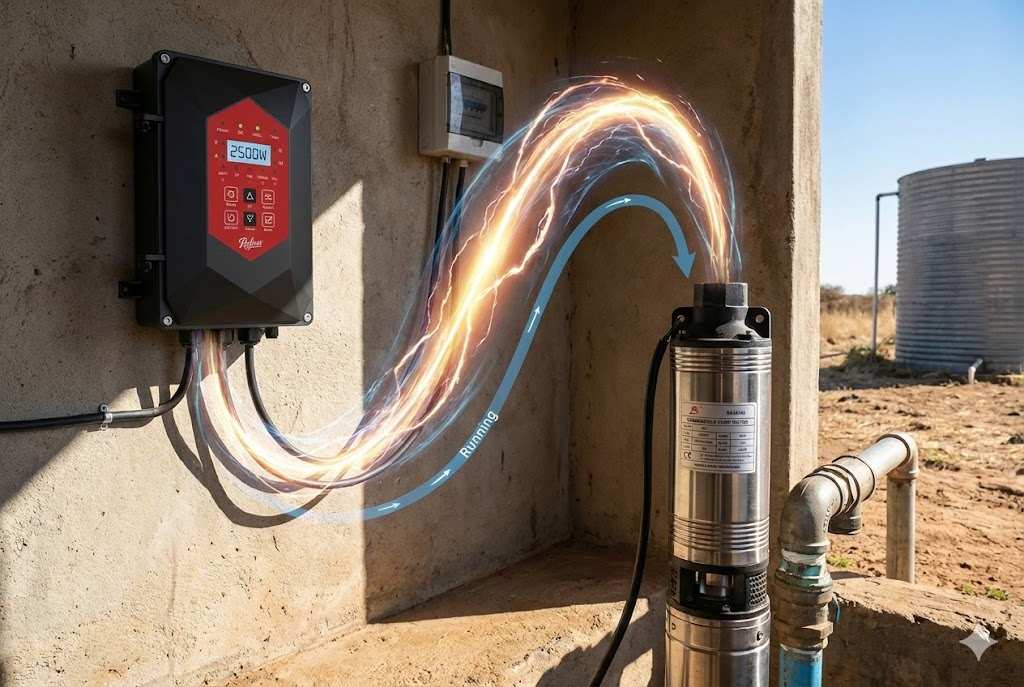
For a 0.75 kW (750W) borehole pump, you need an inverter with a continuous output of at least 2,500 watts. This handles the pump’s high startup surge, which can be 3-5 times its running wattage. Always check the motor's specific startup requirements.
This simple rule applies to standard AC pumps.
But modern borehole pump systems have evolved.
Did you know that many advanced solar pumps no longer require a separate, traditional inverter?
They use something far more intelligent.
This guide will explain both the traditional sizing rule and the technology that is making it obsolete.
We must look deeper than just the wattage.
Why a Simple Wattage Match Fails for Pumps
You think a 750W pump needs a 750W inverter.
This mistake leads to inverter shutdowns or permanent damage.
The pump motor’s startup surge demands much more power than its running wattage.
You must size the inverter for the pump's startup power, not its running power. The startup surge of an AC induction motor can be 3 to 5 times its rated wattage, requiring an inverter with a much higher peak rating.
When you switch on a standard AC borehole pump, it does not gracefully start.
It demands a massive, instantaneous surge of electrical current.
This is called inrush current or locked-rotor amps (LRA).
This initial jolt of energy is needed to overcome inertia and get the motor's rotor spinning from a standstill.
A 0.75 kW pump may run steadily on 750 watts.
But for the first few seconds, it can demand 2,500 watts, 3,000 watts, or even more.
An inverter is rated for two power levels: continuous power and peak (or surge) power.
If the pump’s startup surge exceeds the inverter’s peak power rating, the inverter's protection circuit will trip.
The inverter will shut down to protect itself.
In a worst-case scenario, a poorly made inverter could be permanently damaged.
Calculating the Correct Inverter Size
The first step is to confirm your pump's power rating.
A "0.75" pump usually means 0.75 kilowatts (kW), which is 750 watts.
It could also mean 0.75 horsepower (HP), which is approximately 560 watts.
This article assumes 0.75 kW or 750 watts.
Always verify this on the pump's nameplate.
The nameplate is the most reliable source of information.
It will list the pump's voltage, running amps, and sometimes the LRA.
If the LRA is not listed, use a safe general rule.
The 3-5x Rule
A conservative estimate is to multiply the running watts by 3 to 5 to find the required peak power.
- Running Power: 750 Watts
- Estimated Startup Power: 750W x 3.5 = 2,625 Watts
Based on this, you need an inverter with a peak power rating of at least 2,625 watts.
Inverter manufacturers often recommend an inverter with a continuous rating that is 2-3 times the pump's running watts to ensure it can handle the surge.
| Pump Running Watts | Multiplier for Safety | Minimum Continuous Inverter Rating |
|---|---|---|
| 750 W | 3x | 2,250 W |
| 750 W | 4x | 3,000 W |
A 2,500W or 3,000W continuous-rated pure sine wave inverter is a safe and reliable choice for a standard 0.75 kW AC borehole pump.
The Modern Solution: Solar Pump Inverters
You need a reliable off-grid water solution.
But pairing a standard pump, panels, and a traditional inverter creates an inefficient system.
You lose energy at each conversion step, increasing costs.
A modern solar pump inverter is not just a power converter. It is an intelligent controller with an integrated MPPT. It runs the pump directly from DC solar power, maximizing efficiency and eliminating the large startup surge.
The age of bulky, inefficient off-grid pump systems is over.
The industry has moved towards highly integrated solar water pumping systems.
At the heart of this revolution is the dedicated solar pump inverter, also called a variable speed drive (VSD) or intelligent pump controller.
This device is fundamentally different from a standard power inverter.
A standard inverter’s only job is to change DC power to AC power.
A solar pump inverter is a smart brain for the entire system.
It does much more than just convert power.
It intelligently manages the power from the solar panels and controls the pump's motor with incredible precision.
This technology is the key to creating a durable, cost-effective, and highly efficient water supply.
How Solar Inverters Eliminate Surge
The biggest advantage is the "soft start" capability.
Instead of hitting the motor with a sudden jolt of power, a solar pump inverter gradually ramps up the frequency and voltage.
The pump starts spinning slowly and smoothly accelerates to its optimal speed.
- This completely eliminates the damaging inrush current.
- It dramatically reduces mechanical stress on the pump, motor, and pipes.
- It allows you to size the inverter based on the pump's actual running power, not a massive surge power.
Therefore, for a 750W pump, you would use a solar pump inverter rated for 750W or slightly higher (e.g., 1.1 kW) to provide a safe margin.
Maximum Power Point Tracking (MPPT)
Every solar pump inverter has integrated Maximum Power Point Tracking (MPPT).
This is a critical feature for solar applications.
The power output from a solar panel array changes constantly with the sun's intensity.
MPPT technology continuously adjusts the electrical load to find the "sweet spot" where the panels produce the absolute maximum amount of power.
This ensures the pump receives the most energy possible throughout the day, from sunrise to sunset.
The efficiency gains are substantial.
MPPT can boost water output by up to 30% compared to a system without it.
It allows the pump to start earlier in the day, run on cloudy days, and stop later in the evening.
The Powerhouse: High-Efficiency BLDC Motors
You want the most efficient pump system possible.
An old AC motor wastes a significant amount of your precious solar energy as heat.
This means you need more solar panels, driving up your total system cost.
Modern solar pumps use Brushless DC (BLDC) motors with over 90% efficiency. Paired with a solar inverter, they convert more solar energy into water, reducing the number of panels needed and lowering operational costs.
The solar inverter provides the brains, but the BLDC motor provides the brawn.
The combination of these two technologies creates an unbeatable system.
A traditional AC induction motor is a robust but relatively inefficient technology.
It might only be 70-80% efficient.
This means that for every 1000 watts of power it receives, 200-300 watts are lost forever as waste heat.
A BLDC motor, on the other hand, is a masterpiece of modern engineering.
It uses powerful permanent magnets (often neodymium iron boron) on its rotor.
This design eliminates the need for carbon brushes, which are a major source of friction, wear, and energy loss in older motor types.
The Technical Advantages of BLDC
The superiority of the BLDC motor is clear and measurable.
- Extreme Efficiency: With efficiency rates exceeding 90%, almost all the solar power sent to the motor is converted into the rotational force that pumps water. This is a 15-25% improvement over typical AC motors.
- Higher Power Density: BLDC motors are much more compact and lightweight for their power output. They can be up to 47% smaller and 39% lighter than AC motors of the same power rating. This makes installation easier, especially in deep boreholes, and reduces shipping costs.
- Incredible Reliability: No brushes means no parts to wear out. BLDC motors are virtually maintenance-free and are designed for a very long service life, a critical factor for equipment installed in remote, hard-to-access locations.
- Enhanced Torque: These motors provide high starting torque even at low speeds. This allows them to handle difficult starting conditions without faltering.
Adopting a system with a BLDC motor is a strategic decision.
It directly translates to a smaller, less expensive solar array and more water pumped per day.
Choosing the Right System: AC/DC Hybrid Solutions
You need water 24/7, even on cloudy days or at night.
A pure solar system can only operate when the sun is shining.
This limitation forces you to invest in a massive battery bank or a separate generator setup.
An AC/DC hybrid solar pump inverter provides the ultimate flexibility. It automatically uses solar power when available and seamlessly switches to a grid or generator backup when solar energy is insufficient, ensuring an uninterrupted water supply.
The final piece of the puzzle is ensuring you have water whenever you need it.
While pure DC solar pumps are excellent for daytime-only applications like irrigation or filling a large tank, some uses demand 24-hour reliability.
This is where hybrid technology becomes essential.
A hybrid solar pump inverter (or controller) is designed with two power inputs.
You can connect your solar panel array and an AC power source (like the utility grid or a generator) to the controller at the same time.
The system's intelligent logic is designed to prioritize solar power above all else.
How Hybrid Logic Works
The operation is fully automatic and seamless.
- Priority on Solar: When there is sufficient sunlight, the controller powers the pump exclusively using free energy from the photovoltaic panels. The AC input remains on standby.
- Hybrid Function: When solar power decreases due to clouds, the controller doesn't just switch off. It intelligently blends AC power with the available DC solar power. It will use as much solar energy as it can and only draw the minimum amount of AC power needed to keep the pump running at the desired speed. This maximizes your use of free solar energy.
- Automatic AC Takeover: When the sun goes down or during extended periods of heavy cloud cover, and there is no solar input, the controller automatically switches over to the AC power source. The pump continues to run without any interruption.
This functionality gives you the best of both worlds: the cost savings and environmental benefits of solar, combined with the 24/7 reliability of a grid-connected pump.
It eliminates the need for complex and expensive battery storage systems for most applications, offering a more robust and cost-effective solution for round-the-clock water needs.
Conclusion
For a 0.75kW AC pump, you need a 2,500W+ inverter.
But modern solar inverters with BLDC motors eliminate surge.
They offer a smarter, more efficient, and cost-effective solution for reliable water pumping.
Frequently Asked Questions
Can a 2000 watt inverter run a well pump?
A 2000W inverter is likely too small for a 0.75 kW (1 hp) pump due to the high startup surge. It may work for a smaller 0.5 hp pump, but you must check the pump's peak power requirement.
What is the difference between a solar inverter and a normal inverter?
A normal inverter just converts DC to AC. A solar pump inverter also has MPPT for efficiency and VSD capability for a soft start, making it a specialized pump controller.
Do I need a pure sine wave inverter for a water pump?
Yes, you absolutely need a pure sine wave inverter for any motor. A modified sine wave can cause the motor to overheat, run inefficiently, and shorten its lifespan significantly.
How many solar panels are needed to run a 0.75kW water pump?
To run a 750W pump, you would typically need about 1,000 to 1,200 watts of solar panels. This oversizing ensures good performance even on less-than-perfectly sunny days.
Can I run a well pump directly from solar panels?
You cannot connect a standard pump directly to panels. You need a solar pump controller (inverter) to manage the voltage and current and to properly operate the pump's motor.
What happens if an inverter is too small for a pump?
If the inverter is too small, its overload protection will trip, and the pump will not start. Repeated attempts can damage the inverter's sensitive electronic components over time.