Choosing the wrong pump wastes money and leaves you dry.
An oversized pump burns out; an undersized one never meets your needs.
The best size pump for a well is not a single number. It is determined by calculating your required Flow Rate (GPM) and the Total Dynamic Head (TDH) of your specific well.
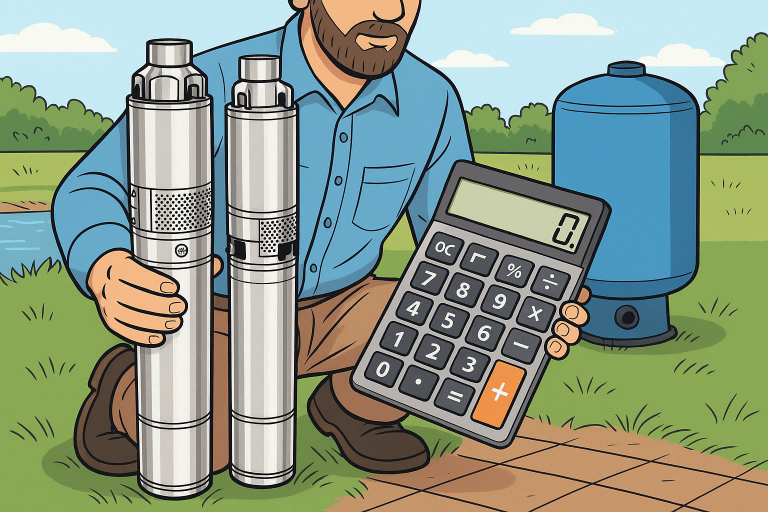
Sizing a well pump is not about picking a generic model off a shelf.
It is a precise process of matching a pump's capabilities to your home or farm's specific demands.
Getting this calculation wrong leads to inefficiency, premature equipment failure, and constant frustration.
Let's break down the process into simple, manageable steps.
This will ensure you select a pump that delivers reliable water for years to come.
Step 1: Calculate Your Daily Water Needs (Flow Rate)
Guessing your water needs can be a costly mistake.
You risk running dry during peak hours or wasting power with an oversized pump.
To find your required flow rate, add up your peak water demand. A good estimate is 75-100 gallons per person daily, 15 gallons per large livestock animal, and GPM based on your irrigation area.
The first step in sizing any pump is to understand how much water you actually need.
This is measured in Gallons Per Minute (GPM) or cubic meters per hour (m³/h).
This figure is not an average over 24 hours.
It represents the maximum amount of water you might need at any one time.
Underestimating this leads to weak water pressure and shortages.
Overestimating it leads to an oversized, inefficient pump that costs more to buy and run.
Breaking Down Your Water Consumption
To get an accurate number, you need to consider all the ways you use water.
Let's categorize them.
1. Domestic Household Use:
This is the water for your sinks, showers, toilets, and appliances.
A common industry standard is to plan for 75-100 gallons per day for each person in the house.
For a family of four, this means 300-400 gallons per day.
However, we need GPM.
Most households can operate comfortably with a pump that can supply 8-12 GPM.
This capacity can handle a shower and a washing machine running at the same time.
2. Livestock Watering:
Your animals' needs are consistent and predictable.
You must ensure they have enough water, especially in hot climates.
A basic guideline is:
- Large cattle: 15 gallons/day per head
- Sheep or goats: 2 gallons/day per head
- Pigs: 4 gallons/day per head
- Chickens (per 100 birds): 5 gallons/day
Calculate the total daily volume and decide over how many hours you want to pump it to determine the required GPM.
3. Agricultural Irrigation:
This is often the most demanding application.
The required flow depends on the type of irrigation (drip, sprinkler), the area, the crop type, and the climate.
A simple pump sizing for irrigation is not possible without detailed analysis, but a general starting point can be estimated.
A well-designed system is mission-critical for farm profitability.
Compiling Your Total GPM
To get your final peak demand in GPM, you must think about overlapping uses.
Will you be irrigating at the same time the family is taking morning showers?
A cautious approach is to add the GPM for each major task that could happen simultaneously.
| Water Use Category | Typical Peak Demand (GPM) | Example Calculation (Family of 4, 10 Cattle) |
|---|---|---|
| Household | 8 - 12 GPM | 10 GPM |
| Livestock | 1 - 5 GPM (spread over time) | 2 GPM |
| Small Garden | 2 - 5 GPM | 3 GPM |
| Simultaneous Peak | Sum of Concurrent Uses | 15 GPM |
In this example, a pump capable of delivering at least 15 GPM would be a safe choice.
Step 2: Measure Your Well's Demands (Total Dynamic Head)
Do you only consider well depth?
You could be ignoring pressure loss from pipes and elevation.
Your pump will underperform, unable to deliver water where you need it.
Total Dynamic Head (TDH) is the true measure of work a pump must do. It is calculated by adding the static head, drawdown, and all friction losses from your piping system.
Simply knowing your well is 300 feet deep is not enough information.
The pump doesn't just have to lift the water out of the ground.
It also has to overcome the pressure of the water in the pipes and the friction created as water moves through them.
This total resistance is called Total Dynamic Head, or TDH.
It is the most critical factor in determining the "power" aspect of your pump size.
Calculating TDH accurately ensures your pump can deliver your required GPM at the final destination, not just at the wellhead.
The Components of Total Dynamic Head
TDH is the sum of three distinct variables.
You must measure or accurately estimate each one.
1. Static Water Level (Static Head):
This is the vertical distance from the ground level down to the water in the well when the pump is not running.
Do not confuse this with total well depth.
If your well is 400 feet deep but the water rests at 150 feet, your static head is 150 feet.
You can measure this with a weighted line or an electronic water level meter.
2. Drawdown:
When the pump turns on, the water level inside the well casing will drop.
The vertical distance the water level drops is the drawdown.
This amount varies based on your well's recovery rate and how fast the pump is pulling water out.
A well report might list this, or you may need to have it tested.
A typical drawdown might be between 10 and 25 feet.
3. Friction Loss:
This is the pressure lost due to friction as water moves through pipes, elbows, valves, and fittings.
Longer pipe runs and smaller pipe diameters create more friction.
Higher flow rates (GPM) also drastically increase friction loss.
You can find friction loss charts online.
They provide the feet of head lost per 100 feet of a specific pipe diameter at a given flow rate.
Putting It All Together: The TDH Calculation
The formula is straightforward.
TDH = Static Head + Drawdown + Friction Loss + Elevation Head
Let's use an example:
- Static Water Level: 200 feet
- Drawdown: 20 feet
- Pipe Run: 500 feet of 1.25-inch pipe at 10 GPM (approx. 2.4 feet of loss per 100 feet of pipe, so 500/100 * 2.4 = 12 feet of loss)
- Elevation Change: The storage tank is on a hill 30 feet above the wellhead.
| TDH Component | Value (Feet) | Description |
|---|---|---|
| Static Head | 200 | Distance from ground to resting water level. |
| Drawdown | 20 | Water level drop during pumping. |
| Friction Loss | 12 | Resistance from pipes and fittings. |
| Elevation Head | 30 | Height of tank above well. |
| Total Dynamic Head | 262 | Total work the pump must do. |
In this scenario, you need a pump that can deliver your target of 10 GPM at a TDH of at least 262 feet.
You would then consult a pump's performance curve to find a model that meets or exceeds these specifications.
Step 3: Match Pump Type to Your Water Conditions
Think any pump will work in your well?
Sand can shred a standard pump, and corrosive water can dissolve it.
Choosing the wrong pump type leads to frequent, costly replacements.
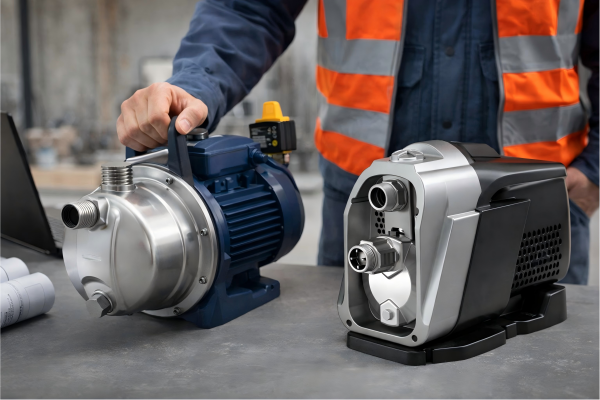
Select your pump type based on your water quality and head requirements. Use a screw pump for sandy or very deep wells, and a centrifugal pump for high-flow, clean water applications.
Once you know your required GPM and TDH, the final major step is to select the right type of pump.
A pump that meets your size requirements on paper might fail quickly if it is not suited for your well's specific environment.
Water is not always clean and neutral.
The presence of sand, silt, or aggressive minerals will dictate which pump design will give you a long and reliable service life.
This is not a corner you want to cut.
The right pump type is the foundation of a durable water system.
The High Head Specialist: Solar Screw Pump
This pump is also known as a progressing cavity pump.
It is an ideal choice for specific, challenging conditions.
It works by using a helical stainless steel rotor that spins inside a rubber stator, pushing "pockets" of water upwards.
- Best Use Case: Very deep wells (high head) with low to moderate flow rate requirements, such as domestic water supply or livestock watering.
- Key Advantage: Sand Tolerance. The flexible rubber stator and wiping action of the rotor allow the pump to handle sandy or silty water without the rapid abrasive damage that destroys centrifugal pumps.
- Performance Profile: Low Flow, High Head. It excels at creating high pressure from a compact design.
The High Flow Workhorse: Solar Centrifugal Pumps
These pumps use a series of spinning impellers to throw water outwards and upwards through a stack of diffusers.
They are the most common type for high-volume applications.
Within this category, the impeller material is a key differentiator.
1. Plastic Impeller Centrifugal Pump:
- Best Use Case: High-flow applications like farm irrigation or filling reservoirs where water is relatively clean and not corrosive.
- Key Advantage: Economical and Wear-Resistant. These pumps are lightweight and cost-effective. The engineered plastic impellers offer excellent resistance to fine sand and abrasion, often outperforming metal in these specific conditions.
- Limitations: Less durable in very deep wells or highly corrosive water.
2. Stainless Steel Impeller Centrifugal Pump:
- Best Use Case: High-flow applications in regions with "aggressive" water, such as acidic or alkaline conditions found in parts of Australia or the Americas.
- Key Advantage: Corrosion Resistance. The SS304 stainless steel used for the impellers and pump body provides superior longevity and reliability in harsh water environments.
- Limitations: Higher initial cost and weight compared to plastic impeller models.
| Pump Type | Primary Strength | Ideal GPM | Ideal TDH | Sand Tolerance |
|---|---|---|---|---|
| Solar Screw Pump | High Head & Sand | Low | Very High | Excellent |
| Plastic Impeller Pump | High Flow & Economy | High | Medium | Good (Fine Sand) |
| SS Impeller Pump | Corrosion Resistance | High | Medium-High | Fair |
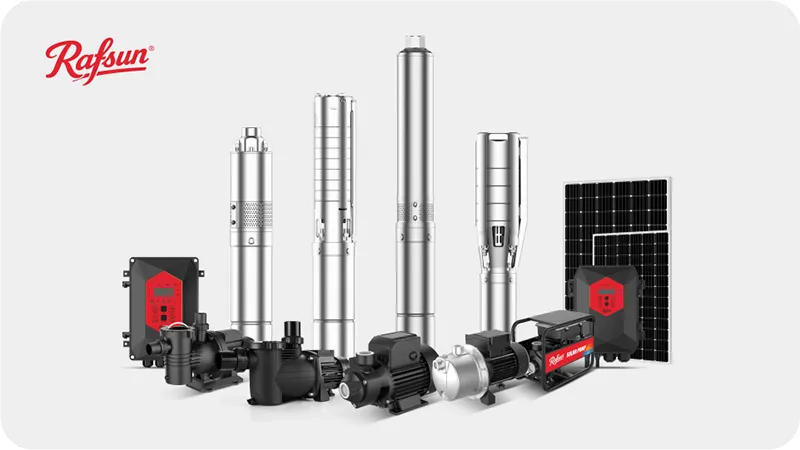
Choosing correctly from this portfolio ensures that the pump you install is not just sized right for today, but built right for the long haul.
Step 4: The Power Equation (Motor and Solar Sizing)
Is your focus only on the pump itself?
An inefficient motor will force you to buy more solar panels.
This inflates your initial investment by 30% or more and wastes energy daily.
The heart of a modern solar pump system is its high-efficiency BLDC motor. This technology reduces the number of solar panels needed, cuts costs, and boosts the overall water output significantly.
You have calculated your GPM and TDH.
You have selected the perfect pump type for your water quality.
The final piece of the sizing puzzle is the motor that drives it and the solar array that powers it.
This is where the most significant technological advancements have occurred.
The shift to high-efficiency Brushless DC (BLDC) permanent magnet motors has revolutionized the economics of solar water pumping.
The motor's efficiency directly determines the size, and therefore the cost, of the solar array required to run your system.
Why Motor Efficiency is the Ultimate Cost-Saver
A pump's job is to convert motor power into water flow.
The motor's job is to convert electrical power into that motor power.
Inefficiencies at any stage require more power from the source.
- Old Technology: Traditional AC or brushed DC motors might have an efficiency of 60-75%. This means 25-40% of the energy from your solar panels is lost as heat before it even does any work.
- Modern BLDC Technology: A BLDC permanent magnet motor boasts an efficiency of over 90%. The energy loss is cut to less than 10%.
This nearly 30% jump in efficiency translates directly into needing 30% less power from your solar panels to achieve the same GPM and TDH.
Given that the solar array is often the most expensive single component of a system, this is a massive saving.
The Technical Edge of BLDC Motors
The superior performance of BLDC motors comes from their advanced design.
- Permanent Magnet Rotor: They use powerful rare-earth magnets (like 40SH Neodymium Iron Boron) in the rotor. The motor doesn't waste energy creating a magnetic field in the rotor, which is a major source of loss in other motor types.
- Brushless Design: Electronic commutation eliminates mechanical brushes. This means no friction, no wear parts to replace, higher reliability, and a longer service life.
- Compact Power: This efficient design results in a motor that is significantly smaller and lighter (up to 47% smaller and 39% lighter) for the same power output, simplifying installation.
| Feature | BLDC Motor System | Traditional Motor System | Financial Impact |
|---|---|---|---|
| System Efficiency | >90% | ~60-75% | Reduces solar panel cost by ~30% |
| Solar Array Size | Smaller | Larger | Lower initial investment |
| Maintenance | None (sealed unit) | Periodic brush replacement | Lower lifetime cost |
| Controller Tech | MPPT standard | Often less advanced | Maximizes water pumped per day |
When you "size" a pump, you are sizing the entire system.
Choosing a pump powered by a high-efficiency BLDC motor is the smartest financial decision you can make.
It makes the entire prospect of solar pumping more affordable and more powerful.
Conclusion
The right size pump is a perfect match for your flow, head, and water quality.
Calculate your needs carefully to ensure an efficient, long-lasting, and cost-effective water system.
Frequently Asked Questions
What is a good flow rate for a well?
A good flow rate is typically 8-12 GPM for a standard home. This allows multiple fixtures to run at once without a significant drop in pressure.
How do I know if my well pump is too small?
Signs include low water pressure, the pump running constantly to keep up, and fixtures sputtering. Your pump cannot meet the peak demand of your home or farm.
Can a well pump be too powerful?
Yes. An oversized pump will rapidly cycle on and off, causing motor burnout. It can also over-pump the well, causing it to draw in sand and air.
How many gallons per minute does a 1 HP pump?
There is no direct answer. A 1 HP pump's GPM depends entirely on the TDH. It might deliver 20 GPM at 100 feet but only 5 GPM at 300 feet.
How deep can a 1/2 HP well pump go?
The depth a 1/2 HP pump can serve depends on its design (screw vs. centrifugal). Always check the pump's performance curve to match its capabilities to your well's TDH.
Does a deeper well need a bigger pump?
Not necessarily. It needs a pump designed for higher head (pressure). A high-head screw pump might be smaller in horsepower than a high-flow centrifugal pump used in a shallow well.