Choosing the wrong pump can leave your pond stagnant or create a whirlpool.
This guesswork wastes money and harms your pond's delicate ecosystem, causing frustration.
To size a solar pump, you need to know your pond's volume, desired circulation rate (GPH), and the head height of any water features. A pump should circulate the total volume every one to two hours.
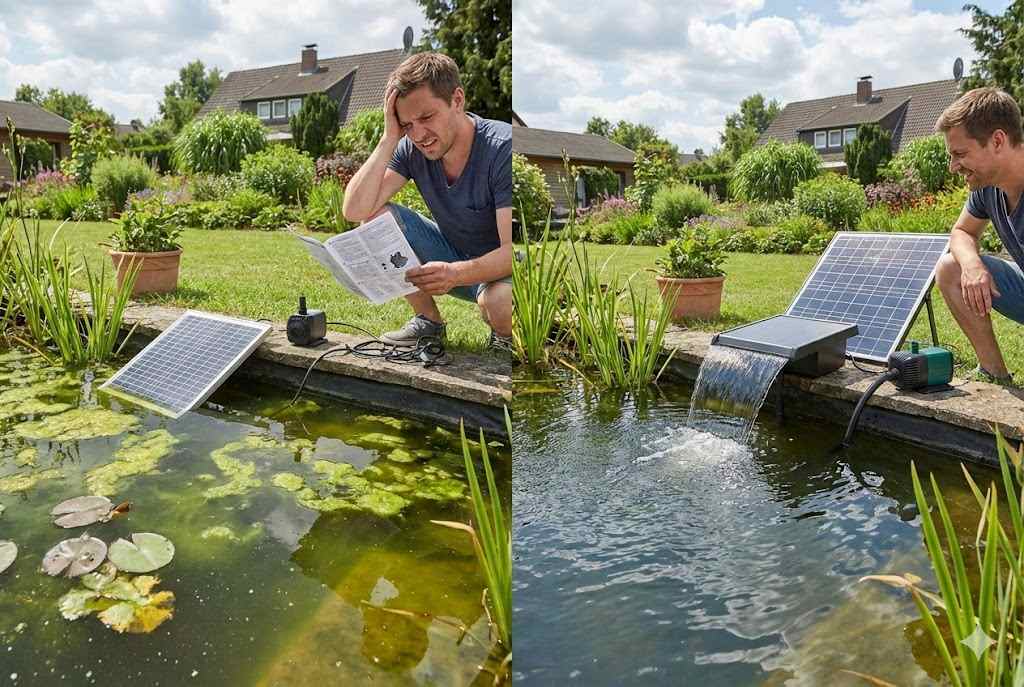
Getting this right seems complex, but it's a straightforward process.
It ensures a healthy, beautiful pond powered by clean, free energy.
Understanding the key factors breaks it down into simple, manageable steps.
This process guarantees you select the perfect system for your water feature.
Let’s walk through how to calculate your exact needs.
Step 1: Calculate Your Pond's Water Volume
Don't know your pond's exact volume?
Estimating can lead to buying a pump that's too weak or wastefully powerful, costing you money and performance.
To find your pond's volume in gallons, use this formula for rectangular ponds: Length (ft) x Width (ft) x Average Depth (ft) x 7.5. For circular ponds: Diameter (ft) x Diameter (ft) x Average Depth (ft) x 5.9.
Accurately determining your pond's volume is the essential first step in selecting the correct solar pump.
This number forms the foundation for all subsequent calculations, including flow rate and filtration needs.
Without an accurate volume measurement, you are essentially guessing, which can lead to an undersized pump that fails to keep the water clean or an oversized pump that wastes energy and creates excessive currents harmful to fish and plants.
The goal is to move from a rough estimate to a reliable figure.
This precision ensures your investment in a solar pump system yields a healthy, balanced, and aesthetically pleasing pond environment.
Measuring Pond Dimensions Accurately
Before you can use any formula, you need precise measurements of your pond.
Use a tape measure for this.
For length and width, measure the longest and widest points of your pond.
Depth can be more challenging, especially in ponds with sloped sides.
Measure the depth at several different points across the pond's surface.
Add these measurements together and divide by the number of measurements you took.
This will give you a reliable average depth, which is far more accurate than just measuring the deepest point.
For example, if you take three measurements of 2 ft, 3 ft, and 4 ft, your average depth is (2+3+4)/3 = 3 ft.
Formulas for Different Pond Shapes
Ponds come in all shapes and sizes, so a single formula won't work for everyone.
Below are the most common formulas to determine the volume in U.S. Gallons.
-
Square or Rectangular Ponds: This is the most straightforward calculation.
Volume (Gallons) = Length (ft) x Width (ft) x Average Depth (ft) x 7.5 -
Circular Ponds: Use the diameter (the distance across the widest point) for this calculation.
Volume (Gallons) = Diameter (ft) x Diameter (ft) x Average Depth (ft) x 5.9 -
Oval Ponds: This uses the length and width at their widest points.
Volume (Gallons) = Length (ft) x Width (ft) x Average Depth (ft) x 6.7
If your pond has a highly irregular shape, you can approximate its volume by mentally dividing it into smaller, regular shapes (e.g., a rectangle and a circle).
Calculate the volume for each shape and then add them together for a close total.
This foundational step removes the guesswork and sets you on the path to a perfectly sized system.
Step 2: Determine Your Required Flow Rate (GPH)
A sluggish pump won't keep your water clear, leading to algae and unhealthy fish.
Your pond's circulation is its lifeline, and getting it wrong is a common mistake.
A healthy pond needs its entire water volume circulated at least once every two hours. For ponds with fish (especially koi), aim for a turnover rate of once per hour to ensure proper oxygenation and filtration.
Once you know your pond's volume, the next step is to decide how quickly you need to circulate that water.
This is measured in Gallons Per Hour (GPH).
The GPH rating is perhaps the most important specification on any pump.
It tells you exactly how much water the pump can move in a given time.
This circulation, known as the "turnover rate," is vital for the health of your pond.
Proper turnover ensures that all the water passes through your filtration system regularly.
It also aerates the water, providing essential oxygen for fish and beneficial bacteria.
Choosing the correct flow rate prevents stagnant areas where algae can bloom and harmful bacteria can multiply.
Understanding Pond Turnover Rate
The turnover rate is the time it takes for the entire volume of your pond to pass through the pump.
The ideal rate depends on the type of pond you have.
-
General Water Garden (Plants, Few Small Fish): A turnover rate of once every two hours is sufficient. This provides adequate filtration and aeration without creating strong currents that can disturb plants. To find the GPH, simply divide your pond's volume by 2.
- Example: A 2,000-gallon pond needs a pump with a GPH of at least 1,000 (2,000 / 2 = 1,000 GPH).
-
Pond with Fish (Goldfish, etc.): Fish add biological load (waste) to the water, requiring more robust filtration. Aim to turn over the water volume once every hour.
- Example: A 2,000-gallon fish pond needs a pump with a GPH of at least 2,000 (2,000 / 1 = 2,000 GPH).
-
Koi Pond: Koi are large fish that produce a significant amount of waste. They also require highly oxygenated water. For a healthy koi pond, you should turn the water over at least once per hour, and many experts recommend even faster rates.
Choosing the Right Pump for Flow
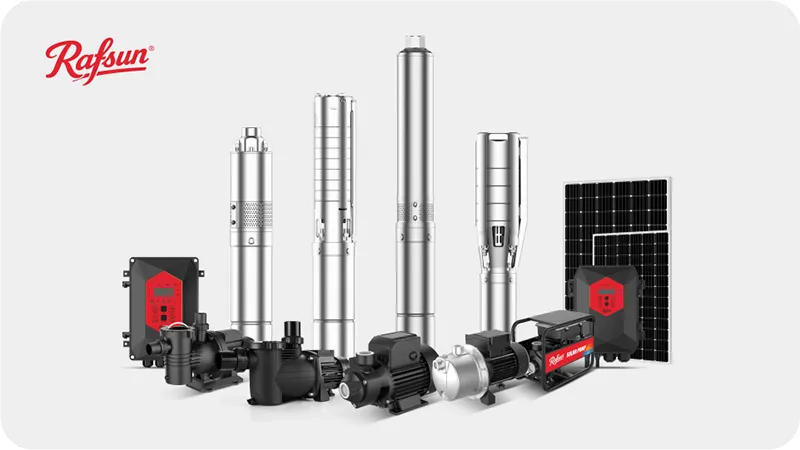
For most ponds focused on circulation and filtration, a high-flow centrifugal pump is the ideal choice.
These pumps, often using durable and economical plastic impellers, are engineered to move large volumes of water efficiently at low to medium pressure.
They are the workhorses of pond circulation.
Their design prioritizes GPH, ensuring your entire pond gets the filtration and aeration it needs to stay healthy.
For environments with acidic water from leaves or special mineral content, a pump with SS304 stainless steel impellers offers superior corrosion resistance and longevity while providing the same high-flow performance.
This ensures the pump lasts for years, even in challenging conditions.
Step 3: Factor in Head Height for Water Features
Ignoring head height can turn your majestic waterfall into a disappointing trickle.
The pump's power diminishes the higher it has to lift water, a critical detail many overlook.
Head height (or lift) is the vertical distance from the pond's surface to the highest point water is pumped. Every foot of height reduces the pump's actual GPH. Check the pump's performance chart to find its flow at your specific head height.
If your pond plan includes a waterfall, fountain, or stream, calculating GPH is only part of the equation.
You must also account for "head height" or "total dynamic head."
This is the measurement of all the vertical and horizontal forces the pump has to work against to move water.
Gravity is the primary force.
The higher the pump needs to lift water, the more its flow rate will decrease.
A pump rated for 2,000 GPH might only produce 1,200 GPH when pushing water up a 5-foot waterfall.
Failing to account for head height is the most common reason for underperforming water features.
It is crucial to select a pump that can deliver your desired flow rate at your required height.
Calculating Total Dynamic Head
Total Dynamic Head is calculated by considering two factors:
-
Vertical Lift (Head Height): This is the most significant factor. Measure the vertical distance in feet from the surface of your pond to the highest point the water will reach (e.g., the top of your waterfall spillway).
-
Friction Loss from Tubing: Water moving through tubing creates friction, which the pump also has to overcome. As a general rule of thumb, for every 10 feet of tubing, add 1 foot of head height to your calculation.
- Example: If your waterfall is 5 feet high and you use 20 feet of tubing to get there, your Total Dynamic Head is 5 ft + 2 ft (for tubing) = 7 ft.
Matching the Pump to the Head Height
Once you know your Total Dynamic Head, you must consult the pump's performance chart.
Every quality pump comes with a chart or graph that shows its GPH output at various head heights.
Find your calculated head height on the chart and see what the corresponding GPH is.
This is the pump's true performance in your specific setup.
For applications with very high head requirements, like a tall, dramatic waterfall, a standard high-flow pump may not be sufficient.
In these cases, a solar screw pump is a superior choice.
This specialized pump mechanism is designed for low flow but very high pressure.
It excels at pushing water to great heights, ensuring your water feature has the powerful and consistent flow you envisioned.
| Pump Type | Best For | Head Performance | Flow Performance |
|---|---|---|---|
| High-Flow (Plastic Impeller) | General circulation, filtration, low waterfalls | Medium | High |
| High-Pressure (Screw Pump) | Tall waterfalls, high-pressure fountains | Very High | Low |
Step 4: Choose the Right Solar Panel and Controller
A mismatched solar panel will underpower your pump, causing it to stall or run erratically.
This nullifies your investment and leads to a stagnant pond, especially on less-than-perfect days.
To size your solar panel array, its total wattage should be at least 1.3 to 1.5 times the pump's wattage rating. This "over-paneling" ensures reliable performance even in lower light conditions.
The final step is to power your correctly sized pump.
The beauty of modern solar pump technology lies in its incredible efficiency.
The heart of these systems is the Brushless DC (BLDC) permanent magnet motor.
With an efficiency rating exceeding 90%, these motors convert nearly every watt of solar energy into water-moving power.
This is a massive leap from older motor types, which could waste 30-40% of energy as heat.
This high efficiency means you can achieve impressive performance with a smaller and more affordable solar panel array.
Sizing this power system correctly is crucial for day-in, day-out reliability.
Matching Panels to Pump Wattage
The key is to provide the pump with more power than it technically requires.
This practice, known as "over-paneling," creates a power surplus that allows the pump to start earlier in the morning, run later in the evening, and maintain better performance on overcast days.
- The Rule of Thumb: Look at the wattage rating of your chosen pump motor. Multiply that number by 1.3. This is the minimum wattage your solar panel array should have. For even better performance in regions with less sun, using a factor of 1.5 is recommended.
- Example: For a 100-watt pump, you should use a solar array of at least 130 watts (100W x 1.3 = 130W).
The Brains of the Operation: The Controller
The solar controller is the intelligent link between your panels and your pump.
A high-quality controller dramatically improves the performance and reliability of the entire system.
Look for a controller with Maximum Power Point Tracking (MPPT).
This technology acts as a smart DC-to-DC converter, constantly optimizing the electrical output from the panels to match the motor's needs.
An MPPT controller can boost the overall energy harvest by up to 30%.
This translates directly into better performance in low-light conditions.
For ponds that require 24/7 circulation, such as critical koi ponds, an AC/DC hybrid controller is the ultimate solution.
This LDC controller has inputs for both your solar panels and your AC grid power.
It prioritizes using the free solar energy whenever it's available.
If clouds roll in or at night, it automatically and seamlessly blends in or switches to AC power to ensure the pump never stops.
This gives you the cost-saving benefits of solar with the complete reliability of the grid.
Conclusion
Sizing your solar pond pump correctly involves calculating volume, flow rate, and head height.
Pairing the right pump with an efficient motor and a smart controller ensures a healthy, beautiful pond.
Frequently Asked Questions
How many watts solar pump do I need for a 1000 gallon pond?
For a 1000-gallon pond, you need about a 500 GPH pump. This typically requires a pump motor around 50 watts, so a solar panel array of 65-75 watts would be ideal.
How do you calculate pond pump size?
Calculate your pond's volume in gallons. Then, decide on a turnover rate (usually every 1-2 hours) to determine the required Gallons Per Hour (GPH) for your pump.
Can a solar pump be too strong for a pond?
Yes. An oversized pump can create strong currents that disturb plants and stress fish. It also consumes more energy than necessary, requiring a larger, more expensive solar setup.
How many GPH should a pond pump be?
Your pump's GPH should be at least half of your pond's total volume. For a 1000-gallon pond, you need a pump rated for at least 500 GPH.
Do solar pond pumps need a battery?
Solar pumps do not require a battery to run during the day. However, a battery system or an AC/DC hybrid controller is needed for them to operate at night or on cloudy days.
How much head do I need for a waterfall?
Measure the vertical height from the pond surface to the waterfall spillway. For every 10 feet of tubing, add 1 foot of head. This total is your minimum head requirement.
How long do solar pond pumps last?
A quality solar pond pump with a brushless motor can last for many years. The panels are typically rated for 20-25 years, while the motor itself is virtually maintenance-free.