Sizing a solar system for your pool pump feels like a complex puzzle.
Get it wrong, and you either overspend on panels you don't need or end up with a system that can't do the job.
The solution is simpler than you think.
**For a modern 1.5 HP variable-speed DC pool pump, a solar system of 1.8 to 2.2 kilowatts (kW) is typically sufficient.
The exact size is determined by the pump motor's wattage and efficiency, not its horsepower rating, which can be highly misleading.
**
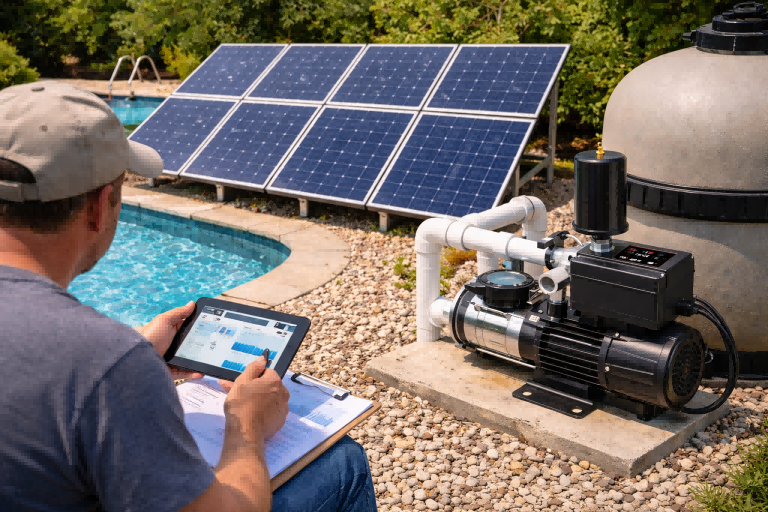
You cannot accurately size a solar array for a pool pump based on its horsepower alone.
This single metric has become the most common source of confusion and costly mistakes for consumers and installers alike.
Two pumps, both labeled "1.5 HP," can have wildly different energy appetites, with one potentially requiring a 30% larger solar system than the other.
To invest correctly and avoid buying unnecessary panels, you must look past the horsepower sticker.
The real answer lies in understanding the pump's actual power consumption in watts, which is a direct result of its underlying motor technology.
Why horsepower is a misleading metric
You rely on horsepower to size your system, a seemingly logical approach.
But this often leads to installing an oversized, unnecessarily expensive solar array.
The smarter solution is to focus on the pump's actual wattage instead.
**A pump's horsepower doesn't reflect its real-world energy consumption.
The motor's efficiency and the system's workload (flow and head) are what determine the actual wattage needed.
This true wattage is what dictates your required solar system size.
**
The term "horsepower" in the context of pool pumps is more of a marketing category than a precise unit of electrical consumption.
It represents the potential work output of the motor shaft under ideal conditions.
However, it tells you nothing about how efficiently the pump converts electrical watts from your solar panels into that work.
The actual size of the solar system you need is directly proportional to the watts the pump draws, not its HP rating.
This wattage is determined by two far more important factors: the motor's internal efficiency and the specific job it has to do.
Ignoring these is like choosing a car engine without knowing its fuel economy.
The Inefficiency Tax of AC Motors
The majority of older, single-speed pool pumps use an AC (Alternating Current) induction motor.
While this technology is a proven workhorse, it is fundamentally inefficient by modern standards.
Many of these motors operate at an efficiency level of only 65-75%.
This means for every 1000 watts of precious solar energy you generate, up to 350 watts (35%) are instantly lost as waste heat and noise before the pump even begins to move water.
This "inefficiency tax" forces you to build a larger, more expensive solar array just to power the waste.
Calculating the True Wattage
The pump's workload also heavily influences its power draw.
A pump that only has to push water through 50 feet of straight pipe will use far fewer watts than the exact same pump pushing water up a small incline, through a heater, and around multiple 90-degree bends.
This total resistance is known as Total Dynamic Head (TDH).
A higher TDH requires the motor to work harder, drawing more watts.
| Pump Specification | Inefficient 1.5 HP AC Pump | High-Efficiency 1.5 HP DC Pump | Impact on Solar System Size |
|---|---|---|---|
| Motor Efficiency | ~70% | > 90% | The DC pump converts more solar to work. |
| Typical Wattage Draw | 1800 - 2200 Watts | 1200 - 1500 Watts (Variable) | The DC pump needs a smaller power source. |
| Required Solar Array | 2.5 kW - 3.0 kW | 1.8 kW - 2.2 kW | You save by needing up to 30% fewer panels. |
Therefore, selecting a pump based on its low wattage consumption and high motor efficiency is the most direct path to reducing the required size of your solar investment.
The core of efficiency: BLDC motor technology
You want a smaller and more affordable solar system for your project.
But you know that compromising on the pump's power is not an option.
The secret to achieving both goals lies in a highly efficient motor.
**A Brushless DC (BLDC) permanent magnet motor, with over 90% efficiency, is the key.
This modern technology drastically reduces the pump's energy waste, allowing you to power it with a significantly smaller and more cost-effective solar system.
**
The most significant advancement in pump technology is the shift from outdated AC motors to sophisticated Brushless DC (BLDC) permanent magnet motors.
This is the same core technology that powers high-performance electric vehicles, chosen for its unmatched efficiency and power density.
Unlike AC motors that waste energy creating a magnetic field in the rotor, BLDC motors use powerful, permanent rare-earth magnets (such as 40SH neodymium iron boron).
An intelligent electronic controller precisely sequences power to coils in the stator, creating a rotating magnetic field that spins the rotor with almost no electrical loss.
This design eliminates the friction and energy waste of the brushes found in older DC motors and the induction losses inherent in AC motors.
The result is a motor that converts over 90% of the incoming solar electricity directly into mechanical force.
Technical Advantages for Solar Sizing
This superior efficiency has a direct and substantial impact on sizing your solar system.
Instead of buying extra solar panels to compensate for a wasteful pump, you can specify a smaller array from the start.
-
Greater than 90% Efficiency: This is the most important figure.
When less than 10% of the energy is lost, the solar system you build is dedicated almost entirely to the task of pumping water, not generating waste heat.
You simply need to generate fewer watts overall. -
High Power Density: BLDC motors are fundamentally more compact and powerful for their size.
They can be up to 47% smaller and 39% lighter than an AC motor with a similar horsepower rating, simplifying installation logistics. -
Intelligent Control: These motors are designed to be paired with smart controllers, like an MPPT (Maximum Power Point Tracking) controller.
The MPPT constantly optimizes the electrical load to ensure the solar panels operate at their peak efficiency voltage, harvesting up to 30% more power throughout the day compared to a simple controller.
This synergy of an efficient motor and a smart controller means a 1.5 HP pump that consumes only 1500 watts can be reliably powered by a solar array of just 1.8 kW.
An inefficient AC pump drawing 2200 watts would require a much larger 2.8 kW array to perform the same task.
Ensuring 24/7 operation: The hybrid AC/DC solution
You are concerned about what happens on cloudy days or when you must run the pump at night.
A system that depends exclusively on the sun seems unreliable for a critical task like pool filtration.
A hybrid system gives you the reliability of the grid with the savings of solar.
**An AC/DC hybrid controller solves the reliability problem.
It prioritizes free solar power but automatically switches to or blends with grid power when sunlight is insufficient.
This guarantees uninterrupted pump operation 24/7, regardless of the weather.
**
The ultimate solution for mission-critical applications like pool circulation is not a pure solar system, but a hybrid one.
This approach completely removes the anxiety about weather dependency and operational hours.
It provides a seamless, fully automatic system that delivers the maximum possible cost savings from solar without ever compromising the performance or reliability your pool requires.
The technology is built around an intelligent controller that serves as the brain of the system, managing power from two different sources.
This provides a robust, fail-safe water management solution.
How Hybrid Controllers Guarantee Uptime
The core of the system is the hybrid inverter, or controller, which has two distinct power inputs.
One input receives the variable DC power directly from the solar panel array.
The second input connects to the stable AC power from the utility grid.
The controller's sophisticated internal software constantly monitors the solar input and makes real-time decisions based on its pre-programmed logic.
-
Solar-First Principle: By default, the controller will always draw 100% of the pump's required power from the solar panels as long as it is available.
On a bright, sunny day, the system operates completely off-grid, costing nothing to run. -
Automatic Grid Takeover: The moment solar energy production drops below the level needed by the pump—due to cloud cover, passing storms, or sunset—the controller instantly and seamlessly switches to the AC grid input.
The pump continues to run at its set speed without any hesitation or interruption. -
Smart Power Blending: The most advanced controllers feature a power blending function.
If the solar panels can only provide 60% of the needed power on a partly cloudy day, the controller will draw only the remaining 40% from the grid.
This feature ensures you are always using every last available watt of free solar energy before spending money on grid power.
This intelligent management means you can set your pump's filtration schedule and forget it.
The system will automatically find the most cost-effective way to run, guaranteeing your pool stays clean while keeping your electricity bills as low as possible.
Conclusion
The right size solar system depends on your pump's true wattage, not its horsepower.
Choose a high-efficiency DC pump with a BLDC motor and a hybrid controller for the smallest system and guaranteed reliability.
Frequently Asked Questions
What happens to a solar pool pump on a cloudy day?
A pure solar pump will run slower or stop.
A hybrid AC/DC solar pump will automatically draw power from the grid to maintain its speed and keep filtering.
Can I run my existing pool pump on solar panels?
Yes, but it's often inefficient.
An old AC pump will require a very large solar array and a special inverter, often making a new, efficient DC solar pump more cost-effective.
Do solar pool pumps save money?
Yes, they significantly reduce or completely eliminate the electricity costs associated with running your pool pump, which is often a home's second-biggest energy consumer.
How many panels does it take to run a 1.5 HP pool pump?
For a modern, high-efficiency 1.5 HP DC pump, you typically need 5 to 7 panels (around 2 kW), depending on the panel wattage and your location.
Do solar pool pumps connect to the grid?
Pure DC solar pumps do not.
Hybrid AC/DC solar pumps connect to both your solar panels and the grid for 24/7 reliability, using solar power whenever it's available.
What maintenance do solar pool pumps require?
The pump itself requires the same maintenance as a standard pump (e.g., cleaning the basket).
The solar panels only need occasional cleaning to remove dust or debris.
Can you oversize a solar system for a pump?
Yes, it's recommended to oversize the solar array by about 20-30%.
This ensures the pump gets full power earlier in the morning, later in the evening, and during light overcast.