Struggling to find the right irrigation pump?
Poor water pressure and high energy costs can ruin your crop yields and profits.
Choosing the right pump technology is your solution.
The best pump for irrigation depends on your specific needs. Key factors include the water source, required pressure (head), and flow rate. For most modern farms, centrifugal pumps, including surface and submersible types, offer the most versatile and efficient solution for moving large water volumes.
Choosing an irrigation pump can feel overwhelming.
Many options exist.
Each one has different strengths.
This guide will break down the most common types.
We will help you understand which pump is the perfect fit for your agricultural needs.
Let's explore the details to make your decision easier.
Understanding Centrifugal Pumps for Surface Irrigation
Are you pulling water from a nearby pond, lake, or canal?
This can be a challenge if the pump isn't suited for surface water sources.
You might experience low efficiency and high operational costs.
Centrifugal pumps are excellent for surface irrigation. They are ideal for moving large volumes of water from sources like rivers or reservoirs. They work best when placed close to the water's surface, providing reliable flow for flood or furrow irrigation systems.
Centrifugal pumps are the most common choice for surface irrigation.
They use a spinning impeller to create water flow.
This simple design makes them reliable and easy to maintain.
Understanding their mechanics is key to using them effectively.
How Centrifugal Pumps Work
A motor spins an impeller inside the pump casing.
The spinning creates a low-pressure area at the center, or "eye," of the impeller.
Atmospheric pressure on the water source pushes water into the pump.
The impeller vanes then catch the water and spin it outwards at high speed.
This high-speed movement increases the water's velocity and pressure.
The water then exits the pump through a discharge outlet.
This process, known as centrifugal force, is highly efficient for moving large water volumes at lower pressures.
For many farmers, this means they can cover more land in less time.
Over 75% of irrigation pumps used globally are a type of centrifugal pump.
Key Considerations for Surface Pumps
You must consider several factors for optimal performance.
- Net Positive Suction Head (NPSH): This is a critical parameter. It measures the pressure at the suction port to prevent cavitation. Cavitation occurs when pressure drops too low, forming vapor bubbles that collapse and damage the impeller.
- Priming: Most standard centrifugal pumps are not self-priming. They must be filled with water before starting. This is called priming. Failure to prime can cause the pump to run dry and overheat, leading to severe damage. Some models include self-priming features, which can be a significant advantage.
- Efficiency Curve: Every pump has a performance curve. This chart shows the relationship between flow rate (Q) and head (H). Operating the pump at its Best Efficiency Point (BEP) on this curve ensures the lowest energy consumption and longest lifespan. Operating far from the BEP can increase energy use by up to 25%.
Below is a table comparing different aspects.
| Feature | Standard Centrifugal Pump | Self-Priming Centrifugal Pump |
|---|---|---|
| Priming Required? | Yes, manual priming | No, automatic priming |
| Placement | Must be below water level | Can be above water level |
| Initial Cost | Lower | Higher |
| Maintenance | Simpler | More complex check valves |
| Best Use Case | Flooded suction setups | Suction lift applications |
Choosing the right centrifugal pump means matching its capabilities to your farm's unique layout.
Exploring Submersible Pumps for Wells and Boreholes
Do you rely on deep groundwater for your irrigation?
Lifting water from deep wells is an energy-intensive task.
Using the wrong pump can lead to system failure and costly repairs.
Submersible pumps are the ideal solution for deep wells and boreholes. These pumps are installed completely underwater, pushing water to the surface instead of pulling it. This design is highly efficient, requires no priming, and operates quietly, making it perfect for deep water extraction.
Submersible pumps offer a powerful solution for accessing deep water tables.
Their design overcomes the limitations of surface pumps.
A surface pump can only lift water from about 7-8 meters due to atmospheric pressure limits.
Submersible pumps don't have this restriction.
They push water up from inside the well.
This makes them essential for farms in arid regions or areas with low water tables.
The Advantage of Pushing Water
Submersible pumps are long, cylindrical units.
They contain a sealed motor and a series of stacked impellers.
The entire unit is submerged in the well, directly in the water.
When activated, the motor drives the impellers.
Each impeller stage adds pressure, lifting the water higher.
This multi-stage design allows them to generate very high pressure, or head.
This is necessary to push water from depths that can exceed 200 meters.
Because the pump is submerged, it is cooled by the surrounding water.
This helps prevent overheating and extends the motor's life.
It also eliminates the need for priming.
This can save significant time and effort during setup and maintenance.
Key Factors for Selecting a Submersible Pump
Choosing the right submersible pump is crucial for system longevity and efficiency.
- Well Diameter: The pump's diameter must be smaller than the diameter of the well casing. A proper fit ensures easy installation and leaves room for water to flow past the motor for cooling. A clearance of at least 1 inch is often recommended.
- Total Dynamic Head (TDH): This is the total pressure the pump must create. It includes the static lift (vertical distance from the water level to the discharge point), friction losses in the pipes, and the final pressure required at the sprinkler heads. An accurate TDH calculation is vital. Miscalculation can lead to underperformance or energy waste.
- Flow Rate: You must match the pump's flow rate to the well's yield. The well's yield is the maximum rate at which it can produce water. Over-pumping, where the pump extracts water faster than the well can replenish it, can damage both the pump and the aquifer.
Here is a breakdown of pump types based on well depth.
| Well Depth Range | Recommended Pump Type | Key Characteristic |
|---|---|---|
| 0 - 25 feet (0-8m) | Surface Jet Pump or Centrifugal | Easy access and maintenance. |
| 25 - 100 feet (8-30m) | Deep Well Jet Pump or Submersible | Jet pumps are an option but less efficient. |
| >100 feet (>30m) | Submersible Pump | Most efficient and reliable choice for deep lifts. |
Investing in a quality submersible pump ensures a consistent and reliable water supply for years.
It is a critical component for any deep-well irrigation system.
Harnessing the Sun with Solar Water Pumps
Are you farming in a remote area without a reliable power grid?
Grid connection fees and diesel fuel costs can be prohibitively expensive.
This can make profitable farming nearly impossible.
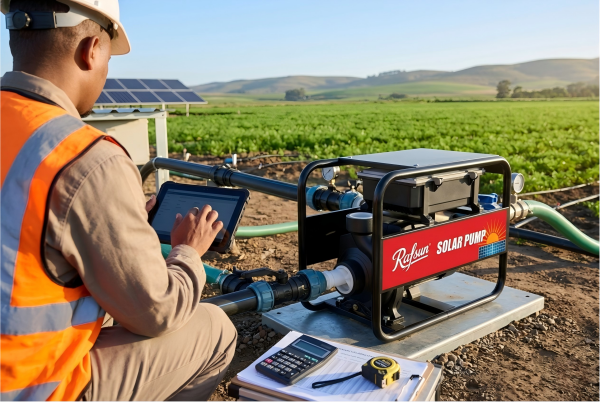
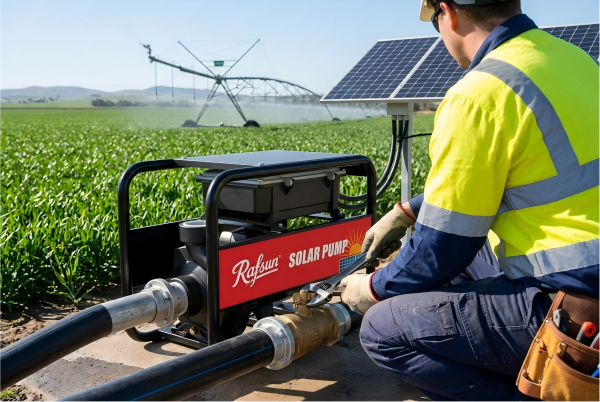
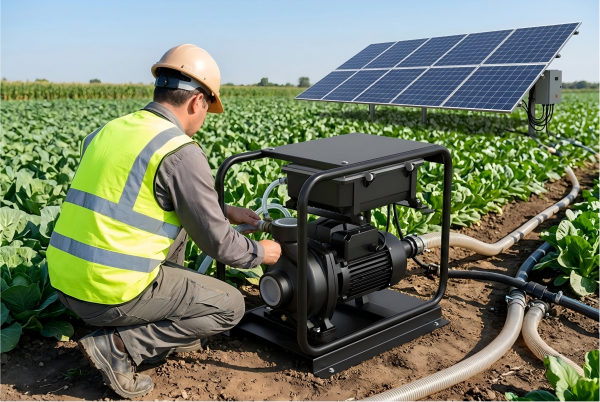
Solar water pumps provide a sustainable and cost-effective solution for off-grid irrigation. They use photovoltaic (PV) panels to power the pump directly from sunlight. This eliminates reliance on fuel or the grid, offering energy independence and significantly lower long-term operating costs.
Solar water pumps are transforming agriculture in remote regions.
They offer a clean and reliable alternative to traditional power sources.
The technology has advanced significantly in the last decade.
Costs have fallen by over 80%, making solar pumps a viable investment for many farms.
Their independence from the grid is a game-changer.
Farmers are no longer subject to power outages or fluctuating fuel prices.
How Solar Pumping Systems Work
A solar irrigation system has three main components.
- Solar Panels: These convert sunlight into direct current (DC) electricity.
- Pump Controller: This device manages the power from the panels. It often includes features like Maximum Power Point Tracking (MPPT) to optimize electricity output. It also protects the pump motor.
- The Pump: This can be a DC or AC pump. DC pumps are generally more efficient for smaller systems as they connect directly to the panels. AC pumps require an inverter to change the DC power to AC power but can be used for larger, more powerful applications.
The system is simple.
When the sun shines, the panels generate electricity.
The controller directs this power to the pump.
The pump then moves water to a storage tank or directly to the fields.
Many systems are designed to pump water into a storage tank during peak sun hours.
This stored water can then be used for irrigation at any time, day or night, using gravity.
This design provides a consistent water supply even when the sun isn't shining.
Sizing Your Solar Pumping System
Proper system sizing is essential for success.
An undersized system will not pump enough water.
An oversized system is an unnecessary expense.
You must consider three main variables.
- Daily Water Requirement: How much water do your crops need each day? This is measured in gallons or cubic meters per day.
- Total Dynamic Head (TDH): As with other pumps, you need to know how high and how far you need to move the water. This determines how powerful the pump must be.
- Solar Irradiance: This is the amount of solar energy available at your location. It varies by geography and season. This data, measured in Peak Sun Hours, determines how many solar panels you need to generate enough power.
| System Component | Sizing Consideration | Impact on Performance |
|---|---|---|
| Pump | Must meet TDH and daily flow rate needs. | Determines if water needs can be met. |
| Solar Panels | Total wattage must be sufficient for the pump motor. | Determines how many hours the pump can run per day. |
| Controller | Must match the voltage and current of the system. | Optimizes power and protects the pump. |
Solar pumps are a long-term investment.
While the initial cost is higher than a diesel pump, the savings on fuel are substantial.
The average payback period for a solar pump can be as short as 2-3 years.
After that, the energy is virtually free for the 25+ year lifespan of the solar panels.
Variable Speed Drive (VSD) Pumps: The Smart Choice for Efficiency
Do your energy bills for irrigation fluctuate wildly?
Conventional pumps run at a single, fixed speed.
They often use more energy than necessary, especially during periods of low water demand.
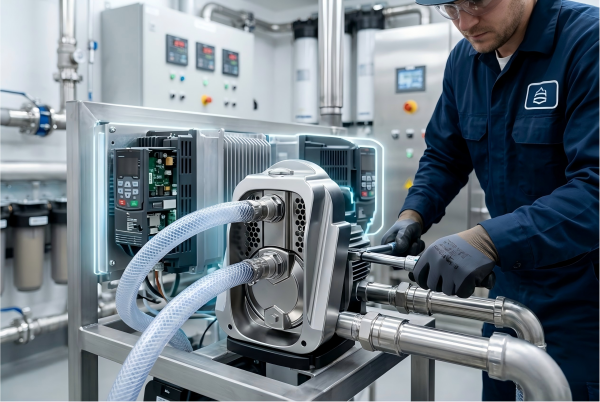
Variable Speed Drive (VSD) pumps, also called variable frequency drive (VFD) pumps, are the most energy-efficient option. They automatically adjust the motor's speed to match the exact water demand. This precision control can reduce energy consumption by 30-60% or more.
Variable Speed Drive technology represents a major leap forward in pump efficiency.
It brings intelligent control to water management.
Instead of running at full power all the time, a VSD pump adapts in real-time.
This is like trading an old light switch for a modern dimmer.
You get exactly the amount of light—or water pressure—that you need.
This has a massive impact on energy consumption.
Energy can account for over 90% of a pump system's total life cycle cost.
The Power of Precision Control
A VSD is an electronic controller.
It manages the frequency of the electrical power supplied to the pump motor.
The pump's speed is directly proportional to the frequency.
- Lower frequency = Slower motor speed = Lower flow and pressure.
- Higher frequency = Faster motor speed = Higher flow and pressure.
A pressure sensor is installed in the pipeline.
The user sets a desired pressure level on the VSD controller.
The sensor continuously monitors the system pressure.
If the pressure drops because a valve is opened, the VSD speeds up the pump to maintain the set pressure.
If pressure rises because a valve is closed, the VSD slows the pump down.
This constant, automatic adjustment ensures the pump only works as hard as it needs to.
When is a VSD Pump the Right Choice?
VSD pumps offer the most significant benefits in applications with varying demand.
Key Applications:
- Drip and Sprinkler Systems: These systems often have multiple zones that turn on and off at different times. A VSD pump can maintain constant pressure across all zones, whether one or ten are active. This improves irrigation uniformity.
- Systems with Long Pipelines: They can overcome friction losses more efficiently and prevent dangerous pressure surges (water hammer) by starting and stopping the motor slowly.
- Filling Multiple Tanks: A VSD can adjust flow rates as tanks become full, avoiding overflows and wasted energy.
The affinity laws for pumps illustrate the dramatic energy savings.
| Parameter | Relationship to Speed | Example (Speed reduced to 80%) |
|---|---|---|
| Flow | Proportional to speed | Flow is reduced to 80%. |
| Pressure | Proportional to speed² | Pressure is reduced to 64% (0.8²). |
| Power | Proportional to speed³ | Power is reduced to 51% (0.8³)! |
This third law is the most important.
A small reduction in speed leads to a huge reduction in power consumption.
Even a 20% speed reduction can cut your energy use nearly in half.
While the upfront cost of a VSD pump is higher than a fixed-speed pump, the return on investment is often very fast.
For many medium to large-scale farms, the energy savings can lead to a payback period of just 1-2 years.
Conclusion
Choosing the best pump is vital for your farm's success.
It depends on water source, depth, and power availability.
Centrifugal, submersible, solar, and VSD pumps all offer unique benefits.
FAQs
What size pump do I need for irrigation?
The pump size depends on your required flow rate and total dynamic head (TDH). Calculate your GPM and TDH to find a pump that meets those specifications efficiently.
How do I choose a pump for a sprinkler system?
For sprinkler systems, choose a pump that can provide the necessary pressure (PSI) at the required flow rate (GPM). VSD pumps are often ideal as they maintain constant pressure.
Can I use a pool pump for irrigation?
It is not recommended. Pool pumps are designed for low-pressure circulation and filtration, not the high pressure needed for most irrigation systems, leading to poor performance and damage.
How much horsepower do I need for an irrigation pump?
Horsepower is determined by flow and pressure needs. You can use online calculators, but a professional assessment considering TDH and GPM is best for an accurate horsepower requirement.
How long can you run an irrigation pump?
An irrigation pump can run for many hours, provided it is properly sized and not overheating. Pumps like submersibles are cooled by water and can run continuously if needed.
What is the difference between a water pump and an irrigation pump?
An irrigation pump is a specific type of water pump designed to handle the volume and pressure needed for agricultural use. All irrigation pumps are water pumps, but not all water pumps are suitable for irrigation.
What is the most efficient irrigation pump?
Variable Speed Drive (VSD) pumps are the most energy-efficient. They adjust their speed to match water demand, which can reduce energy consumption by 30-60% compared to fixed-speed pumps.
Which is better, a submersible or surface pump?
A submersible pump is better for deep wells (>25 feet), while a surface pump is better for shallow sources like ponds or rivers. The choice depends entirely on your water source's depth.