Struggling with low water pressure in high-rise buildings or complex systems?
This pressure drop frustrates clients and hurts your reputation.
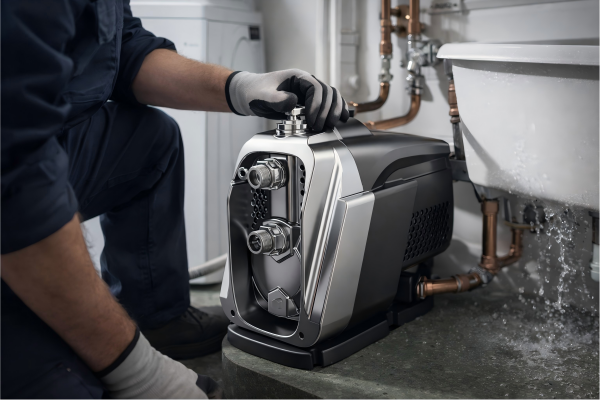
A multi-stage pump provides the high-pressure solution you need.
A multi-stage pump is used when high pressure is required that a single-stage pump cannot efficiently generate.
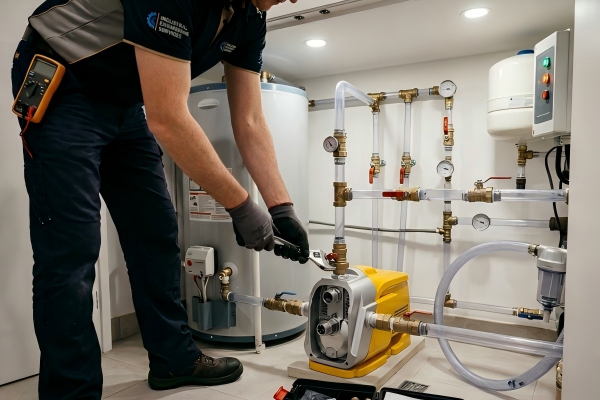
They are ideal for boiler feed, reverse osmosis, irrigation, and boosting water pressure in tall buildings, handling high head requirements with superior energy efficiency compared to single-stage alternatives.
Understanding the right application for a multi-stage pump is crucial.
It can be the key difference between an efficient, reliable water system and one that constantly fails.
Your clients depend on you to know when this powerful technology is the best choice.
Let's explore the specific scenarios where these pumps are not just an option, but a necessity.
What Exactly is a Multi-Stage Pump and How Does It Work?
Finding a pump that delivers consistently high pressure can be a major challenge.
Standard pumps often fail to meet the head requirements of demanding applications.
This leads to system inefficiency and failure.
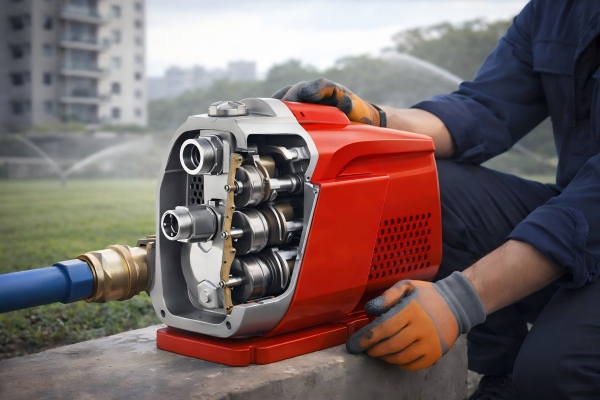
A multi-stage pump contains two or more impellers within a single casing.
Water enters the first impeller, its pressure is boosted, and then it's directed to the next impeller.
This process repeats through each stage, progressively increasing the pressure to achieve very high head.
To truly grasp when to use a multi-stage pump, we must first understand its core mechanics.
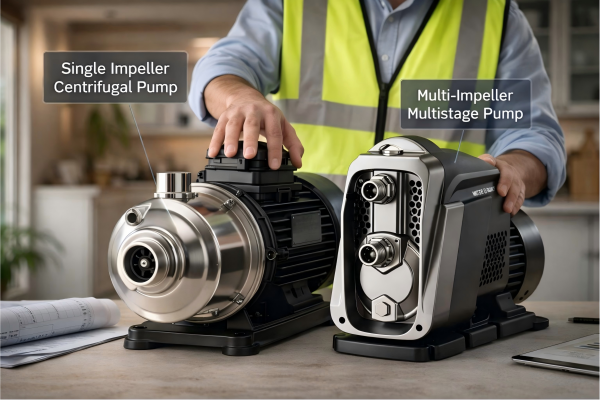
Unlike a single-stage pump, which has only one impeller, a multi-stage pump is essentially a series of pumps connected in one unit.
This design is brilliantly simple but incredibly effective.
The total head generated by the pump is the sum of the head generated by each individual stage or impeller.
This allows for extraordinary pressure capabilities from a relatively compact footprint.
Think of it as climbing a staircase instead of trying to jump to the top floor in one leap.
Each step (impeller stage) adds to the total height (pressure) achieved.
This sequential pressure-building is what makes the multi-stage pump a specialist in high-pressure, high-head applications.
The Flow of Fluid
The journey of the fluid through the pump is what defines its function.
Liquid enters the pump inlet at suction pressure.
It then flows into the eye of the first impeller.
The impeller's rotation imparts velocity to the fluid.
The fluid then passes through a diffuser, which converts this high velocity into high pressure.
This now-pressurized fluid is then guided through a return channel to the eye of the second impeller.
This cycle repeats for every stage in the pump.
Finally, after passing through the last impeller and diffuser, the fluid exits the pump at its maximum pressure.
Key Components and Their Roles
A multi-stage pump is an assembly of precision-engineered parts.
Each component plays a vital role in its performance.
Understanding these parts helps in appreciating the pump's reliability and efficiency.
| Component | Function | Impact on Performance |
|---|---|---|
| Impellers | Rotating components that impart velocity to the fluid. | The number and design of impellers determine the total head. |
| Diffusers | Stationary vanes that surround the impeller. | Convert fluid velocity into pressure energy efficiently. |
| Casing | The outer shell that houses the impellers and diffusers. | Contains the pressure and directs the flow between stages. |
| Shaft | Transmits torque from the motor to the impellers. | Must be strong enough to handle cumulative operational loads. |
| Bearings | Support the rotating shaft. | Reduce friction and maintain alignment for long service life. |
| Seals | Prevent leakage along the shaft. | Crucial for maintaining pressure and preventing fluid loss. |
Horizontal vs. Vertical Configuration
Multi-stage pumps come in two primary configurations: horizontal and vertical.
The choice depends on the application's space constraints and system design.
- Horizontal Multi-Stage Pumps: These are ideal for applications with ample horizontal space. They are often easier to install and maintain.
- Vertical Multi-Stage Pumps: These are perfect for installations where floor space is limited, such as in building basements for pressure boosting. They have a smaller footprint and are commonly used in modern systems. A vertical design can also simplify piping arrangements, saving on installation costs.
Key Advantages of Choosing a Multi-Stage Pump System?
Your clients demand efficiency and reliability, but standard pumps often fall short.
Choosing the wrong pump leads to high energy bills and frequent maintenance calls.
This can damage your business relationship.
The primary advantage is achieving high pressure with exceptional energy efficiency.
Multi-stage pumps operate closer to their Best Efficiency Point (BEP) across a wider range of flows.
This results in lower operational costs, a smaller footprint, and enhanced durability compared to single-stage options.
Selecting the right pump technology is a critical decision for any distributor.
It directly impacts your clients' operational success and your reputation.
Multi-stage pumps offer a suite of benefits that make them a superior choice for specific applications, providing tangible value that strengthens your product offering.
These are not just pumps; they are performance-driven solutions.
Let's break down the specific advantages that you can present to your customers.
Superior Energy Efficiency
Energy consumption is a major operational cost for any pumping system.
This is where multi-stage pumps truly shine.
They are engineered to operate at peak efficiency when generating high pressure.
A single-stage pump trying to achieve the same pressure would need a very large diameter impeller.
This large impeller would operate far from its Best Efficiency Point (BEP), wasting significant energy.
A multi-stage pump, by contrast, uses smaller, more efficient impellers.
Each impeller operates near its own BEP.
This design can lead to energy savings of 20-30% or more in high-pressure applications.
For facilities running pumps continuously, these savings translate into thousands of dollars annually.
Enhanced Reliability and Durability
The design of a multi-stage pump contributes directly to its long service life.
The pressure is built up gradually across several stages.
This means that the a-xial and radial loads on any single component are significantly lower than in a high-pressure single-stage pump.
- Balanced Loads: The hydraulic forces are distributed more evenly, reducing stress on bearings and seals.
- Lower Vibration: Operating closer to the BEP results in smoother, quieter operation with less vibration.
- Reduced Wear: Gradual pressure increase minimizes the erosive effects of high-velocity fluid on internal components.
This robust construction means less downtime for your clients.
It also means fewer warranty claims and service calls for you.
Versatility and Wide Application Range
Multi-stage pumps are incredibly versatile.
By varying the number of stages, a single pump model can be adapted to meet a wide range of head and flow requirements.
This modularity is a significant advantage for distributors.
It allows you to serve multiple market segments with a smaller inventory.
You can offer customized solutions without stocking hundreds of different pump models.
| Application Area | Typical Pressure Requirement | Why Multi-Stage is Ideal |
|---|---|---|
| Building Services | 10 - 25 bar | Compact vertical design for boosting water to top floors. |
| Industrial Cleaning | > 100 bar | Delivers the high-pressure jet needed for effective cleaning. |
| Reverse Osmosis | 40 - 70 bar | Provides the steady, high pressure needed for membrane filtration. |
| Boiler Feedwater | > 50 bar | Reliably injects water into high-pressure steam boilers. |
This adaptability makes the multi-stage pump a powerful tool in your portfolio.
It addresses the specific, high-pressure needs of diverse industries.
High-Pressure Applications: Where Do Multi-Stage Pumps Excel?
Your industrial clients face processes that demand extremely high, stable water pressure.
Failing to provide this pressure can lead to production halts and product defects.
This is a critical failure point they cannot afford.
Multi-stage pumps excel in applications requiring consistent high pressure.
This includes boiler feedwater systems, high-pressure cleaning, reverse osmosis (RO) desalination, and snowmaking.
Their design is perfectly suited to overcome the high-pressure resistance inherent in these processes, ensuring reliable operation.
The fundamental purpose of a multi-stage pump is to generate high pressure efficiently.
This makes it the go-to solution for a wide range of demanding industrial and commercial applications.
In these scenarios, a single-stage pump would be either physically incapable or grossly inefficient.
Understanding these key applications allows you to position these pumps correctly for your target market.
You can speak directly to the challenges your customers face and offer a proven solution.
Let's examine the most common high-pressure environments where multi-stage pumps are the undisputed champions.
Boiler Feedwater Systems
Power plants and large industrial facilities rely on boilers to generate steam.
These boilers operate under extremely high pressure.
A boiler feedwater pump must inject water into the boiler drum, overcoming this internal pressure.
This requires a discharge pressure significantly higher than the boiler's operating pressure.
- Pressure Requirements: Often exceed 100 bar (1450 PSI).
- Criticality: Pump failure leads to an immediate plant shutdown, costing millions in lost production.
Multi-stage pumps provide the reliability and high head necessary for this critical service.
Their robust design handles the high temperatures and pressures without fail.
Reverse Osmosis and Desalination
Reverse Osmosis (RO) is a water purification process that uses a semi-permeable membrane.
To force water through the membrane and separate out salts and impurities, very high pressure is needed.
This process, known as overcoming osmotic pressure, is energy-intensive.
- Typical Pressures: Brackish water RO requires 15-25 bar, while seawater desalination can require 55-70 bar.
- Efficiency is Key: Energy costs can account for over 40% of the operational budget of a desalination plant.
The high efficiency of multi-stage pumps is vital in making RO economically viable.
They provide the constant, high pressure required for the membranes to function effectively while minimizing power consumption.
High-Pressure Cleaning and Jetting
Industries from food processing to heavy manufacturing use high-pressure water jets for cleaning.
This can include cleaning tanks, stripping paint, or de-scaling pipes.
The effectiveness of the cleaning process is directly related to the pressure of the water jet.
Multi-stage pumps are the heart of these systems.
They can generate the pressures needed to remove even the most stubborn contaminants.
| Cleaning Task | Required Pressure Range (bar) | Pump Characteristic Needed |
|---|---|---|
| General Washdown | 50 - 100 | Reliable, continuous duty. |
| Vehicle Cleaning | 100 - 150 | Compact design, ability to handle start/stop cycles. |
| Concrete Hydro-demolition | > 700 | Extreme high-pressure capability from specialized models. |
Snowmaking
Ski resorts depend on artificial snow to extend their season and ensure good conditions.
Snowmaking machines mix water and compressed air at high pressure.
This mixture is then sprayed into the cold air, where it freezes into snow.
A network of multi-stage pumps is required to move water up the mountain and deliver it to the snow guns at the required pressure, often over 30 bar.
The pumps must be reliable in cold conditions and efficient enough to manage the high energy costs of the operation.
Comparing Multi-Stage vs. Single-Stage Pumps: Which is Right for Your Clients?
Your customers are confused about which pump type to choose for a specific job.
Advising them incorrectly could lead to an inefficient system and a lost client.
You need to provide clear, data-backed recommendations.
Choose a multi-stage pump for high-head, low-to-medium flow applications like boiler feed or pressure boosting.
Opt for a single-stage pump for low-head, high-flow applications such as general water transfer or circulation.
The choice depends on balancing pressure needs with flow requirements.
The decision between a multi-stage and a single-stage pump is one of the most common questions you will face as a distributor.
It is not about which pump is "better," but which pump is "right" for the application.
Providing your clients with a clear understanding of the core differences, performance characteristics, and ideal use cases will establish you as a trusted expert.
This knowledge empowers them to make the best investment for their needs.
Let's dissect the comparison based on the key performance indicators that matter most.
Head vs. Flow Performance
The primary distinction lies in their performance curves.
This is the fundamental principle that guides selection.
- Single-Stage Pumps: These are designed for high flow rates at relatively low pressure (head). Their impeller is optimized to move large volumes of water. They are the workhorses for applications like drainage, irrigation, and water circulation in HVAC systems.
- Multi-Stage Pumps: These are engineered for the opposite. They excel at creating high pressure (head) at low to medium flow rates. The series of impellers is designed to build pressure, not move massive volumes.
| Pump Type | Ideal Head Range | Ideal Flow Rate | Best For... |
|---|---|---|---|
| Single-Stage | Low to Medium | High | Draining a flooded area, circulating water in a pool. |
| Multi-Stage | High to Very High | Low to Medium | Boosting water to the 50th floor, feeding a high-pressure boiler. |
Cost and Complexity
Initial investment and long-term maintenance are critical considerations for any business owner.
There is a clear trade-off between the two pump types.
- Initial Cost: Single-stage pumps are mechanically simpler. They have fewer components, making them less expensive to manufacture and purchase. For a low-pressure application, they are the most cost-effective choice upfront.
- Maintenance: While single-stage pumps are simpler, a multi-stage pump designed for a high-pressure application is often more reliable in that context. Attempting to use a single-stage pump for a high-pressure duty (e.g., by running it at very high speeds) would lead to rapid wear and frequent failures. The multi-stage pump, though more complex, will have a lower total cost of ownership in its intended application due to higher efficiency and longer service intervals. Over a 10-year lifespan, a 25% improvement in energy efficiency can easily dwarf the initial price difference.
Making the Right Recommendation
Your role is to guide the customer to the optimal solution.
You can do this by asking a few key questions:
- What is the required discharge pressure (head) in meters or bar? This is the most important question. If the head is high, a multi-stage pump is likely the correct answer.
- What is the required flow rate in m³/h or GPM? If the flow is extremely high and the pressure is low, a single-stage pump is better.
- What is the application? Knowing if it's for boiler feed, reverse osmosis, or simple water transfer immediately points to the correct pump technology.
By analyzing the relationship between head and flow, you can confidently recommend the pump that will provide the best performance, efficiency, and long-term value for your client.
Conclusion
Multi-stage pumps are purpose-built for high-pressure needs.
Choosing the right pump ensures system efficiency, reliability, and long-term savings for your clients, reinforcing your value as a knowledgeable supplier.
Frequently Asked Questions
What is the main difference between a single-stage and a multi-stage pump?
A single-stage pump has one impeller for low-pressure, high-flow tasks.
A multi-stage pump has multiple impellers in series to generate very high pressure for specific applications.
Can a multi-stage pump be used for low-pressure applications?
Yes, but it would be inefficient and not cost-effective.
A single-stage pump is better suited and more economical for low-pressure, high-volume tasks like general water transfer.
Are multi-stage pumps more expensive?
Yes, their initial purchase price is typically higher due to a more complex design and more components.
However, their energy efficiency in high-pressure applications often leads to a lower total cost of ownership.
What is the advantage of a vertical multi-stage pump?
Vertical multi-stage pumps have a smaller footprint, making them ideal for installations with limited floor space.
This design is common in building services for pressure boosting systems.
How do I know how many stages I need in a pump?
The number of stages is determined by the total required head (pressure).
Each stage adds a certain amount of pressure, and the sum of all stages equals the pump's final output pressure.
What is the life expectancy of a multi-stage pump?
With proper maintenance and operating within its design parameters, a high-quality multi-stage pump can have a service life of 15-20 years or more, even in demanding applications.
Do multi-stage pumps require more maintenance?
Their maintenance is more involved than single-stage pumps due to more parts.
However, their robust design for high-pressure work often results in longer intervals between required maintenance cycles.
What are common failure modes for multi-stage pumps?
Common issues include bearing failure from misalignment, seal leakage from improper fluid handling, and impeller wear from cavitation or abrasive fluids.
Regular monitoring and maintenance prevent most failures.