Choosing the wrong irrigation pump can waste water, energy, and money.
Your crops might not get enough water, or you could face constant, expensive repairs.
The best pump for irrigation depends on your specific needs.
For small farms and deep wells, a solar screw pump is ideal.
For large-scale irrigation, a high-flow solar plastic impeller pump is recommended.
For corrosive water, a stainless steel impeller pump is essential.
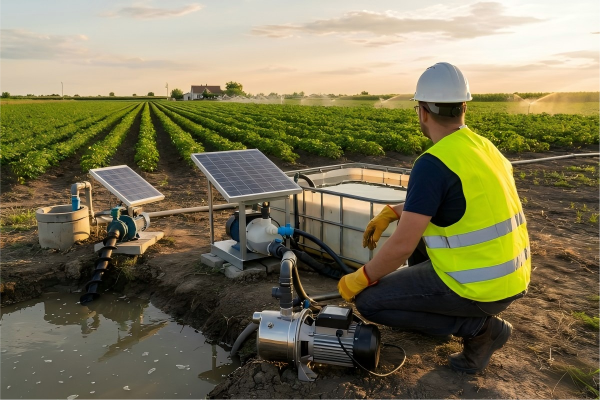
Selecting the right pump is a critical decision for any agricultural operation.
There is no single "best" pump for everyone.
The optimal choice depends on a careful analysis of your farm's unique conditions.
You need to consider the depth of your well, the volume of water you require, the quality of your water, and your budget.
A pump that is perfect for a small homestead in Latin America might be completely inadequate for a large commercial farm in Australia.
This guide will break down the three most effective types of solar irrigation pumps.
We will explore their specific strengths and weaknesses.
This will help you make an informed decision that matches your needs perfectly, ensuring efficient and reliable water delivery for your crops.
The Solar Screw Pump | Best for Low Flow and High Head
You have a very deep well, making it difficult to lift water to the surface.
However, your water needs are relatively small, for things like livestock or a small vegetable patch.
A massive, high-flow pump would be overkill and a waste of money.
**A solar screw pump excels at lifting water from extreme depths.
It provides low flow but very high pressure (head), making it perfect for deep wells, domestic water supply, and small-scale irrigation where high volume is not the priority.
**
The solar screw pump works on a principle known as a progressing cavity.
It uses a single helical stainless steel screw (the rotor) that rotates inside a double helical rubber sleeve (the stator).
As the screw turns, it forms a series of sealed cavities that move progressively from the pump's inlet to its outlet.
This mechanism pushes the water through with consistent pressure, allowing it to overcome the immense weight of a tall water column in a deep well.
This design is fundamentally different from centrifugal pumps, which use spinning impellers to create flow.
The screw pump's strength is its ability to generate significant head with relatively low power input, making it incredibly efficient for deep-lift applications.
It is also inherently robust when dealing with abrasive materials, a common challenge in many regions.
When is a Screw Pump the Right Choice?
A screw pump is a specialized tool designed for specific challenges.
It is the champion of high-lift, low-volume scenarios.
- Deep Well Applications: Its primary advantage is lifting water from depths where centrifugal pumps struggle.
If your well is over 100 meters (about 330 feet) deep, a screw pump is often the most cost-effective and reliable solution. - High Sand and Silt Resistance: The design of the rotor and stator allows the pump to handle water with a higher concentration of sand and other abrasives without rapid wear.
The rubber stator provides a compliant surface that can pass small particles without damage, a feature where impeller pumps are more vulnerable.
This makes it ideal for newly drilled wells or areas with challenging water quality. - Livestock and Domestic Use: The lower flow rate is perfectly matched for filling livestock troughs, supplying water to a house, or running a small-drip irrigation system for a garden.
It provides a steady, reliable supply without the high energy consumption of a larger pump.
Performance and Limitations
While powerful, it is important to understand the trade-offs.
| Feature | Advantage | Limitation |
|---|---|---|
| Flow Rate | Low energy consumption for its head. | Not suitable for flood irrigation or large sprinkler systems. |
| Head (Lift) | Can lift water from extreme depths (>150 meters). | Not efficient for shallow wells where a centrifugal pump is better. |
| Sand Handling | Excellent resistance to abrasion from sand/silt. | The rubber stator will eventually wear and require replacement. |
| Cost | Cost-effective for deep-well applications. | Can be more expensive than a small centrifugal pump for shallow wells. |
The screw pump's efficiency shines in its niche.
For farmers and homeowners in arid, electricity-scarce regions like parts of Africa and Latin America, its ability to tap into deep water sources using minimal solar power is a game-changer.
The Solar Plastic Impeller Pump | Best for High Flow and General Use
You need to irrigate a medium-to-large farm or pasture.
Your priority is moving a large volume of water efficiently and affordably.
A low-flow pump simply will not cover enough ground to keep your crops or livestock properly hydrated.
**A solar plastic impeller pump is a workhorse designed for high water output.
This multi-stage centrifugal pump delivers high flow at a medium head, making it the most economical and popular choice for farm irrigation and pasture water supply.
**
This type of pump is a multi-stage centrifugal pump.
It works by using a series of impellers, each housed in its own stage.
The motor spins these impellers at high speed.
Water enters the first stage, where the impeller slings it outward, increasing its velocity and pressure.
The water then moves to the next stage, where another impeller adds more energy, and so on.
By stacking multiple stages, the pump can achieve a good balance of both flow and pressure.
The use of high-strength, wear-resistant engineered plastic for the impellers is a key design choice.
It makes the pump significantly more affordable and lightweight than its stainless steel counterpart.
This plastic is also surprisingly resilient against fine sand, often outperforming metal impellers that can be eroded by abrasion.
Ideal Applications for High Volume
This pump's design makes it extremely versatile for most agricultural needs.
- Farm Irrigation: Its high flow rate is perfect for running sprinkler systems, drip lines over large areas, or for flood irrigation.
It can move the volume of water needed to meet the demands of commercial agriculture. - Pasture Water Supply: It can quickly fill large tanks and troughs for livestock, ensuring a constant supply of water across extensive grazing lands.
- Cost-Effective Operations: For farms in regions like Africa and the Americas, the lower initial cost and excellent performance make solar plastic impeller pumps a top choice.
Their lightweight nature also reduces shipping costs and simplifies installation, which can be done without heavy equipment.
Balancing Performance, Durability, and Cost
The plastic impeller pump represents a strategic balance of key factors.
It offers over 80% of the performance of a stainless steel model for a fraction of the price.
Key Advantages:
- High Water Output: This is its main selling point.
It is designed to move more water per hour than a screw pump. - Excellent Fine Sand Resistance: The specific grade of plastic used is tough yet slightly flexible, allowing it to handle water with fine sand better than many metal impellers, which are more brittle and prone to abrasive wear.
- Lightweight and Economical: The use of plastic significantly reduces the pump's weight and manufacturing cost.
This makes it easier to ship, handle, and install, and it lowers the barrier to entry for farmers adopting solar pumping technology.
Important Limitations:
- Corrosive Environments: The pump is not intended for use in highly acidic or alkaline water.
Aggressive water chemistry can degrade the plastic components and metal housing over time. - Extreme Depth: While it offers a medium head, it is not designed for the extreme depths that a screw pump can handle.
It is most efficient in wells less than 80-100 meters deep.
This pump hits the sweet spot for a huge segment of the market, providing a reliable and affordable solution for moving large volumes of water for agriculture.
The Solar Stainless Steel Impeller Pump | Best for Durability and Corrosive Water
Your well water is harsh.
It is acidic or alkaline, and it has a history of corroding and destroying previous pumps in just a few years.
You need a solution that can withstand this aggressive environment and provide long-term reliability.
**The solar stainless steel impeller pump is a premium option built for ultimate durability.
Its SS304 stainless steel impeller and pump body offer superior corrosion resistance, ensuring a long service life in acidic or alkaline water conditions.
**
This pump is functionally similar to the plastic impeller model; it is also a multi-stage centrifugal pump designed for high flow.
The critical difference lies in the material.
Every component that touches water—the impellers, the diffusers, the pump casing, and the outlet—is made from SS304 grade stainless steel.
This material is specifically chosen for its exceptional resistance to rust and corrosion.
While a standard pump might fail in a year or two in alkaline soil regions like those found in Australia, a stainless steel pump is engineered to last for many years in the same conditions.
This robust construction makes it the go-to choice for high-value applications where reliability is non-negotiable and water quality is a known problem.
The initial investment is higher, but it pays for itself by avoiding the cost and downtime associated with frequent pump replacements.
When to Invest in Stainless Steel
The decision to choose a stainless steel pump is driven by water quality and the need for long-term reliability.
- Corrosive Water Conditions: This is the primary reason to select this pump.
If a water test reveals a pH level that is either highly acidic (below 6.5) or highly alkaline (above 8.5), a stainless steel pump is not a luxury; it is a necessity.
It's also essential in water with high salinity or other dissolved minerals. - High-End Applications: For high-value ranches, premium residential water supplies, or critical irrigation projects, the added reliability justifies the cost.
The peace of mind that comes from knowing your water system is built to last is a significant factor. - Specific Geographic Regions: Certain areas are known for their challenging water.
The alkaline soils in parts of Australia and the Americas make stainless steel pumps a very popular choice for anyone drilling a new well.
Comparing Pump Materials
The choice between plastic and stainless steel comes down to a simple cost-benefit analysis based on your water.
| Material | Initial Cost | Lifespan in Normal Water | Lifespan in Corrosive Water | Best For |
|---|---|---|---|---|
| Plastic Impeller | Lower | Very Good (5-10+ years) | Poor (1-3 years) | General use, sandy water, budget-conscious projects. |
| Stainless Steel Impeller | Higher | Excellent (15+ years) | Very Good (8-15+ years) | Corrosive water, high-reliability needs, long-term investment. |
While a stainless steel pump costs more upfront, its total cost of ownership can be significantly lower in the wrong water conditions.
It prevents the recurring cycle of buying, installing, and replacing cheaper pumps that simply are not built for the job.
Conclusion
The best irrigation pump is the one that fits your well depth, water volume needs, and water quality.
Choosing correctly ensures efficiency, reliability, and long-term value for your farm.
Frequently Asked Questions
What size of irrigation pump do I need?
Your pump size depends on the required flow rate (GPM or m³/h) and total dynamic head (TDH).
Calculate these based on your field size, irrigation type, and well depth.
How do I choose a pump for drip irrigation?
Drip irrigation requires lower flow but consistent pressure.
A small centrifugal pump or a solar screw pump can be excellent choices, depending on the water source's depth.
Can I use a surface pump for irrigation?
Yes, if your water source (like a pond, river, or shallow well) is less than 7 meters deep.
For deeper wells, you must use a submersible pump.
What is the most efficient type of irrigation pump?
Pump efficiency depends heavily on the model and operating point.
Modern solar pumps with BLDC motors and MPPT controllers are highly efficient, often exceeding 90% motor efficiency.
How much does an agricultural water pump cost?
Costs vary widely, from a few hundred dollars for small pumps to thousands for large, high-capacity, or specialized stainless steel models.
Solar pump systems also include panels and controllers.
What is the difference between a submersible and a jet pump?
A submersible pump is placed directly in the water, pushing it up.
A jet pump sits on the surface and uses suction to pull water up, limiting it to shallow depths.