A deep and tilted bore presents a serious challenge.
Standard pumps can bind, wear unevenly, and fail prematurely, costing you time and money.
For a deep and tilted bore, the most suitable pump is a solar screw pump. Its positive displacement design is less sensitive to orientation and more tolerant of abrasives, ensuring reliable performance where centrifugal pumps may fail.
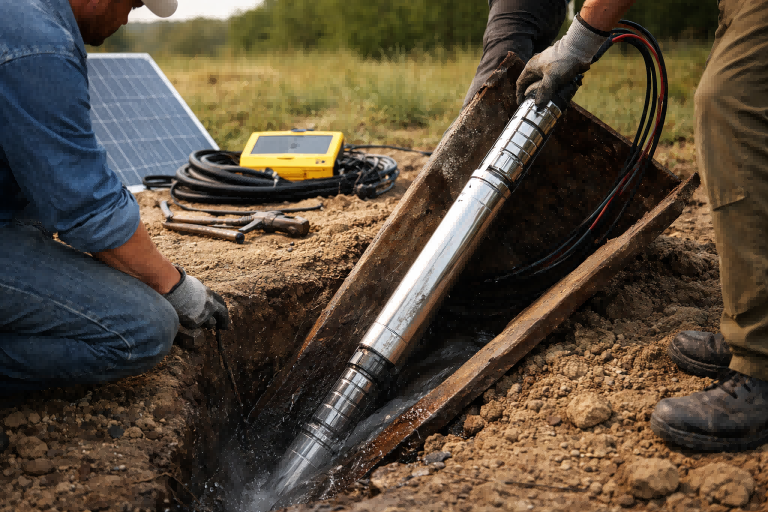
A perfectly vertical bore is the ideal, but reality is often different.
Geological shifts or drilling challenges can result in a well that is not perfectly straight.
This tilt, however slight, introduces forces that can be destructive to the wrong type of pump.
Understanding the mechanics of different pump types is crucial to selecting one that will not only work but will also last in these demanding conditions.
Let's explore why the screw pump stands out as the superior engineering solution for this specific problem.
The Unbeatable Choice for Tilted Bores: Solar Screw Pumps
Worried your angled bore will destroy a new pump?
Friction and uneven wear on shafts and impellers are common causes of failure in tilted installations.
The solar screw pump is engineered to handle these conditions. Its flexible stator and simple rotor design minimize the side-loading stresses that cause other pumps to seize or wear out quickly.
A solar screw pump, often called a progressing cavity pump, operates on a fundamentally different principle than a centrifugal pump.
This difference is precisely what makes it so resilient in a non-vertical bore.
Instead of relying on high-speed spinning impellers balanced on a long shaft, its mechanism is simple, robust, and inherently more flexible.
This design makes it the go-to solution for what many would consider a "problem well."
It thrives where precision-balanced, high-RPM machinery struggles.
Why Orientation Matters Less to a Screw Pump
The core of the pump consists of a single helical stainless steel rotor turning inside a double-helix rubber stator.
This design has fewer critical alignment points compared to a multi-stage centrifugal pump.
- Positive Displacement Action: The pump works by trapping water in cavities and pushing it upwards. This action is powerful and is not dependent on centrifugal force, which can be affected by the pump's orientation.
- Flexible Stator: The rubber stator has a degree of flexibility. It can accommodate slight misalignments and movements without causing catastrophic failure, unlike the rigid, tight-tolerance components of a centrifugal pump.
- No Long, Rigid Shaft with Impellers: A multi-stage centrifugal pump has numerous impellers stacked on a long driveshaft. When tilted, gravity pulls this assembly against the pump housing, causing significant friction, wear, and eventual failure. A screw pump's shorter, simpler rotor design is far less susceptible to this issue.
Exceptional Performance in Harsh Conditions
Beyond its suitability for tilted bores, the screw pump is a champion in difficult water conditions, which often accompany deep wells.
| Feature | Solar Screw Pump Advantage | Impact on Tilted Bore Installation |
|---|---|---|
| Sand Tolerance | Excellent | Reduces abrasive wear exacerbated by tilting. |
| High Head | Generates very high pressure from a compact size. | Efficiently lifts water from great depths. |
| Mechanism | Positive Displacement | Reliable flow regardless of orientation. |
| Motor Pairing | High-efficiency BLDC Motor | Reduces solar panel cost by over 30%. |
This pump is not just a workaround; it's an engineered solution.
Its inherent sand resistance is a critical bonus, as tilted wells can have more sediment buildup.
The combination of its mechanical design and power efficiency makes it the most logical and cost-effective choice for long-term reliability in a deep, tilted bore.
When High Flow is Priority: Centrifugal Pumps (with a Caution)
You need massive water volume for irrigation, not just household use.
A screw pump's lower flow rate might not be enough to meet your agricultural demands.
A multi-stage centrifugal pump delivers much higher flow rates. However, in a tilted bore, it requires special installation considerations and may have a reduced lifespan due to increased wear on its components.
If your primary need is a high volume of water for applications like farm irrigation or filling large reservoirs, a centrifugal pump is unmatched in its ability to move water.
Its design is optimized for high flow rather than the high pressure of a screw pump.
However, its suitability for a tilted bore comes with significant caveats.
The very design that allows for high flow—a long shaft spinning multiple impellers at high speed—is its main vulnerability in a non-vertical installation.
The risk of premature failure is substantially higher if proper precautions are not taken.
The Challenge of a Tilted Installation for Centrifugal Pumps
A multi-stage centrifugal pump is a precision-engineered machine.
It relies on the perfect alignment of its rotating assembly to function efficiently and without premature wear.
When you install it in a tilted bore, you introduce several problems:
- Uneven Bearing and Bushing Wear: Gravity will pull the entire rotor and impeller stack against one side of the pump housing. This "side-loading" concentrates wear on the bearings and bushings, leading to vibrations, loss of efficiency, and eventual seizure.
- Shaft Flex and Fatigue: A long, spinning shaft in a tilted position can experience increased flex and metal fatigue over time, potentially leading to a catastrophic shaft break.
- Impeller Damage: The uneven wear can cause the impellers to scrape against the diffuser walls, damaging both components and drastically reducing the pump's performance.
Material Choices and Their Impact
Even within centrifugal pumps, material selection can influence durability in a challenging installation.
- Plastic Impeller Pumps: These pumps are lighter, which slightly reduces the side-loading forces. The plastic impellers can also tolerate fine sand well. However, the plastic components may wear faster under the constant friction of a tilted installation compared to stainless steel. They are an economical choice but should be monitored closely.
- Stainless Steel Impeller Pumps: These are heavier, which can increase side-loading forces. However, the SS304 stainless steel construction is inherently more durable and resistant to the abrasive wear caused by friction. This makes it a more robust, albeit more expensive, option if you must use a centrifugal pump in a tilted bore.
| Pump Type | Suitability in Tilted Bore | Primary Risk | Best Use Case (If Tilted) |
|---|---|---|---|
| Screw Pump | Excellent | Minimal | Any deep, tilted, or sandy bore. |
| Centrifugal | Poor to Fair | High friction, premature wear | High flow needed, bore is only slightly tilted. |
If high flow is non-negotiable, you must accept the higher risk and maintenance burden. A professional installation with centralizers might mitigate some, but not all, of the risks associated with using a centrifugal pump in a tilted bore.
The Engine of Efficiency: The BLDC Motor Advantage
You have the right pump, but what powers it?
Using an inefficient motor means buying more solar panels.
This inflates your initial investment and wastes valuable energy every single day.
All modern, high-performance solar pumps use a Brushless DC (BLDC) motor. Its efficiency, often exceeding 90%, is the key to a cost-effective and powerful system, regardless of the pump type or well condition.
The pump end—whether it's a screw or centrifugal design—is only half of the equation.
The motor is the heart of the system, converting electrical energy into the mechanical force that moves water.
The single biggest technological leap in solar pumping has been the adoption of the BLDC permanent magnet motor.
This technology makes solar water pumping more viable and affordable than ever before.
Its incredible efficiency allows you to achieve your water goals with a significantly smaller and less expensive solar array, which is often the most costly part of the entire system.
Why BLDC Technology is Superior
The design of a BLDC motor eliminates major sources of energy loss found in traditional motors.
- No Brushes: Traditional DC motors use carbon brushes to transmit power to the rotor. These create friction, heat, and wear out over time. BLDC motors are electronically commutated, eliminating this physical contact for a frictionless, maintenance-free, and longer-lasting operation.
- Permanent Magnets: The rotor is made from powerful rare-earth permanent magnets (like 40SH grade Neodymium Iron Boron). This means the motor doesn't have to expend energy creating a magnetic field in the rotor, a process that accounts for significant energy loss in AC induction motors.
- Intelligent Control: These motors are paired with an MPPT (Maximum Power Point Tracking) controller. This "brain" constantly adjusts the electrical load to extract the maximum possible power from your solar panels as sunlight conditions change throughout the day. This intelligent management can boost total water output by up to 30%.
The Tangible Benefits for Your System
The impact of a high-efficiency motor is felt directly in your wallet and in the system's performance.
An efficiency gain from 65% (older tech) to over 90% (BLDC) means the motor needs about 30% less power to do the same work.
| Feature | BLDC Motor System | Traditional Motor System |
|---|---|---|
| Motor Efficiency | > 90% | ~60-75% |
| Solar Panels Needed | ~30% Fewer | Baseline |
| Maintenance | Zero (Brushless) | Brush replacement |
| Size & Weight | Up to 47% smaller, 39% lighter | Larger and heavier |
| Lifespan | Longer due to less heat and wear | Shorter lifespan |
Furthermore, many modern systems offer an AC/DC hybrid controller.
This allows the system to automatically switch to grid or generator power when sunlight is insufficient, ensuring you have water 24/7 without any manual intervention.
This combination of an efficient pump, a hyper-efficient motor, and intelligent control creates a robust and reliable water solution for any off-grid application.
Conclusion
For a deep, tilted bore, a solar screw pump is the superior choice for reliability.
Its design handles misalignment and abrasives, powered by an efficient BLDC motor for cost-effective operation.
Frequently Asked Questions
Can a submersible pump be installed horizontally?
Yes, some submersible pumps, particularly screw pumps, can be installed horizontally or at an angle. Always check the manufacturer's specifications, as many centrifugal pumps are designed for vertical installation only.
What is the ideal angle for a submersible pump?
The ideal angle for a submersible pump is perfectly vertical (90 degrees to the horizontal). Any deviation can increase wear, so it's critical to choose a pump designed to handle tilted installations.
What causes a submersible pump to fail?
Common causes include running dry, abrasive wear from sand, electrical issues like power surges, and mechanical failure from blockages or excessive wear in tilted installations.
Can a bore pump be too powerful?
Yes. An oversized pump can cycle too frequently, cause excessive drawdown in the well ("pumping it dry"), and waste energy. Proper sizing is crucial for efficiency and longevity.
How do you protect a submersible pump from sand?
Use a pump designed for sandy conditions, like a screw pump. You can also install the pump well above the bottom of the bore and use a flow sleeve to prevent sediment intake.
What is the main difference between a helical rotor pump and a submersible pump?
A helical rotor (or screw) pump is a specific type of submersible pump. "Submersible pump" is a general category, while "helical rotor" describes the positive displacement mechanism it uses.