Choosing a pump for a 200-foot well can be confusing.
The wrong choice leads to low pressure, high costs, or complete system failure.
For a 200-foot (about 60 meters) borewell, the best options are a solar screw pump for high head and sand resistance, or a multi-stage centrifugal pump for higher flow. The choice depends entirely on your required water volume and water quality.
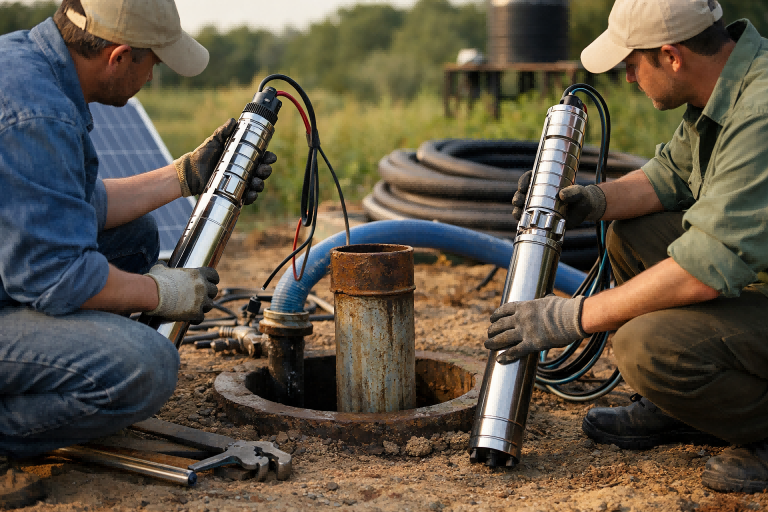
The depth of 200 feet is a critical starting point.
But it is only one piece of the puzzle.
To select the perfect pump, you must also consider how much water you need, how clean your water is, and what power source you plan to use.
These factors will guide you to a solution that is both effective and efficient for the long term.
Let's explore the best pump types for this specific depth and see which one fits your situation perfectly.
The High-Pressure Specialist: Solar Screw Pumps
You need reliable water from your deep well, but worried about pressure.
Standard pumps struggle with high head, giving you a weak flow at the surface.
A solar screw pump excels at this.
A solar screw pump is an excellent choice for a 200-foot borewell, especially when you need high pressure for domestic use and your water contains sand. It provides a consistent flow even from significant depths.
A solar screw pump, also known as a progressing cavity pump, is engineered specifically for challenging well conditions.
Its design is fundamentally different from a centrifugal pump, giving it unique advantages for deep borewells like yours.
Instead of spinning impellers to throw water outwards, it uses a simple, robust mechanism to literally push water to the surface.
This makes it a reliable workhorse in situations where other pumps might fail.
How a Screw Pump Works
The core of the pump consists of a single helical rotor, typically made of stainless steel.
This rotor spins inside a rubber stator that has a double helical cavity.
As the rotor turns, it forms a series of sealed cavities that move progressively up the pump.
These cavities trap water at the inlet and carry it under constant pressure to the outlet.
This positive displacement action is highly efficient at generating high pressure, or "head," making it perfect for lifting water 200 feet or more.
Key Advantages for a 200-Foot Well
When evaluating a pump for this depth, the screw pump offers several compelling benefits.
- High Head Capability: Its primary strength is creating high pressure from a compact design. It does not lose efficiency at greater depths as some other pumps do.
- Excellent Sand Resistance: The rubber stator and stainless steel screw can handle sandy and silty water without the rapid wear and tear that would destroy the tight tolerances of a centrifugal pump's impellers. This translates to a much longer service life in less-than-perfect water conditions.
- Consistent Flow Rate: The pump's output is not as sensitive to changes in head as a centrifugal pump. It delivers a predictable and steady stream of water, which is ideal for filling tanks or supplying household pressure systems.
- High Motor Efficiency: When paired with a Brushless DC (BLDC) motor, the entire system's efficiency is remarkable, often exceeding 90%. This means you need fewer solar panels to power it, saving significant costs on the initial system setup.
The table below compares its performance profile.
| Feature | Solar Screw Pump | Multi-Stage Centrifugal Pump |
|---|---|---|
| Best Use Case | High head, low flow | High flow, medium head |
| Sand Tolerance | Excellent | Fair to Poor (depends on model) |
| Mechanism | Positive Displacement | Centrifugal Force |
| Typical Application | Domestic water, livestock | Farm irrigation, tank filling |
For a 200-foot borewell supplying a home or livestock, the screw pump's reliability and resilience make it a top contender.
The High-Volume Mover: Centrifugal Impeller Pumps
You need to move a lot of water for irrigation or filling a large tank.
A screw pump might not provide the high flow rate you require.
This is where a centrifugal pump is the better tool for the job.
For a 200-foot well requiring high water volume, a multi-stage solar centrifugal pump is the ideal solution. It is designed to deliver a high flow rate efficiently, making it perfect for agricultural and large-scale water supply needs.
While a screw pump excels at pressure, a centrifugal pump is built for volume.
If your primary goal is to irrigate fields, fill a large stock pond, or supply water to multiple locations at once, you need a pump that can deliver a high flow rate, measured in gallons or liters per minute.
A multi-stage centrifugal pump is specifically designed for this purpose.
It uses a completely different principle to move water, one that is optimized for transfering large quantities of fluid efficiently at medium head ranges like 200 feet.
How a Multi-Stage Centrifugal Pump Works
This pump contains a series of impellers and diffusers stacked on top of each other along a single shaft.
Each set is called a "stage."
Water enters the first stage at the bottom, where the spinning impeller uses centrifugal force to throw the water outwards at high velocity.
The surrounding diffuser then slows the water down, converting its velocity into pressure.
This pressurized water is then channeled into the inlet of the next stage above it, where the process is repeated.
Each stage adds more pressure, effectively increasing the total head the pump can overcome.
By adding more stages, the pump can be designed to efficiently lift water from 200 feet, 300 feet, or even deeper, all while maintaining a high flow rate.
Choosing Your Impeller Material
For a 200-foot well, you have two primary choices for the impeller material, each with distinct advantages.
- Plastic Impeller Pumps: These are highly economical and surprisingly durable. The engineered plastic is wear-resistant and excels at handling fine sand, often outperforming metal impellers in these conditions. They are lightweight, which simplifies installation, and offer a fantastic balance of performance and cost for most agricultural applications with non-corrosive water.
- Stainless Steel Impeller Pumps: This is the premium option. If your water is acidic or alkaline, the SS304 stainless steel offers superior corrosion resistance, ensuring a much longer service life. These pumps are heavier and more expensive, but they provide the ultimate reliability and durability for high-end residential systems or in regions with known water quality issues, like parts of Australia.
The selection depends on आपका water test results and budget.
| Impeller Type | Best For | Advantages | Limitations |
|---|---|---|---|
| Plastic | High flow, fine sand, general use | Economical, lightweight, wear-resistant | Not for corrosive water or extreme depth |
| Stainless Steel | Corrosive water, premium systems | Highly durable, long service life | Higher cost, heavier |
Both versions, when powered by an efficient BLDC motor, offer an excellent solution for high-volume water needs from a 200-foot depth.
The Power Behind the Pump: The BLDC Motor
You've chosen a pump type, but what actually drives it?
The motor is the heart of the system, and an inefficient one wastes solar power.
This means you will need more panels, increasing costs.
The most efficient solar pumps for a 200-foot well use a Brushless DC (BLDC) motor. With over 90% efficiency, this motor significantly reduces the number of solar panels needed, lowering overall system cost and improving reliability.
Regardless of whether you choose a screw pump or a centrifugal pump, the single most important component determining its performance and cost-effectiveness is the motor.
Traditional water pumps often use AC induction motors, which are reliable but relatively inefficient.
Modern solar water pumps have embraced a far superior technology: the Brushless DC (BLDC) permanent magnet motor.
This advanced motor is the key to unlocking the full potential of solar energy for water pumping, making the entire system more powerful, compact, and affordable.
The efficiency gains are not minor; they fundamentally change the economics of solar pumping.
What Makes BLDC Motors So Efficient?
Several key design features contribute to the BLDC motor's efficiency, which regularly exceeds 90%.
- Permanent Magnet Rotor: Instead of using electricity to create a magnetic field in the rotor (as AC motors do), a BLDC motor uses powerful rare-earth magnets, like 40SH neodymium iron boron. This completely eliminates a major source of energy loss.
- Brushless Design: Physical brushes in older DC motors create friction, heat, and wear. By using an electronic controller to switch the motor's phases, BLDC motors eliminate this friction. This results in higher efficiency, zero maintenance, and a dramatically longer service life.
- Compact and Powerful: The high power density of these motors means they are much smaller and lighter than AC motors of equivalent power. A typical BLDC motor for a solar pump can be up to 47% smaller and 39% lighter, which makes installation in a narrow borewell much easier.
Market Value and System Impact
The high efficiency of the BLDC motor has a ripple effect across the entire solar pumping system.
A more efficient motor requires less input power to do the same amount of work.
This directly translates into needing a smaller solar array.
For example, an older system might require 1,200 watts of solar panels to run a pump, while a modern system with a BLDC motor might achieve the same water output with only 800 watts of panels.
This 33% reduction in solar panel cost is a massive saving for the end-user.
Furthermore, the system is managed by an intelligent Maximum Power Point Tracking (MPPT) controller.
This controller constantly optimizes the power drawn from the solar panels to ensure the motor is running at its most efficient speed based on the available sunlight.
It provides a soft start to eliminate damaging power surges and protects the pump from dry running, further enhancing system reliability.
The combination of a high-performance pump end, a high-efficiency BLDC motor, and an intelligent controller creates a truly optimized water solution.
Conclusion
For a 200-foot well, a solar screw pump is best for high pressure, while a centrifugal pump is for high volume.
The key is the efficient BLDC motor driving them.
Frequently Asked Questions
Which motor is best for a borewell?
A submersible BLDC (Brushless DC) motor is best for modern solar borewell pumps. Its high efficiency (over 90%) reduces solar panel costs and ensures a long, maintenance-free life.
What is the life of a borewell submersible pump?
The life of a submersible pump can range from 5 to 15 years. Longevity depends on water quality, usage hours, and motor type, with brushless DC motors generally lasting longer.
How do I choose a borewell motor?
Choose a motor based on the required pump horsepower and power source. For solar applications, select a high-efficiency BLDC motor sized to match the pump's head and flow requirements for your well.
Can I run a submersible pump without a control panel?
No, it is not recommended. The control panel (or controller) protects the motor from voltage fluctuations, dry running, and overload, which is essential for the pump's long-term health.
How much HP motor is required for a 200 feet borewell?
For a 200-foot borewell, a 1 HP to 1.5 HP motor is typically sufficient for domestic use. The exact horsepower depends on the desired flow rate at the surface.
What is the difference between a submersible pump and a borewell pump?
There is no major difference; the terms are often used interchangeably. Both are types of submersible pumps designed to be placed inside a borewell casing to push water to the surface.