You see the promise of free water from the sun, but worry about the high cost.
This doubt about the initial investment and performance makes you hesitate.
Understanding these challenges is the first step to choosing a system that overcomes them.
The main disadvantages of a solar water pumping system are the high initial cost, its dependence on sunlight and weather, and potentially lower flow rates compared to grid-powered alternatives. However, these drawbacks are often solved by proper system design, technology choices, and long-term cost analysis.
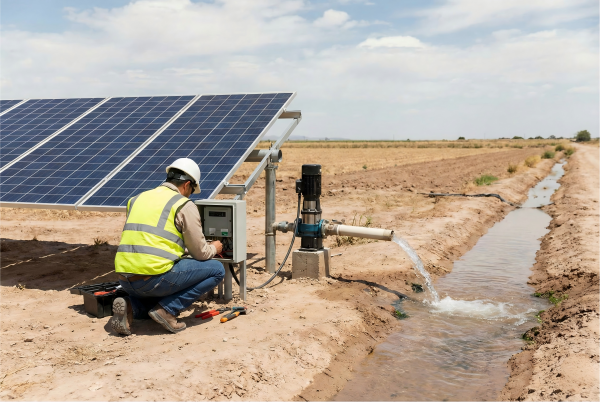
Solar water pumps are a revolutionary technology for off-grid water access.
They offer energy independence and environmental benefits that are hard to ignore.
However, like any technology, they are not without their challenges.
For a potential buyer or distributor, looking past the marketing and understanding the practical disadvantages is crucial for making a wise investment.
Instead of being deal-breakers, these disadvantages are simply factors that need to be planned for.
With the right knowledge and system components, each of these challenges can be effectively managed, ensuring a reliable and cost-effective water supply for years to come.
Let's explore these disadvantages in detail and discuss the modern solutions that address them head-on.
The Hurdle of | High Initial Investment
The steep upfront price tag for a complete solar pump system can be a major barrier.
This high initial cash outlay makes you question if the long-term savings are truly worth it.
A significant disadvantage is the high initial cost.
A full system, including panels, pump, and controller, can be several times more expensive than a conventional AC pump, making it a substantial one-time investment.
The conversation about cost is one of the first and most important ones when considering a solar water pump.
It is an undeniable fact that the initial purchase price is higher than that of a traditional pump system.
This cost is driven by three main components: the solar panels, the pump and motor, and the controller.
For a remote agricultural application, the cost of the solar array alone can be thousands of dollars.
When a customer sees this quote, their immediate reaction is often to compare it to a much cheaper diesel or grid-connected pump.
This comparison, however, is where a deeper understanding is needed.
Shifting from Cost to Total Cost of Ownership (TCO)
A smart investment is not about the cheapest price; it's about the best long-term value.
The high initial cost is a sunk cost.
Once paid, the operational costs are nearly zero.
This is in stark contrast to conventional pumps.
A diesel pump requires constant refueling, oil changes, travel time for maintenance, and eventual engine replacement.
A grid-powered pump incurs a monthly electricity bill that will only increase over time.
When you analyze the Total Cost of Ownership over a 5 or 10-year period, the financial picture changes dramatically.
| Cost Factor | Solar Pumping System | Diesel Pumping System |
|---|---|---|
| Initial Investment | High | Medium |
| Fuel/Energy Cost | None | High and Fluctuating |
| Routine Maintenance | Very Low (Panel cleaning) | High (Oil, filters, fuel runs) |
| System Lifespan | 20+ years (Panels) | 5-10 years (Engine) |
| 5-Year TCO | Low (Essentially the initial cost) | Very High |
How Technology Reduces the Initial Cost
The key to reducing the initial investment lies in efficiency.
The more efficient the pump's motor, the fewer solar panels are needed to run it.
This is where the choice of technology becomes critical.
Advanced systems use Brushless DC (BLDC) permanent magnet motors, which can achieve efficiencies exceeding 90%.
A less efficient motor might require 25-40% more solar panels to do the same amount of work.
This directly translates to a lower upfront cost for the most expensive part of the system: the solar array.
Furthermore, these high-efficiency motors are often more compact and lightweight.
A modern BLDC motor can be up to 47% smaller and 39% lighter than a traditional motor of equivalent power.
For distributors, this means significantly lower shipping costs per unit and easier handling and installation for the end-user, further reducing the total project cost.
The Unpredictability of | Weather and Sunlight
Your water needs are constant, but the sun is not.
This reliance on good weather can cause anxiety about water security for your farm, livestock, or home, especially during cloudy spells or overnight.
Solar pumps are fundamentally dependent on sunlight.
Their performance decreases on cloudy days and stops completely at night.
This variability is a significant operational disadvantage that requires intelligent system design to overcome.
The power source for a solar pump is variable by nature.
From sunrise to sunset, the intensity of solar irradiation changes, directly affecting the pump's speed and water output.
On a perfectly clear day, the pump will start slowly in the morning, reach its peak performance around solar noon, and then gradually slow down as the sun sets.
This is a predictable curve.
The real challenge comes from unpredictable weather.
A week of heavy cloud cover or seasonal monsoon rains can reduce solar panel output by 50-90%.
For an agricultural operation that depends on consistent watering, this can be a serious problem.
The pump may not generate enough pressure or flow to run sprinklers effectively, or it may not pump enough total volume to meet daily demand.
This disadvantage means you cannot simply install a solar pump and expect it to work like a grid-powered pump.
You must plan for this intermittency.
Solution 1: The "Water Battery" Storage Tank
The simplest and most reliable solution does not involve storing electricity at all.
It involves storing the end product: water.
By using the pump during peak sun hours to fill a large storage tank, you create a buffer that provides water on demand, 24/7.
The tank acts as a "water battery."
- Sizing is Key: The tank should be large enough to hold at least 2-3 days' worth of your total daily water consumption. This provides a crucial buffer for consecutive cloudy days.
- Gravity is Free: By placing the tank on elevated ground or a tower, you can use gravity to create reliable water pressure for your home or irrigation system, without any additional energy.
- Simplicity and Longevity: A water tank has a lifespan of 20+ years, requires almost no maintenance, and has zero efficiency loss, unlike batteries. It is the most robust solution for ensuring water security.
Solution 2: The AC/DC Hybrid Controller
For critical applications where direct pumping is required at all times, a modern hybrid controller offers the ultimate solution.
This intelligent device can accept power from two sources simultaneously: DC from the solar panels and AC from the grid or a generator.
The controller's logic is designed to prioritize solar power at all times to minimize costs.
- Full Sun: The pump runs 100% on free solar energy.
- Partial Clouds: The controller intelligently blends AC power with the available solar power to maintain pump speed, maximizing the use of free energy.
- Night or No Sun: The controller automatically and seamlessly switches to 100% AC power, ensuring the pump runs at full capacity whenever needed.
This hybrid approach completely eliminates the disadvantage of weather dependency, offering the best of both worlds: the low running cost of solar and the absolute reliability of the grid.
The Question of | Performance and Application Limits
You worry a solar pump won't be powerful enough for your deep well or large farm.
This concern about limited flow and pressure might lead you to stick with a less efficient, traditional pumping solution, missing out on long-term benefits.
A common disadvantage is that some solar pumps may not match the high flow rates or pressure of large, grid-powered AC pumps.
The specific pump type must be carefully matched to the application to avoid poor performance.
The term "solar pump" is a broad category.
It is not a one-size-fits-all solution.
A major disadvantage arises when the wrong type of pump is used for the job.
This leads to a perception that solar pumps are "weak" or "ineffective."
In reality, the issue is a mismatch between the technology and the application's demands for flow rate (the volume of water) and head (the vertical distance the water needs to be lifted).
A pump designed for a shallow well will fail to deliver any water if installed in a deep well.
Likewise, a pump designed for high head and low flow will be inefficient and disappointing if used for flood irrigation.
Understanding the specific strengths and limitations of each pump type is essential for distributors to guide their customers and for end-users to achieve success.
Matching the Pump to the Water Need
A well-designed product portfolio contains different pump technologies to meet diverse needs.
This turns the disadvantage of "limited performance" into an advantage of "specialized solutions."
- Solar Screw Pump (Low Flow, High Head): This pump uses a helical rotor inside a rubber stator. It excels at pushing water from very deep wells (high head), but it delivers a relatively low volume of water (low flow). It is also highly resistant to sand.
- Best For: Deep well domestic water supply, livestock drinking troughs, and small-scale drip irrigation.
- Solar Plastic Impeller Pump (High Flow, Medium Head): This is a multi-stage centrifugal pump. It is designed to move a large volume of water (high flow) but is best for shallow to medium-depth wells (medium head). It is lightweight and economical.
- Best For: Farm irrigation, filling reservoirs quickly, and general water transfer where well depth is not extreme.
- Solar Stainless Steel Impeller Pump (High Flow, High Corrosion Resistance): This pump is functionally similar to the plastic impeller model but is built with SS304 stainless steel. This makes it extremely durable and resistant to corrosion from acidic or alkaline water.
- Best For: Regions with aggressive water quality, high-value applications requiring maximum reliability, and coastal areas.
The Performance Triangle: Flow, Head, and Power
The performance of any pumping system is a balance of these three factors.
| Pump Type | Primary Strength | Ideal Head (Depth) | Ideal Flow (Volume) |
|---|---|---|---|
| Screw Pump | High Head | Deep (>80m) | Low |
| Plastic Impeller | High Flow / Cost | Shallow/Medium (<80m) | High |
| Stainless Steel Impeller | Corrosion Resistance | Shallow/Medium (<80m) | High |
By understanding this relationship, a distributor can confidently specify a system that will meet and exceed customer expectations.
The "disadvantage" of limited performance disappears when the right tool is selected for the specific task.
The power of the underlying BLDC motor and the intelligence of the MPPT controller then maximize the output of the chosen pump, ensuring it delivers optimal performance across a wide range of solar conditions.
Conclusion
The disadvantages of solar pumps—cost, weather dependency, and performance limits—are real.
However, they are solved with smart planning, modern technology like hybrid controllers, and correct product selection.
Frequently Asked Questions
What is the life expectancy of a solar water pump?
The solar panels are typically warrantied for 20-25 years.
The pump and motor can last 10+ years, with longevity depending heavily on water quality and proper installation.
How deep can a solar pump pump water from?
This depends entirely on the pump type.
Solar screw pumps are designed for very deep wells, capable of lifting water from depths exceeding 200 meters (650 feet).
Do solar pumps require batteries?
No, batteries are not required for most systems.
The standard and most cost-effective solution is to pump water into a storage tank during the day for 24/7 access.
Can a solar pump run a sprinkler system?
Yes, if the system is properly designed.
You need to select a centrifugal pump (plastic or stainless steel impeller) that provides enough pressure (PSI) and flow (GPM) to meet the sprinkler's requirements.
How many solar panels are needed for a water pump?
This depends on the pump's power rating (in watts) and the daily solar irradiation at your location.
A high-efficiency motor will require fewer panels than a less-efficient one.
Is it difficult to install a solar water pump?
For a professional, installation is straightforward.
It involves mounting the panels, lowering the pump into the well, and connecting the wiring to the controller.
DIY installation is possible but requires electrical and plumbing knowledge.