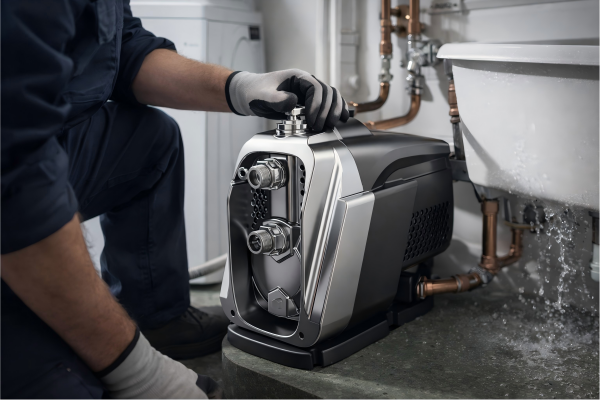
Struggling with low water pressure in a high-rise building or for a specific industrial process?
Your current pump might not be powerful enough to handle the demand, causing frustratingly weak flow.
A multistage pump works by using multiple impellers in a series on a single shaft.
Fluid is pressurized by the first impeller, then channeled to the next, with each stage adding more pressure.
This design allows it to achieve very high discharge pressures.
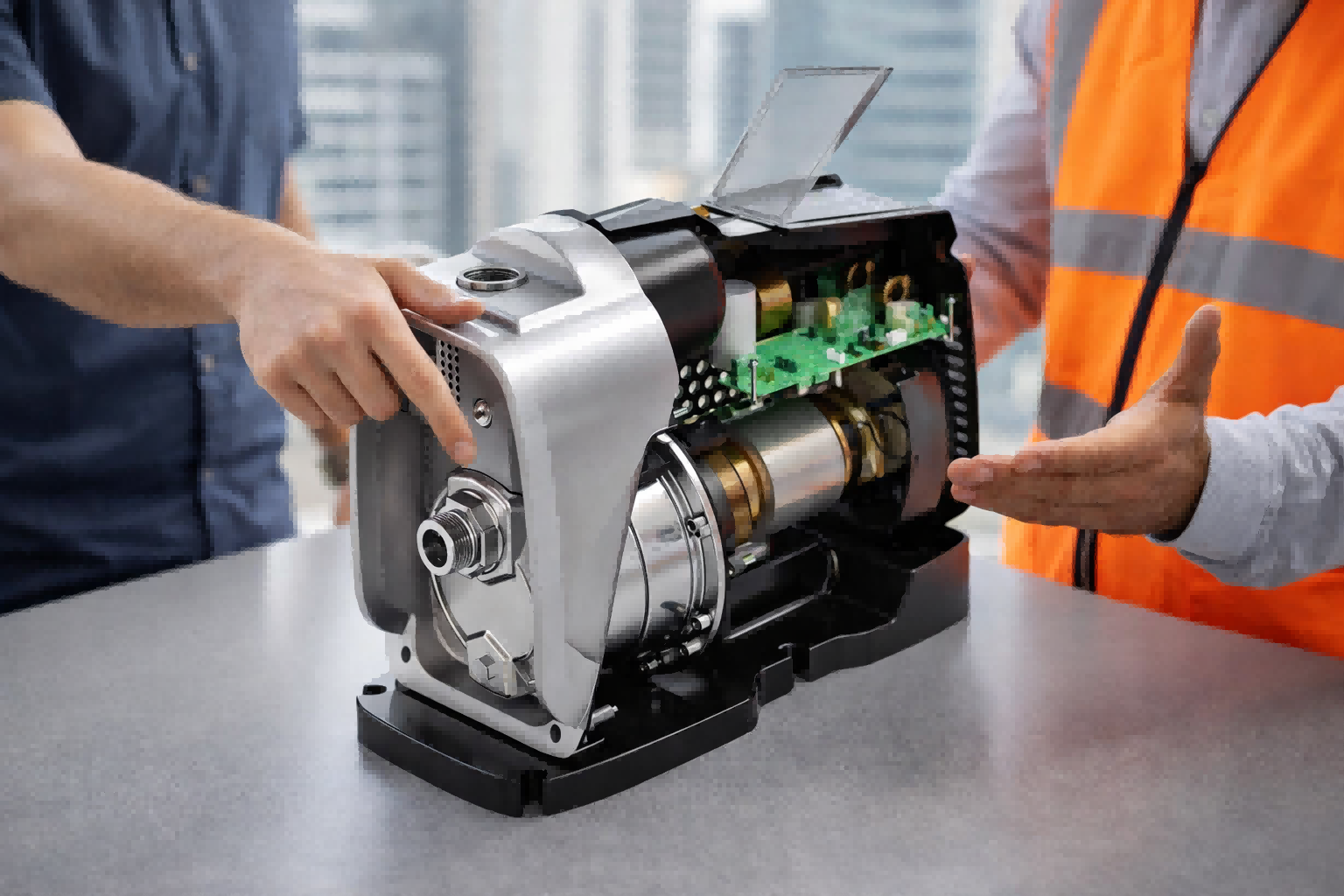
Ever wondered how water reaches the top floor of a skyscraper with immense force?
Or how industrial systems like boiler feeds maintain incredibly high pressures?
The answer often lies in a sophisticated piece of engineering: the multistage pump.
Unlike its single-stage counterpart, which is great for many tasks, the multistage pump is a specialist designed for high-pressure challenges.
It achieves this not through brute force from one component, but through a clever, sequential process of pressure amplification.
Let's explore the step-by-step journey of fluid inside one of these powerful machines.
What is the step-by-step process inside a multistage pump?
Is the inner working of a high-pressure pump a complete mystery to you?
Understanding the mechanics can seem complex, leaving you unsure of how it achieves such impressive results.
The process is a sequential journey.
Liquid enters the first chamber and is pressurized by an impeller.
It is then guided to the next chamber, where a second impeller adds even more pressure.
This cycle repeats through all stages until the final high-pressure discharge.
To truly grasp how a multistage pump generates high pressure, we need to follow the fluid's path from the inlet to the outlet.
This journey is a series of distinct, repeating steps, with each step building upon the last.
It's a model of efficiency, where energy is added incrementally to achieve a result that a single stage could not.
Let's break down this process into its core actions.
Inlet and First Stage
The entire process begins at the suction port, or the pump's inlet.
Here, the liquid enters the pump casing under initial, lower pressure.
It is immediately directed toward the center of the very first impeller.
This entry point is technically known as the "eye" of the impeller.
Think of this as the starting line where the fluid begins its pressurization journey.
The design of the inlet and the eye of the impeller is critical.
It ensures the liquid flows smoothly and without turbulence, preparing it for the intense acceleration that is about to happen.
Impeller Action
Once the fluid is in the eye of the impeller, the real work begins.
The impeller is a rotor with a series of curved vanes.
It spins at high speed, driven by the pump's motor.
As the liquid flows along these spinning vanes, a strong centrifugal force slings it outward toward the edge of the impeller.
This action does two things simultaneously.
First, it dramatically increases the liquid's velocity (speed).
Second, this conversion of the motor's rotational energy into kinetic energy (velocity) also starts to increase the liquid's pressure.
The impeller's primary job is to impart energy to the fluid, primarily in the form of speed.
Diffuser to Vanes Transition
After being thrown from the impeller at high speed, the fluid enters a stationary component called a diffuser or guide vanes.
The diffuser has a series of channels that gradually widen.
This design forces the fast-moving liquid to slow down in a controlled manner.
According to Bernoulli's principle, as the liquid's velocity decreases, its kinetic energy is converted into potential energy, which in this case is a significant increase in pressure.
The diffuser is the key component that turns the speed generated by the impeller into useful, high pressure.
It also efficiently guides the now-pressurized fluid directly to the next stage.
The Series Flow to Repeated Stages
This is where the "multistage" design truly shines.
The fluid, having exited the first diffuser at a higher pressure, does not leave the pump.
Instead, it is channeled directly into the eye of the second impeller.
Here, the entire process repeats.
The second impeller adds more velocity, and the second diffuser converts that new velocity into even more pressure.
The pressure from the second stage is added on top of the pressure generated by the first stage.
This cycle continues sequentially through every stage in the pump—whether it has three, four, or even dozens of stages.
Each impeller-diffuser combination acts as its own small pump, with the outlet of one feeding the inlet of the next.
| Stage Number | Action | Result | Cumulative Pressure |
|---|---|---|---|
| Stage 1 | Impeller adds velocity, diffuser converts it to pressure. | Pressure increases by X. | P + X |
| Stage 2 | Impeller adds more velocity, diffuser converts it. | Pressure increases by another X. | P + 2X |
| Stage 3 | Impeller adds more velocity, diffuser converts it. | Pressure increases by another X. | P + 3X |
| ...N Stages | Process repeats for all N stages. | Pressure increases at each stage. | P + NX |
Final Discharge
After passing through the final impeller and diffuser set, the fluid has reached its maximum pressure.
It has accumulated the pressure gains from every single stage within the pump.
The fluid is then collected in a final chamber within the pump casing.
From here, it is directed out of the main discharge port.
The liquid exits as a smooth, constant flow at a very high pressure, ready to be used for demanding applications like feeding a boiler or supplying water to the top of a tall building.
The final pressure is the sum of the pressure increases from each individual stage.
What is the key takeaway about multistage pumps?
Feeling overwhelmed by all the technical details of pump mechanics?
It's easy to get lost in the jargon of impellers and diffusers, missing the main point of the technology.
The core concept is simple: each stage adds pressure, while the flow rate stays the same.
Think of it like climbing a staircase; each step takes you higher (more pressure), but your speed of climbing (flow rate) doesn't change.
This makes them perfect for high-pressure jobs.
While the step-by-step process explains how a multistage pump works, understanding the fundamental principle behind it is crucial for knowing why it's chosen for certain jobs.
The design isn't just about adding parts; it's a specific engineering choice to solve a particular problem that other pumps can't handle efficiently.
The relationship between pressure, flow, and the pump's components is the key to appreciating its unique capabilities and where it fits in the world of fluid dynamics.
Let's distill this down to its essential takeaways.
The Relationship Between Pressure and Flow
The single most important concept to understand about a multistage pump is how it treats pressure versus flow rate.
The design's primary goal is to achieve high head, which is another term for high pressure.
- Pressure is Additive: As we saw in the step-by-step process, each stage (an impeller and diffuser pair) contributes a certain amount of pressure increase. The total pressure gained is the sum of the pressure from each stage. If one stage provides a 50 PSI boost, four stages will provide a 200 PSI boost.
- Flow Rate is Constant: In contrast, the volume of liquid that passes through the pump per minute (the flow rate) remains relatively constant. The liquid that enters the first stage is the same volume that exits the last stage. All impellers are on the same shaft and spin at the same speed, handling the same amount of fluid.
This characteristic makes multistage pumps fundamentally different from pumps that use a single, larger impeller.
A single-stage pump can be designed for high flow or moderate pressure, but achieving very high pressure requires an impractically large and fast-spinning impeller.
The multistage design cleverly overcomes this physical limitation by breaking the work into smaller, manageable, and stackable steps.
It is an ideal solution for applications defined as "high head, low to medium flow."
Key Components of Each Stage
A multistage pump is essentially a collection of smaller pump assemblies stacked together in one housing.
Each of these individual assemblies is called a "stage," and every stage consists of the same two primary components working in harmony.
| Component | Type | Function |
|---|---|---|
| Impeller | Rotating | Spins to rapidly increase the liquid's velocity (kinetic energy). It slings the fluid outwards. |
| Diffuser/Volute | Stationary | Slows the liquid down, converting its velocity into high pressure (potential energy). It also guides the flow to the next stage. |
These components are all housed within a single, robust pump casing.
The impellers are all mounted on a common shaft, ensuring they rotate in perfect synchronization.
The diffusers are fixed within the casing, creating the precise channels needed to manage the fluid's path and pressure conversion.
The quality of these components, from their material construction to their hydraulic design, directly impacts the pump's overall efficiency, reliability, and lifespan.
What are the common uses for multistage pumps?
Do you have a high-pressure application but are unsure which pump is the right tool?
Choosing the wrong pump can lead to poor performance, high energy costs, and premature failure.
Multistage pumps are the go-to solution for high-pressure tasks.
They are essential for boiler feed water, supplying water to high-rise buildings, powering reverse osmosis systems, and in oil and gas production.
Their design is perfectly matched for these demanding jobs.
The unique ability of multistage pumps to generate very high pressures while maintaining a steady flow makes them indispensable in a wide range of residential, commercial, and industrial applications.
Any time a fluid needs to be moved against significant resistance—be it gravity, friction in long pipes, or a pressurized system—a multistage pump is often the most efficient and reliable choice.
Their design is specifically tailored to overcome these challenges.
Here are some of the most common environments where you will find these powerful machines at work.
Powering Water Supply Systems
One of the most visible applications is in water supply for tall structures.
Gravity is a powerful force, and pushing water up hundreds of feet requires immense pressure.
- High-Rise Buildings: A standard municipal water pressure can typically only push water up a few floors. To supply water to the upper levels of skyscrapers, hotels, and large apartment complexes, multistage booster pumps are used to increase the pressure sufficiently to ensure strong, consistent flow at every tap.
- Municipal Water Distribution: In hilly areas or for boosting pressure in long pipelines, water districts use multistage pumps to ensure that communities at higher elevations or far from the main reservoir receive adequate water pressure.
Industrial and Manufacturing Processes
Many industrial processes rely on high-pressure fluids to function correctly and efficiently.
Multistage pumps are a critical component in these systems.
- Boiler Feed Water: Power plants and large heating systems use boilers that operate under extremely high pressures. Multistage pumps are essential for forcing feedwater into the boiler drum against this internal pressure, ensuring a continuous and safe operation.
- Reverse Osmosis (RO) Systems: Desalination and water purification plants use reverse osmosis, a process that forces water through a semi-permeable membrane. This requires overcoming the natural osmotic pressure, which often calls for the very high and stable pressures delivered by multistage pumps.
- High-Pressure Cleaning: Industrial cleaning systems, such as large-scale vehicle washes or machine cleaning stations, use multistage pumps to generate the high-pressure water jets needed to remove tough grime and dirt effectively.
Specialized Applications
Beyond general water supply and manufacturing, the robust design of multistage pumps makes them suitable for more specialized and demanding fields.
- Oil and Gas Production: In the energy sector, these pumps are used for a variety of tasks. They are crucial for water injection into oil wells to enhance recovery, as well as for transporting crude oil through long pipelines that have significant frictional losses.
- Snowmaking: Ski resorts rely on multistage pumps to move large volumes of water at high pressure up mountainsides to feed snowmaking machines. The pumps must overcome both the elevation change (high head) and the pressure requirements of the snow guns themselves.
- Firefighting Systems: Large-scale fire suppression systems, particularly in high-rise buildings and industrial facilities, utilize multistage pumps to guarantee that there is enough pressure to power sprinklers and fire hoses effectively on all levels, even the highest floors.
Conclusion
In summary, a multistage pump efficiently builds high pressure by passing fluid through a series of impeller-diffuser stages.
This design makes it the ideal choice for high-head applications.
FAQs
What is the main difference between a single-stage and a multistage pump?
A single-stage pump has one impeller and is for lower-pressure tasks.
A multistage pump has multiple impellers in series to generate much higher pressures.
Why do multistage pumps have multiple impellers?
Each impeller adds more pressure to the fluid.
Using multiple impellers allows the pump to achieve very high final discharge pressures incrementally and efficiently.
Are multistage pumps more efficient?
For high-pressure applications, yes.
They are more efficient at creating high head than a single-stage pump designed for the same pressure, saving energy.
What is meant by "head" in a pump?
Head is the height to which a pump can raise a fluid.
It is a way of measuring the pressure a pump can produce.
Can a multistage pump be used for low-pressure jobs?
It can, but it would be inefficient and not cost-effective.
A single-stage pump is better suited and more economical for low-pressure requirements.
How do you control the pressure of a multistage pump?
Pressure can be controlled by changing the motor speed with a variable frequency drive (VFD) or by using a pressure regulating valve on the discharge line.
What are the two main types of multistage pumps?
The two main types are horizontal and vertical.
Horizontal pumps have a longer footprint, while vertical pumps save floor space and are common in buildings.
Do multistage pumps require more maintenance?
They have more components, which can mean more complex maintenance.
However, they are typically robustly built for continuous duty in demanding applications.