You need a constant water supply.
You worry that running your pump non-stop will cause it to overheat and fail, leaving you dry.
The right pump can run continuously without issue.
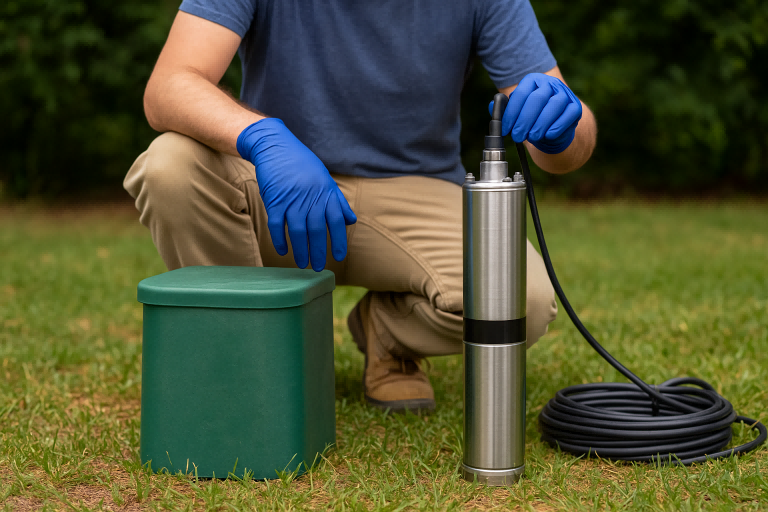
A submersible pump designed for continuous duty can run indefinitely, as long as it remains fully submerged in water.
The key is not a time limit, but the motor's ability to stay cool and the pump's suitability for the water conditions.
The question isn't just about a number of hours.
It is about the engineering behind the pump.
A pump is a system where the motor, pump-end, and power source must work in harmony.
A failure in any one of these components can bring the entire system to a halt.
Understanding what enables a pump to run for extended periods requires looking beyond the simple on/off switch.
We need to explore the technology that prevents overheating, the materials that resist wear and tear, and the intelligent controls that ensure the pump operates safely and efficiently 24 hours a day.
Let's examine the factors that truly determine a submersible pump's continuous runtime.
Why Motor Technology is the Key to Continuous Operation
You worry your pump's motor will burn out from running too long.
This common fear leads to underutilizing your water system.
The right motor technology eliminates this risk entirely.
A brushless DC (BLDC) permanent magnet motor is designed for continuous duty.
Its high efficiency (over 90%) means it generates very little waste heat, which is the primary cause of motor burnout.
This allows it to run indefinitely without overheating.
The single greatest limiting factor for any electric motor is heat.
When a motor runs, electrical resistance and friction generate heat.
If a motor cannot dissipate this heat faster than it is created, its internal temperature will rise.
This excessive heat melts the protective enamel coating on the copper windings, causing short circuits and leading to a catastrophic burnout.
For a submersible pump, this problem is magnified.
The motor is sealed in a housing deep underground, relying entirely on the surrounding water to act as a coolant.
If the motor runs inefficiently and produces a lot of waste heat, even the cooling effect of the water may not be enough to prevent a gradual and fatal temperature rise.
Therefore, the motor's fundamental design and efficiency are the true determinants of whether a pump can be rated for continuous operation.
Heat: The Enemy of Continuous Pumping
Traditional brushed or AC induction motors are notoriously inefficient.
They can lose 20-30% of their energy intake as waste heat.
-
Energy Waste: For every 1000 watts of power an old motor consumes, it could be converting up to 300 watts into pure heat instead of mechanical work. This is like running a small heater inside your pump.
-
Cooling Dependence: This high heat output makes the motor entirely dependent on a high flow of cool water passing over it. If the water level drops or flow is restricted, the motor's temperature can quickly spike into the danger zone.
-
Wear and Tear: Brushed motors also generate heat and carbon dust from the friction of the brushes against the commutator. This not only adds to the heat problem but is also a primary point of mechanical failure.
The BLDC Motor Advantage
Modern submersible pumps increasingly use brushless DC (BLDC) permanent magnet motors precisely because they solve the heat problem.
Their design is fundamentally more efficient.
-
Over 90% Efficiency: A BLDC motor converts more than 90% of its electrical energy directly into rotational force. This means it might produce only 100 watts of waste heat for every 1000 watts consumed—a 66% reduction compared to older motors.
-
Cooler Operation: Because they run so much cooler, BLDC motors are not as dangerously dependent on water flow for cooling. They can operate continuously and safely across a wider range of conditions without risk of overheating.
-
No Friction, No Wear: The "brushless" design means there are no physical brushes to wear out or create friction. This eliminates a major source of heat and mechanical failure, dramatically extending the motor's operational lifespan.
| Feature | BLDC Permanent Magnet Motor | Traditional Brushed/AC Motor | Impact on Continuous Run Time |
|---|---|---|---|
| Energy Efficiency | > 90% | ~70-80% | High: Generates significantly less waste heat, allowing for indefinite operation. |
| Primary Heat Source | Minimal Electrical Resistance | Electrical Resistance + Brush Friction | High: Eliminates a major source of heat and a common failure point. |
| Cooling Requirement | Low | High | High: Less dependent on high water flow, providing a larger safety margin. |
| Designed Duty Cycle | Continuous | Often Intermittent | High: Engineered from the ground up for 24/7 operation. |
For a distributor, this technological edge is a key selling point.
A pump with a BLDC motor is not just a pump; it's a reliable, long-term water solution that is far less likely to fail due to the most common cause: motor burnout.
Does the Pump Type Affect Its Continuous Run Time?
Choosing the wrong pump for your well can cause it to wear out quickly.
This leads to costly replacements and downtime.
Matching the pump type to your water condition is crucial.
Yes, the pump type significantly impacts its long-term durability.
A pump well-suited to the water conditions (e.g., sandy or corrosive) can run continuously for years, while a mismatched pump will fail quickly regardless of its motor.
While the motor provides the power and determines the heat profile, the pump-end is the part that does the physical work of moving water.
The pump-end is in constant contact with the well water and everything suspended within it.
Its design and materials determine how it will withstand the specific challenges of your well, such as abrasive sand or corrosive minerals.
If the pump-end is not suited for the environment, it will fail.
A worn-out pump-end will lose pressure and flow, and it will force the motor to work harder, drawing more power and generating more heat.
This can eventually lead to the failure of the entire system.
Therefore, ensuring the pump type can handle the long-term stress of its environment is just as critical as the motor's ability to run continuously.
The "continuous run time" of a pump is ultimately limited by its weakest link.
For Sandy Wells: The Screw Pump
In wells with high concentrations of sand, silt, or sediment, a standard centrifugal pump will be destroyed by abrasion.
The fast-spinning impellers act like a grinder, and the sand particles quickly wear them down.
-
The Solution: A solar screw pump (also called a progressing cavity pump) is the ideal choice for these conditions. Instead of impellers, it uses a single stainless steel helical rotor that spins slowly inside a rubber stator.
-
How it Works: This mechanism creates sealed cavities that move water and suspended solids upward through compression. Because it operates at a much lower speed and has no delicate impeller edges, it is highly resistant to abrasive wear.
-
Continuous Operation: A screw pump can run continuously in sandy water conditions that would grind a centrifugal pump to a halt in a matter of weeks or months. This makes it a perfect long-term solution for domestic and livestock water in regions with challenging well conditions.
For High Flow Needs: The Plastic Impeller Pump
For general-purpose applications like farm irrigation or pasture water supply where the water is relatively clean, high flow is the priority.
-
The Solution: A solar plastic impeller pump is an excellent, cost-effective choice. It uses a series of plastic impellers stacked in stages to generate high flow rates at a medium head.
-
Material Advantage: The engineered plastic used for the impellers is lightweight and surprisingly resistant to wear from fine sand. This allows it to outperform and outlast low-cost cast iron impellers in mildly abrasive conditions.
-
Continuous Operation: In its intended environment—clean to slightly sandy water—this pump type can run continuously, driven by its efficient BLDC motor, to deliver large volumes of water for agriculture. However, it is not designed for highly corrosive or coarse sand environments.
For Corrosive Water: The Stainless Steel Impeller Pump
Water chemistry can be just as destructive as physical abrasion.
Water that is acidic (low pH) or highly alkaline (high pH) will chemically attack and corrode the internal components of a pump.
-
The Solution: A solar stainless steel impeller pump is the premium solution for aggressive water conditions. The impellers, diffusers, and pump body are all constructed from SS304 stainless steel.
-
Corrosion Resistance: SS304 is a high-grade, corrosion-resistant alloy that is inert to most chemical attacks found in groundwater. It will not rust or degrade, ensuring the pump's internal tolerances and performance are maintained for its entire service life.
-
Continuous Operation: This pump is built for maximum durability. It can run continuously for years in alkaline soil regions or in water with low pH levels without succumbing to corrosion, making it the most reliable choice for high-end applications or challenging water environments.
How Does the Power Source Impact Continuous Pumping?
Your pump is designed to run continuously.
But if your power source is not stable, you still face interruptions.
A pump is useless without reliable power.
For a solar pump, continuous 24-hour operation is achieved with a hybrid AC/DC controller.
This system automatically switches between solar power during the day and grid (AC) power at night or on cloudy days, ensuring an uninterrupted water supply.
A pump's ability to run continuously is not just a feature of the pump itself; it is a feature of the entire system.
This is especially true for solar-powered pumps.
Solar energy is powerful and free, but it is inherently intermittent.
It is only available when the sun is shining.
For applications that demand water 24/7—such as domestic water supply or critical livestock watering—relying solely on solar panels is not a viable strategy.
The solution is not to limit the pump's runtime, but to provide it with a power source that is as continuous as the pump's own operational rating.
This is accomplished through intelligent power management systems that can blend different energy sources seamlessly, ensuring the pump always has the power it needs to run, day or night, rain or shine.
The Solar-Only System: Daytime Operation
A standard DC solar pump system is beautifully simple.
It connects directly to solar panels through an MPPT controller.
-
How it Works: The MPPT (Maximum Power Point Tracking) controller optimizes the output from the solar panels and delivers it directly to the BLDC motor. The pump runs whenever there is sufficient sunlight.
-
Limitations: The pump will slow down on cloudy days and stop completely at night. This is perfectly acceptable for many applications like filling a storage tank for irrigation, but it does not provide continuous, on-demand water. The pump is capable of continuous operation, but its power source is not.
The Hybrid AC/DC System: True 24/7 Operation
To achieve true continuous operation, the system needs a backup power source and a brain to manage it.
-
The Solution: An AC/DC hybrid controller is the key. This advanced controller has inputs for both DC power from solar panels and AC power from the electrical grid or a generator.
-
Intelligent Switching: The controller is programmed with a "solar-first" priority.
- Full Sun: During the day, the controller draws 100% of the pump's power from the solar panels.
- Low Sun / High Demand: If clouds reduce the solar input, or if water demand exceeds what solar can provide, the controller will blend in just enough AC power to make up the difference, maximizing the use of free solar energy.
- Night / No Sun: When there is no solar input, the controller automatically and seamlessly switches over to 100% AC power.
-
The User Experience: For the end user, the result is completely uninterrupted water flow. The pump runs whenever it is needed, 24 hours a day, without any manual switching. They get the economic benefit of solar power without sacrificing the reliability of the grid.
A pump that is mechanically and electrically rated for continuous duty is only truly continuous when its power system is too.
Hybrid AC/DC technology bridges this gap, transforming a daytime solar pump into a full-time, professional-grade water solution.
Conclusion
A submersible pump can run continuously if its motor is efficient, its materials match the water, and its power source is reliable.
Modern pump systems make this possible.
Frequently Asked Questions
Is it OK to leave a submersible pump running?
Yes, if the pump is rated for "continuous duty" and remains fully submerged for cooling, it is designed to be left running for extended periods.
How do you know if a submersible pump is running dry?
You may hear gurgling sounds from the well, see sputtering water at the tap, or the pump's thermal overload protection may shut it off.
What is the life of a submersible pump?
A quality submersible pump can last 10-15 years, but its lifespan is highly dependent on usage, motor quality, and the abrasiveness or corrosiveness of the water.
What happens if a submersible pump runs dry?
Running dry is catastrophic. The pump will rapidly overheat because it loses its water coolant, causing the motor to burn out and potentially melting plastic components.
Does turning a well pump on and off hurt it?
Frequent starting and stopping (short cycling) is very damaging to a pump motor. It causes excessive heat buildup and stress on components.
Should my well pump run all the time?
No, a standard well pump should only run when filling the pressure tank. If it runs constantly, you likely have a leak, a bad pressure switch, or a worn-out pump.
How many hours a day should a well pump run?
This depends on your water usage. For a typical home, a pump might run for a total of 1-2 hours per day, but in short cycles. For irrigation, it could run for many hours straight.