Your home's water pressure is weak and inconsistent.
Your old jet pump is noisy and constantly needs attention.
A submersible pump offers a silent, powerful, and reliable solution.
Yes, a submersible pump is an excellent choice for home use, especially for properties with a well.
They provide superior water pressure, operate silently because they are submerged, and are highly efficient and reliable, making them the modern standard for residential well water systems.
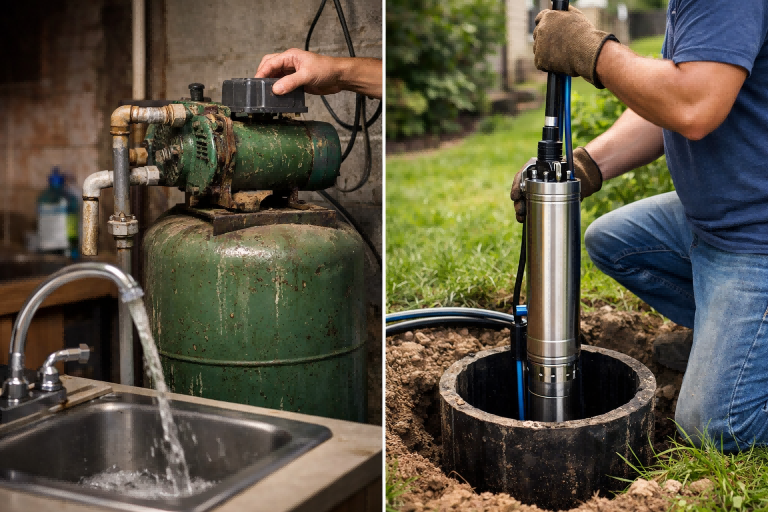
Choosing a submersible pump is a significant upgrade for any home that relies on well water.
Unlike older surface-mounted pumps that struggle to pull water from deep sources, a submersible pump works from within the well itself.
It uses energy far more efficiently to push water to the surface.
This results in stronger, more consistent water pressure throughout your home.
You can shower, do laundry, and water the garden all at once without a frustrating drop in flow.
But not all submersible pumps are created equal.
The ideal pump for your home depends on several factors, including your well's depth, your water quality, and your daily water needs.
Understanding the different types of pumps and the technology that drives them is key to making a smart investment in your home's water system.
Why Submersible Pumps Outperform Other Well Pumps
You suffer from weak showers and fluctuating water pressure.
Your noisy surface pump is a constant annoyance.
A submersible pump delivers powerful, consistent pressure silently from deep within your well.
Submersible pumps outperform other types because they push water instead of pulling it.
This method is more energy-efficient, allows them to work in much deeper wells, and their underwater location makes them completely silent during operation, providing a superior user experience.
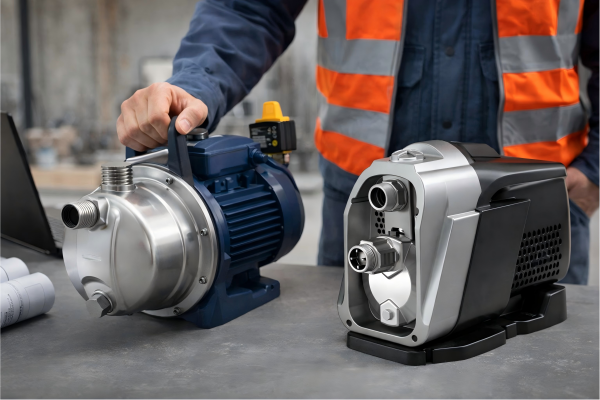
The fundamental design of a submersible pump gives it massive advantages over older technologies like jet pumps.
A jet pump sits on the surface and works like a powerful straw, creating suction to pull water up.
This method is limited by physics; it becomes dramatically less efficient as the water level gets deeper and is practically useless for wells deeper than about 25 feet (7.6 meters).
A submersible pump, however, is installed down in the water.
Its multi-stage design pressurizes the water and powerfully pushes it up the pipe.
This is a much more efficient use of energy, similar to how it is easier to push a heavy cart than to pull it with a long rope.
This core difference in operation leads to a series of benefits that make submersibles the standard for modern residential wells.
The Efficiency of Pushing vs. Sucking
The single greatest advantage of a submersible pump is its operational efficiency.
A surface-mounted jet pump has to work against gravity and atmospheric pressure to create a vacuum and lift water.
As the depth of the well increases, the energy required to do this grows exponentially, while the volume of water delivered drops sharply.
A submersible pump bypasses this problem entirely.
It is already submerged in the water it needs to move.
The motor transfers energy directly into pushing the column of water above it.
This results in significantly higher flow rates and pressure for the same amount of electricity consumed.
When powered by a high-efficiency BLDC (Brushless DC) permanent magnet motor, these pumps can achieve system efficiencies over 90%, drastically reducing long-term energy costs, whether connected to the grid or solar panels.
Silent Operation for a Peaceful Home
One of the most immediate lifestyle benefits of switching to a submersible pump is the elimination of noise.
Jet pumps are typically installed in a basement, garage, or a pump house near the well.
Their operation involves a loud electric motor and the sound of mechanical parts, creating a constant disturbance every time water is used.
A submersible pump is, by its very nature, virtually silent.
It is located deep underground, suspended in the well water.
The water itself, along with the earth surrounding the well casing, acts as a perfect sound insulator.
You will never hear the pump turn on or off.
The only sound you will hear is the flow of water from your tap.
Reliability and Maintenance Advantages
Submersible pumps are built as sealed, self-contained units designed for long-term submersion.
- Self-Priming: Because the pump is always sitting in water, it never needs to be primed. Jet pumps often lose their prime if there are any small air leaks in the suction pipe, requiring a manual and messy re-priming process.
- Consistent Cooling: The pump motor is constantly cooled by the surrounding well water. This prevents overheating and extends the motor's lifespan significantly compared to an air-cooled motor on the surface.
- Fewer Mechanical Parts Above Ground: The entire pumping mechanism is in one unit. There are no complex suction pipes, foot valves, and injector kits to maintain or troubleshoot at the surface.
This integrated design results in a more robust and reliable system with a longer service life and fewer maintenance headaches for the homeowner.
Which Submersible Pump is Right for Your Home?
Choosing a pump seems complex.
You worry about picking the wrong one for your well's depth or water quality.
Matching the pump type to your specific needs ensures reliable, long-lasting performance.
For a typical home with a deep well, a solar screw pump is ideal for providing high pressure.
If you need more water for gardening or have a shallower well, a plastic or stainless steel impeller pump offers higher flow rates.
The "best" submersible pump for your home is the one that is perfectly matched to your unique situation.
There is no one-size-fits-all answer.
The three primary factors to consider are your well's depth (which determines the required "head"), your daily water usage (which determines the required "flow"), and your water's quality (sandy or corrosive).
Different pump designs are engineered to excel under different conditions.
A deep well requires a pump that can generate immense pressure to lift water hundreds of feet.
A home with a large garden and multiple bathrooms needs a pump that can deliver a high volume of water.
A well with acidic water demands a pump made from corrosion-resistant materials.
Let's break down the three most common types of submersible pumps used for residential applications.
Solar Screw Pump: The Deep Well Specialist
A screw pump, also known as a progressing cavity pump, is perfectly designed for deep wells where high pressure is the main requirement.
It uses a single corkscrew-shaped stainless steel rotor that turns inside a rubber stator.
This action traps "pockets" of water and pushes them forcefully up the pipe.
This design is excellent at creating very high head (pressure) even with a relatively small motor.
- Best For: Homes with wells deeper than 200 feet (60 meters).
- Advantages: Excellent pressure for deep wells, highly resistant to sandy or gritty water, and very reliable.
- Limitations: Provides lower flow rates, typically 3-10 gallons per minute (GPM), which is sufficient for most standard households but may not be enough for large-scale irrigation.
Solar Plastic Impeller Pump: The High-Flow Workhorse
This is a multi-stage centrifugal pump.
It uses a series of stacked impellers, each one taking water from the stage below and adding more pressure before sending it to the stage above.
Plastic impeller pumps are an economical and effective choice for a wide range of applications.
The use of durable, engineered plastics makes the impellers highly resistant to wear from fine sand.
- Best For: Homes with shallow to medium-depth wells (less than 200 feet) and a need for higher water volume for things like gardening, lawn sprinklers, or multiple bathrooms.
- Advantages: Delivers high flow rates, excellent resistance to fine sand, lightweight, and very cost-effective.
- Limitations: Plastic components may not be as durable in very deep wells or in water that is highly corrosive (acidic or alkaline).
Solar Stainless Steel Impeller Pump: The Premium Choice
This pump functions identically to the plastic impeller pump but uses impellers made from high-grade SS304 stainless steel.
The entire pump body and internal components are built for maximum durability and longevity, especially in challenging water conditions.
This is the premium option for homeowners who want the most robust and long-lasting system possible.
- Best For: Homes with aggressive water (acidic or alkaline), high-end residential properties, or any application where maximum reliability is the top priority.
- Advantages: Superior corrosion resistance, extremely long service life, and high reliability in harsh environments.
- Limitations: Higher initial cost and heavier than plastic models.
| Pump Type | Ideal Well Depth | Water Volume | Sand Resistance | Key Advantage |
|---|---|---|---|---|
| Screw Pump | Deep (>200 ft / 60m) | Low | Excellent | High Head (Pressure) |
| Plastic Impeller | Shallow-Medium (<200 ft) | High | Good (Fine Sand) | High Flow & Economy |
| SS Impeller | Any Depth | High | Moderate | Corrosion Resistance |
The Unseen Hero: The High-Efficiency BLDC Motor
Your electricity bill is too high.
You think your water pump is a major cause.
An advanced BLDC motor can cut your pump's energy use by over 40%, saving you money.
The high-efficiency BLDC motor is the heart of a modern submersible pump, making it good for home use.
This motor technology is over 90% efficient, using less energy to do the same work, which lowers electricity bills and reduces the number of solar panels needed.
The pump's wet end—whether it is a screw or an impeller design—is only half of the equation.
The real driver of performance and efficiency is the motor.
Traditional submersible pumps often use standard AC induction motors, which have an efficiency rating of around 50-70%.
This means a significant portion of the electricity they consume is wasted as heat rather than converted into a useful pumping action.
Modern, high-quality submersible pumps leverage a far more advanced technology: the Brushless DC (BLDC) permanent magnet motor.
This is a game-changing innovation for residential water systems.
These motors incorporate powerful rare-earth magnets (like 40SH neodymium iron boron) into their rotors.
This design eliminates the electrical and frictional losses associated with the "brushes" found in older DC motors and is inherently more efficient than standard AC motors.
The impact on a homeowner is direct and substantial.
Unpacking the Technical Advantages
A BLDC motor's superiority comes from its fundamental design.
- Exceptional Efficiency: With efficiency rates exceeding 90%, a BLDC motor converts nearly all the electricity it receives into mechanical power. This is a 30-50% improvement over older AC motors.
- High Torque: Permanent magnet motors produce high torque even at low speeds. This allows the pump to start easily against a full head of water, reducing strain on the components.
- Compact and Lightweight Design: A BLDC motor can be up to 47% smaller and 39% lighter than an AC motor with the same power output. This makes installation easier and less costly.
- Maintenance-Free Operation: The "brushless" design means there are no brushes to wear out and replace. The entire motor is a sealed unit, designed for a maintenance-free service life of over 10 years.
Translating Advantages to Homeowner Value
For a homeowner, these technical specs translate into tangible, real-world benefits.
The most significant is a lower cost of ownership.
The high efficiency means the pump consumes far less electricity to supply your home's water needs.
If you are on the grid, this means a lower monthly utility bill.
If you are using a solar-powered system, it means you can power your entire water system with a smaller, less expensive solar array.
For example, a traditional pump might require 1,000 watts of solar panels, whereas a system with a BLDC motor might provide the same water flow with only 600 watts of panels.
This represents a major upfront cost saving.
Furthermore, the reliability and maintenance-free design mean you spend less time and money on service calls and repairs over the life of the pump.
A BLDC motor-driven submersible pump is a smart, forward-thinking investment that pays for itself through energy savings and reliability.
Conclusion
A submersible pump, especially one with a BLDC motor, is an excellent, efficient, and quiet choice for any modern home with a well, ensuring a reliable water supply.
Frequently Asked Questions
What is the average life of a submersible well pump?
A quality submersible pump typically lasts 8 to 15 years.
Longevity depends on a proper installation, water quality, and the presence of protective features like dry-run protection.
Do submersible pumps use a lot of electricity?
Modern submersible pumps with high-efficiency BLDC motors are very energy-efficient.
They use significantly less electricity than older jet pumps, lowering your long-term operating costs.
Can I install a submersible pump myself?
DIY installation is not recommended.
Proper installation requires specialized tools to handle the heavy pump and electrical wiring, and incorrect installation can void the warranty and lead to failure.
Do I need a pressure tank with a submersible pump?
Yes, a pressure tank is essential.
It prevents the pump from cycling on and off every time you open a tap, which extends the pump's life and provides more consistent pressure.
How deep should a submersible pump be in a well?
The pump should be installed at least 10-20 feet below the lowest anticipated water level.
This ensures it remains submerged and has access to cool water, but keeps it above any accumulated sediment at the bottom.
Are solar submersible pumps reliable at night?
Solar pumps can be highly reliable at night if paired with a hybrid controller.
This device automatically switches to AC grid power or a generator when sunlight is unavailable.