Struggling with pump terminology?
This can lead to costly purchasing mistakes.
We clarify the key differences to ensure you select the right equipment for your needs.
The main difference is that "pump" is a general term for any device that moves fluids, while a "centrifugal pump" is a specific type of pump.
Centrifugal pumps use a spinning impeller to create flow, making them a subtype within the broader pump category.
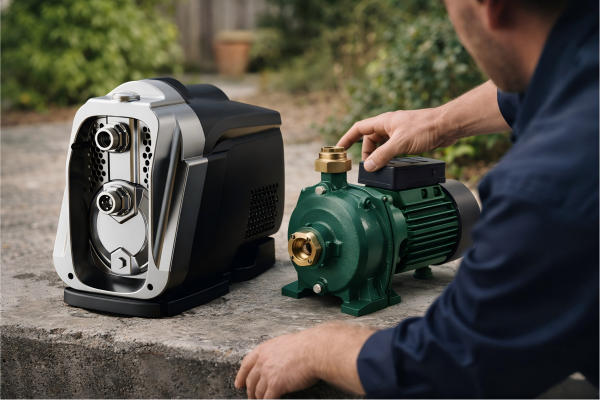
Understanding this distinction is crucial for anyone in the fluid handling industry.
It's like knowing the difference between a "vehicle" and a "sedan".
One is a broad category, and the other is a specific, widely used type within it.
This article will break down the pump family tree.
We will explore where centrifugal pumps fit and compare them to other major types.
This will give you the confidence to specify and purchase the correct pump every time.
Understanding the Broad Category: What is a Pump?
Feeling overwhelmed by the vast world of pumps?
Choosing the wrong one can cause system failure.
Let's define the basics to build a solid foundation for your technical knowledge.
A pump is a mechanical device designed to move fluids—liquids, gases, or slurries—by mechanical action.
It converts electrical or kinetic energy into hydraulic energy, creating pressure differences to induce flow.
Pumps are fundamental to countless industrial, commercial, and residential applications.
A pump is essentially a machine that imparts energy to a fluid.
This energy transfer forces the fluid to move from one point to another.
The applications are nearly endless.
They range from moving water in a household to pumping oil through cross-country pipelines.
To understand pumps, we must first classify them.
The industry broadly divides all pumps into two main families.
These are Dynamic Pumps and Positive Displacement (PD) Pumps.
This primary classification is based on the method they use to move the fluid.
Recognizing which family a pump belongs to tells you a great deal about its performance characteristics.
The Two Major Pump Families
Dynamic and Positive Displacement pumps operate on fundamentally different principles.
This difference dictates their suitability for various applications.
A failure to understand this can result in operational inefficiencies of up to 30%.
About 75% of pumps used in industry are dynamic pumps, with centrifugal pumps being the most common.
Dynamic Pumps
- Also known as kinetic pumps.
- They add energy to the fluid by increasing its velocity.
- This velocity is then converted into pressure energy.
- The flow rate is variable and depends heavily on the system's pressure (or head).
- They are ideal for high flow rates and low-viscosity fluids.
- Centrifugal pumps are the most prominent members of this family.
Positive Displacement (PD) Pumps
- These pumps trap a fixed amount of fluid.
- They then force (displace) that trapped volume into the discharge pipe.
- The flow rate is nearly constant, regardless of the system pressure.
- They are excellent for high-pressure applications and handling viscous fluids.
- Examples include rotary pumps (gear, lobe) and reciprocating pumps (piston, diaphragm).
The choice between these two families is the first critical decision in pump selection.
For a large-scale water distribution network, a dynamic centrifugal pump is the standard choice.
For precisely dosing a chemical additive, a positive displacement pump is required.
| Feature | Dynamic Pumps (e.g., Centrifugal) | Positive Displacement Pumps |
|---|---|---|
| Operating Principle | Uses an impeller to generate velocity | Traps and displaces a fixed fluid volume |
| Flow Rate | Variable, decreases as pressure increases | Constant, largely independent of pressure |
| Best For | High flow, low pressure, low viscosity | Low flow, high pressure, high viscosity |
| Pressure Handling | Moderate pressure capabilities | Can generate very high pressures |
| Self-Priming | Generally not self-priming | Often self-priming |
| Common Use Case | Water supply, irrigation, circulation | Metering, hydraulics, viscous fluid transfer |
Making the right choice impacts everything from initial cost to long-term energy consumption.
Our R&D department, with over 30 engineers, focuses on optimizing pump designs for specific application families.
This ensures our partners receive equipment tailored for maximum efficiency and reliability.
Focusing on the Specifics: What is a Centrifugal Pump?
Need a reliable, high-flow solution?
Many pumps fail to deliver consistent performance under varying conditions.
Let's explore the centrifugal pump, the workhorse of the fluid industry, known for its efficiency and versatility.
A centrifugal pump is a type of dynamic pump that uses a rotating impeller to increase the velocity of a fluid.
The fluid enters the pump along the rotating axis (the eye) and is accelerated by the impeller, flowing radially outward into a casing where pressure builds.
The centrifugal pump is the most common pump type in the world for a reason.
It accounts for over 80% of pump installations globally.
Its design is relatively simple, which makes it robust and cost-effective to manufacture and maintain.
The core of the pump's operation lies in the conversion of energy.
An electric motor or engine rotates the impeller.
The impeller, with its curved vanes, spins the fluid that enters it.
This spinning action creates centrifugal force.
This force pushes the fluid to the outer edge of the impeller at high velocity.
The fluid then exits the impeller and enters the pump casing, known as the volute.
The volute is a specially designed chamber that widens progressively.
As the fluid flows through this widening area, its velocity decreases.
According to Bernoulli's principle, as velocity decreases, pressure increases.
This high-pressure fluid is then directed out of the pump's discharge nozzle.
Key Components and Their Function
Understanding the anatomy of a centrifugal pump helps in troubleshooting and selection.
Each component plays a vital role in its performance.
Our quality control system, with IQC, PQC, and OQA protocols, ensures every component meets a standard 15% higher than the industry average.
- Impeller: This is the rotating heart of the pump. Its design (open, semi-open, or closed) is critical and depends on the fluid being pumped. For example, open impellers are better for fluids with suspended solids.
- Casing (Volute): The stationary housing that surrounds the impeller. It collects the fluid, slows it down to build pressure, and directs it to the outlet.
- Shaft: Connects the impeller to the motor, transmitting the rotational energy.
- Bearings: Support the shaft, reducing friction and ensuring smooth rotation.
- Seals: Prevent leakage along the shaft where it exits the casing. Mechanical seals and packing are the two main types.
Operating Principles and Performance Curve
A centrifugal pump does not create a constant flow.
Its output is defined by a performance curve.
This curve plots the flow rate (Q) against the head (H), which is the height to which the pump can raise the fluid.
The relationship is inverse: as the required head increases, the flow rate the pump can deliver decreases.
| Key Performance Metric | Description | Importance |
|---|---|---|
| Head (H) | The pressure energy given to the fluid, expressed as a height of liquid (e.g., meters). | Dictates how high or against how much resistance the pump can move fluid. |
| Flow Rate (Q) | The volume of fluid moved per unit of time (e.g., m³/hour or GPM). | Defines the pump's capacity. |
| Best Efficiency Point (BEP) | The point on the curve where the pump operates most efficiently. | Operating near the BEP maximizes energy savings and pump lifespan. |
| NPSHr | Net Positive Suction Head Required. The minimum pressure needed at the pump inlet to avoid cavitation. | Crucial for preventing pump damage from vapor bubble collapse. |
Our Intelligent Permanent Magnet Variable Frequency Pump technology allows the pump to automatically adjust its speed.
This keeps the operation near the BEP across a range of conditions.
This technology can reduce energy consumption by up to 40% compared to fixed-speed pumps.
Direct Comparison: Centrifugal vs. Other Pump Types
Choosing between pump types seems complex.
A wrong selection can lead to high energy bills and frequent maintenance.
Let’s directly compare centrifugal pumps with other common types to clarify their ideal uses.
Centrifugal pumps excel at transferring large volumes of low-viscosity fluids at moderate pressures, making them ideal for water circulation.
In contrast, positive displacement pumps are superior for high-pressure or high-viscosity applications where a precise, constant flow is needed.
The best pump for a job depends entirely on the application's specific requirements.
There is no single "best" pump.
There is only the best pump for a particular task.
Factors like fluid viscosity, required pressure, flow rate, and presence of solids are all critical.
Let's break down the comparison against two other major pump categories.
This will highlight the unique strengths and weaknesses of the centrifugal design.
Our sales engineers are trained to analyze these factors to help our partners make optimal selections.
This service improves customer satisfaction by an average of 25%.
Centrifugal Pumps vs. Positive Displacement (PD) Pumps
This is the most fundamental comparison in the pump world.
As discussed, they belong to different families with opposing characteristics.
A centrifugal pump is like a fan.
It moves a large volume of air (fluid), but if you block the outlet, the flow stops, and the fan simple spins in place (though the motor may overheat).
It generates a variable flow depending on the resistance.
A PD pump is like a syringe.
It captures a set volume and pushes it out.
If you block the outlet, it will continue to build pressure until something breaks—the syringe, the line, or the blockage itself.
It generates a near-constant flow regardless of resistance.
| Feature | Centrifugal Pump | Positive Displacement Pump |
|---|---|---|
| Flow vs. Pressure | Flow varies with pressure | Flow is nearly constant |
| Fluid Viscosity | Best for low viscosity (e.g., water) | Can handle high viscosity (e.g., oil, molasses) |
| Efficiency | Efficiency drops significantly with increased viscosity | Less affected by viscosity |
| Mechanical Simplicity | Fewer moving parts, lower maintenance | More complex, higher maintenance potential |
| Cost | Generally lower initial cost for similar flow rates | Higher initial cost |
| Example Use | Municipal water supply, building HVAC | Hydraulic systems, chemical injection, oil pumping |
Centrifugal Pumps vs. Submersible Pumps
This comparison can be confusing because a submersible pump is often a centrifugal pump.
The difference isn't the pumping mechanism but the application and location.
- Centrifugal Pump: This is a broad category of pump defined by its mechanism. It can be located anywhere—in a dry pump house, for example. These are often called end-suction or frame-mounted pumps.
- Submersible Pump: This is a pump designed to be fully submerged in the fluid it is pumping. The pump and its hermetically sealed motor are a single unit. The vast majority of submersible pumps, especially for water and wastewater, use a centrifugal design.
Therefore, you're not choosing between centrifugal and submersible.
You're choosing if you need a submersible version of a centrifugal pump.
Our deep well pumps and solar water pumps are excellent examples of submersible centrifugal pumps.
They are designed for installation down a borehole, fully submerged in water.
The sealed motor design prevents electrical shorting and uses the surrounding water for cooling, increasing motor life by up to 50% in deep well applications.
The alternative would be a surface-mounted centrifugal pump (a jet pump) that uses suction to draw water up, which is far less efficient for deep wells.
Conclusion
A pump is a general device for moving fluid.
A centrifugal pump is a specific, widely-used type of pump that uses an impeller.
Understanding this hierarchy is key to proper selection.
FAQ
Q1: Is a centrifugal pump a positive displacement pump?
No, they are two different categories. Centrifugal pumps are dynamic pumps that use velocity, while positive displacement pumps trap and move a fixed fluid volume.
Q2: What is the main purpose of a centrifugal pump?
Its main purpose is to efficiently move large volumes of low-viscosity fluids, like water, in applications such as water supply, irrigation, and building circulation systems.
Q3: Can a centrifugal pump run dry?
No, running a centrifugal pump dry can quickly damage the mechanical seal and bearings due to lack of lubrication and cooling from the pumped fluid.
Q4: What is the difference between an impeller and a propeller?
An impeller rotates within a casing to throw fluid outward, creating pressure. A propeller rotates in an open fluid to create axial thrust and flow.
Q5: Are all submersible pumps centrifugal?
While the vast majority of submersible pumps for water are centrifugal, some specialized submersible pumps (like grinder pumps) can use positive displacement principles.
Q6: Why is a centrifugal pump not self-priming?
It's not self-priming because the impeller is designed to pump liquid, not air. The casing must be filled with liquid before startup to create the necessary pumping action.
Q7: How do you control the flow of a centrifugal pump?
Flow is typically controlled by a throttle valve on the discharge line. For greater efficiency, a variable frequency drive (VSD) can be used to change the motor speed.
Q8: What is cavitation in a centrifugal pump?
Cavitation is the formation and collapse of vapor bubbles inside the pump, caused by insufficient pressure at the inlet. It is noisy and can severely damage the impeller.