You see the terms "solar pump" and "submersible pump."
Are they the same thing?
This confusion can lead you to choose the wrong, inefficient system for your water needs.
The key difference is the power source, not the pump's design.
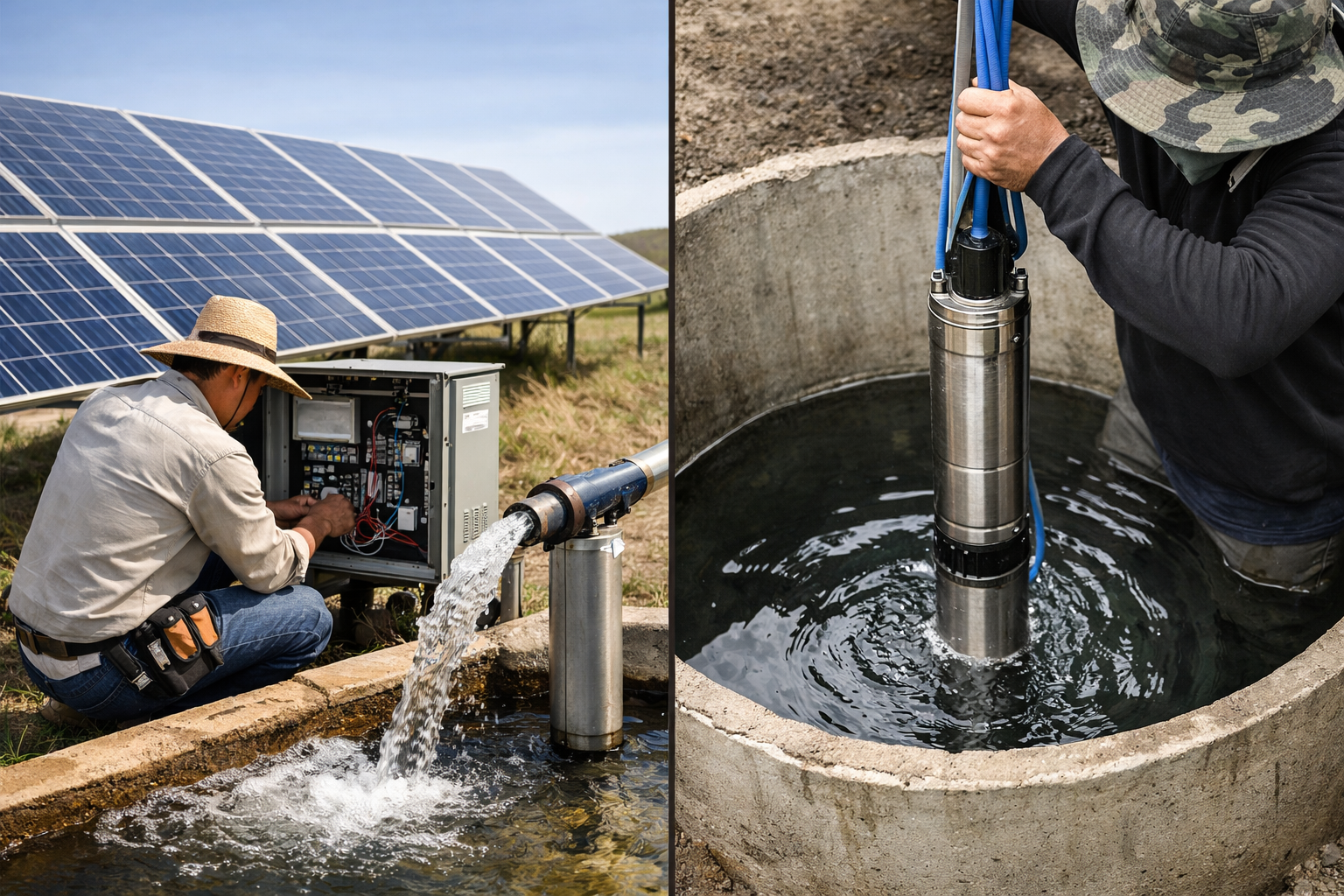
A "solar pump" refers to a complete system powered by solar panels. A "submersible pump" describes a type of pump that operates underwater. A solar pump system can, and often does, use a submersible pump.
This distinction might seem minor, but it is fundamental to understanding modern water solutions.
Thinking of them as separate, competing categories is a common mistake.
The reality is that these terms describe two different aspects of a water pumping setup: one describes how it's powered, and the other describes where it's located.
A submersible pump is a workhorse, but a solar-powered system is a complete, intelligent solution.
Unpacking this difference reveals how modern technology has transformed a simple pump into a self-sufficient, cost-effective water supply, perfectly suited for remote agriculture, livestock, and homes.
Grasping this concept is the first step toward selecting a truly optimized system rather than just a standalone piece of hardware.
Defining the Terms: Power Source vs. Pump Type
You hear "solar" and "submersible" used almost interchangeably.
This makes it nearly impossible to compare products accurately.
You risk misjudging system costs, capabilities, and long-term value.
A submersible pump is defined by its underwater location; it is a hardware category.
A solar pump is defined by its energy source; it is a system category. Therefore, a solar submersible pump is simply a submersible pump that is powered by the sun.
The conversation about water pumps often gets tangled in terminology.
Let's clear this up with a simple analogy.
Think of it like a car.
"Four-wheel drive" describes how the car functions, its type.
"Electric" describes its power source.
You can have an electric car that is also a four-wheel-drive vehicle.
The terms are not mutually exclusive; they describe different characteristics.
It is exactly the same with pumps.
"Submersible" is the type of pump, designed to be pushed down into the water source.
"Solar" is the power source for the entire system that runs the pump.
So, the most common type of solar deep well pump is, in fact, a solar submersible pump.
It is a submersible pump that is engineered to run on DC electricity generated by photovoltaic (PV) panels and managed by a smart controller.
This distinction is crucial for importers like Andrew, who need to educate their customers.
Selling a "solar pump" is not just selling hardware; it's selling an independent, grid-free water solution.
What is a Submersible Pump?
A submersible pump is a device where the entire assembly, including the hermetically sealed motor, is submerged in the fluid to be pumped.
Its core design principle is to push water to the surface, which is far more efficient than pulling it with a surface pump, especially from deep wells.
- Mechanics: It uses a series of impellers to increase water pressure progressively and force it up the pipe.
- Power Sources: Critically, a standard submersible pump is designed to run on Alternating Current (AC) from a stable electrical grid or a large generator. It is not inherently compatible with the Direct Current (DC) produced by solar panels.
- Application: Their primary use is in deep boreholes and wells where a surface pump cannot create enough suction.
What is a Solar Pump System?
A solar pump is not a single item but a synergistic system of three core components working together.
- Solar Panels (PV Array): These capture sunlight and convert it into DC electricity. The amount of power generated varies with the intensity of the sun.
- The Pump Controller: This is the brain of the system and a key differentiator. It takes the variable DC power from the panels and optimizes it for the pump motor. It also provides vital protective functions that a standard AC pump lacks, such as dry-run protection, voltage monitoring, and thermal shutdown.
- The Pump & Motor: This is often a submersible pump, but it is specifically equipped with a highly efficient motor designed to run on the DC power managed by the controller.
The table below clarifies the distinction:
| Feature | Standard Submersible Pump | Solar Pump System |
|---|---|---|
| Primary Identifier | Location (Underwater) | Power Source (Solar Panels) |
| Power Input | Typically AC Grid Power | Variable DC from Panels |
| Core Components | Pump & Motor | Panels, Controller, Pump & Motor |
| "Brain" of Operation | Simple Pressure Switch | Intelligent MPPT Controller |
| Key Advantage | High Power (When Grid is On) | Energy Independence & Low Cost |
Understanding this moves the conversation from "which pump?" to "which system?" It shifts the focus from the hardware in the well to the complete, intelligent solution providing the water.
The Engine of the System: The BLDC Motor Advantage
You need a reliable pump for an off-grid location.
Traditional AC-powered pumps are inefficient and require a grid connection or a massive generator.
This means high fuel costs, constant maintenance, and a dependency on external power that you don't have.
The heart of a modern solar pump is its high-efficiency Brushless DC (BLDC) permanent magnet motor.
This motor technology is fundamentally different from a standard AC motor, converting significantly more electrical energy into water movement, making it perfect for variable solar power.
The single greatest technological leap separating a modern solar pump from a traditional submersible pump is the motor.
A standard AC submersible pump motor is a relatively simple, robust piece of equipment designed for one thing: a constant, stable supply of AC power.
It's inefficient by modern standards, often converting only 50-60% of the electricity it consumes into useful work.
The rest is lost as heat.
When you're paying for grid electricity, this is just a number on your bill.
When you're generating every watt yourself from sunlight, this waste is unacceptable.
The BLDC motor flips this equation on its head.
It is an advanced piece of engineering specifically designed for maximum efficiency with variable DC power.
This isn't just an incremental improvement; it's a game-changer that makes solar pumping economically viable and incredibly reliable.
For an importer and brand owner like Andrew, the motor's quality and efficiency are the core of his product's value proposition.
It is the tangible, technical advantage he can use to justify a premium price and build a reputation for quality.
Why BLDC Motors Dominate Solar Pumping
The superiority of the BLDC motor in a solar application comes down to its fundamental design.
It doesn't use brushes, which wear out and create energy-wasting friction.
Instead, it uses powerful permanent magnets (often 40SH neodymium iron boron) and sophisticated electronics in the controller to precisely manage the motor's rotation.
This results in several key advantages:
- Exceptional Efficiency: BLDC motors regularly achieve efficiencies over 90%. This means more water is pumped per watt of solar energy generated. A system with a 90% efficient motor can produce the same amount of water as a system with a 60% efficient motor using 33% fewer solar panels. This dramatically lowers the initial system cost.
- High Torque at All Speeds: These motors provide strong starting torque, even in low light conditions early in the morning or on cloudy days. They can start pumping sooner and keep pumping longer throughout the day.
- Durability and Longevity: With no brushes to wear out, the motor has far fewer failure points. This results in a maintenance-free design with a significantly longer service life, a critical feature for pumps installed deep in the earth.
- Compact and Lightweight: The high power density of these motors means they are smaller and lighter than AC motors of equivalent power. A modern BLDC motor can be up to 47% smaller and 39% lighter, simplifying shipping, handling, and installation.
The Financial and Performance Impact
This difference in motor technology isn't just academic; it has a direct impact on the system's cost and performance.
| Metric | Standard AC Motor | High-Efficiency BLDC Motor | Advantage |
|---|---|---|---|
| Typical Efficiency | 50% - 65% | > 90% | ~30% Higher |
| Solar Panel Requirement | High | Lower | Reduced System Cost |
| Maintenance | Brushes can wear out | Maintenance-Free | Lower Lifetime Cost |
| Low-Light Performance | Poor; may not start | Excellent; high torque | Longer Pumping Day |
| Service Life | Standard | Extended | Higher Reliability |
For a distributor, this table is pure gold.
It translates complex engineering into clear customer benefits: lower initial cost, zero running costs, higher reliability, and more water per day.
The BLDC motor is the enabling technology that makes the entire solar pump system a superior choice over traditional alternatives in an off-grid setting.
The Brains of the Operation: The Intelligent Controller
You worry about your off-grid pump.
What if the well runs dry?
What if the voltage fluctuates?
Without constant monitoring, a simple issue could destroy your expensive pump, leaving you without water.
A solar pump system includes an intelligent controller; a standard submersible pump does not.
This controller acts as the system's brain, optimizing power with MPPT and providing critical protections like dry-run sensing and automatic shutdown, safeguarding your investment.
If the BLDC motor is the heart of a solar pump system, the intelligent controller is its brain.
This component is completely absent in a standard grid-tied submersible pump setup, which typically relies on a simple mechanical pressure switch to turn it on and off.
The controller's role is far more sophisticated and is arguably the most critical element for the system's efficiency and long-term survival.
It is a dedicated microcomputer that sits between the solar panels and the pump motor, performing a constant balancing act to deliver the maximum amount of water possible while keeping the pump safe.
The controller is what elevates a solar pump from a simple piece of machinery into a smart, self-regulating appliance.
For a business owner like Andrew, selling systems with advanced controllers builds immense customer confidence.
He is not just selling a pump; he is providing a fully automated and protected water management solution that a customer can install and trust to operate reliably without daily supervision.
This level of intelligent operation is a core competitive advantage.
Core Functions of the Intelligent Controller
The controller performs two primary duties: power optimization and system protection.
- Maximum Power Point Tracking (MPPT): This is the controller's primary efficiency function. Solar panels produce a wide range of voltage and current depending on sunlight intensity. MPPT technology constantly analyzes this output and adjusts the electrical load to find the "maximum power point"—the sweet spot that extracts the absolute most energy from the panels at any given moment. A system with MPPT can deliver up to 30% more water over a day compared to one without it.
- Pump Protection: This is the controller's most critical role for longevity. It constantly monitors for conditions that could destroy the pump motor and acts preemptively.
- Dry-Run Protection: It senses when the pump is sucking air (a precursor to rapid overheating) by monitoring motor speed and power draw. It then shuts the pump off, waits for a set period for the well to recover, and attempts to restart automatically.
- Voltage and Current Protection: It shields the motor from damaging voltage spikes or sags from the solar array.
- Stall Protection: If the pump is jammed with sand or debris, the controller detects the overload current and cuts power to prevent the motor windings from burning out.
The AC/DC Hybrid Controller: Ultimate Reliability
For applications demanding a 24/7 water supply regardless of weather, the most advanced systems use an AC/DC hybrid controller.
This provides the ultimate level of energy flexibility and reliability.
| Scenario | Power Source Logic | User Benefit |
|---|---|---|
| Sunny Day | Controller uses 100% DC solar power. | Zero running cost, maximized use of free energy. |
| Cloudy Day | Controller blends available DC solar with AC grid/generator power. | Pump never stops; uses all available solar first to minimize AC cost. |
| Nighttime | Controller automatically switches to 100% AC power. | Uninterrupted 24-hour water supply, no manual intervention needed. |
This hybrid capability is the pinnacle of pump system intelligence.
It guarantees water security for critical applications like livestock watering or domestic supply.
It automatically chooses the most economical power source available at any moment, ensuring the lowest possible operating cost without sacrificing reliability.
This is the kind of advanced, problem-solving feature that helps a distributor stand out in a crowded market.
Choosing the Right Pump Type for the Job
You understand the system, but which pump is right?
Your well is deep, or your farm needs high flow, or your water is corrosive.
Choosing the wrong pump type, even with the best motor and controller, means poor performance and a short service life.
The solar system powers the pump, but the pump’s physical design must match the water source.
Different applications require different pump types: screw pumps for high head, plastic impeller pumps for high flow, and stainless steel pumps for corrosive water.
Once you have decided on a solar-powered system, the final piece of the puzzle is selecting the actual submersible pump that will go down the well.
This is not a one-size-fits-all decision.
The geology of your well, the quality of your water, and your daily volume requirements all dictate which pump design will perform best and last the longest.
A powerful solar system connected to the wrong type of pump is an inefficient investment.
The pump's "wet end"—the part that actually moves the water—must be matched to the specific demands of the job.
As a knowledgeable supplier, providing a portfolio of specialized pumps allows a distributor like Andrew to tailor solutions precisely to his customers' diverse needs, from small domestic wells in Latin America to large cattle stations in Australia.
This flexibility to solve specific problems is key to building a loyal customer base.
Offering this range of options demonstrates true market expertise.
Three Core Designs for Different Needs
Within the category of solar submersible pumps, three designs cover over 90% of all applications.
Each has clear strengths and is engineered for a specific set of conditions.
-
Solar Screw Pump (Progressing Cavity)
- How it Works: A corkscrew-shaped stainless steel rotor spins inside a rubber stator. This action creates sealed cavities of water that are progressively "pushed" up to the surface.
- Best For: Deep wells with low flow rates. It is a "low flow, high head" pump.
- Key Advantages: It can generate immense pressure to lift water from extreme depths (over 200 meters). It is also highly resistant to sand and sediment, which would quickly destroy other pump types.
- Limitations: The flow rate is limited, making it unsuitable for large-scale irrigation.
-
Solar Plastic Impeller Pump (Centrifugal)
- How it Works: This is a multi-stage pump with a stack of durable plastic impellers. Each impeller spins, adding pressure and velocity to the water and pushing it up to the next stage.
- Best For: Applications needing high water volume from moderate depths. It is a "high flow, medium head" pump.
- Key Advantages: Delivers a large volume of water, making it ideal for farm irrigation and livestock troughs. The plastic impellers have excellent resistance to fine sand, and the pump is lightweight and cost-effective.
- Limitations: Not as durable in highly corrosive water or at extreme depths where immense pressure is required.
-
Solar Stainless Steel Impeller Pump (Centrifugal)
- How it Works: Operates on the same centrifugal principle but uses SS304 stainless steel for the impellers, casing, and all wetted parts.
- Best For: Environments with aggressive water quality. It is a premium "high flow, medium-to-high head" pump.
- Key Advantages: Superior resistance to corrosion from acidic or alkaline water. It offers the longest service life and highest reliability in harsh conditions.
- Limitations: Higher initial cost and weight compared to the plastic impeller model.
Matching the Pump to the Application
Choosing the right pump is a process of matching its capabilities to your specific needs.
| Application Need | Best Pump Type | Why It's the Best Choice |
|---|---|---|
| Deep Household Well (150m+) | Screw Pump | Generates the high pressure (head) needed to lift water from great depths. |
| Center-Pivot Farm Irrigation | Plastic Impeller Pump | Delivers the high volume (flow rate) required to water large areas efficiently. |
| Watering Livestock on a Ranch | Plastic Impeller Pump | High flow fills large troughs quickly; sand resistance is a major plus. |
| Region with Salty/Alkaline Soil | Stainless Steel Impeller | SS304 material resists corrosion, preventing premature failure and ensuring clean water. |
By offering this complete and logical product portfolio, a distributor can confidently address any customer requirement, solidifying their position as a full-service water solutions provider.
Conclusion
A solar pump is a complete system, not just a pump.
It combines panels, a smart controller, and an efficient motor to provide reliable, grid-independent water anywhere.
Frequently Asked Questions
Can a submersible pump run on solar power?
Yes, a submersible pump can run on solar power, but it requires a specialized DC motor and a controller to manage the variable power from the solar panels.
Do solar pumps work on cloudy days?
Solar pumps work on cloudy days but at a reduced flow rate. High-efficiency systems can still pump a useful amount of water even with significant cloud cover.
How long does a solar water pump last?
A quality solar water pump system can last for 20-25 years. The solar panels are very durable, and brushless DC motors have a long, maintenance-free service life.
Are solar water pumps worth it?
For off-grid or remote locations, solar water pumps are absolutely worth it. They have no fuel costs, require very little maintenance, and provide a reliable long-term water supply.
Can I run my existing AC pump with solar panels?
Yes, you can run an existing AC pump with solar panels, but it requires a large solar array and a specialized, expensive device called a solar pump inverter to convert DC to AC.
How deep can a solar pump pull water from?
Solar screw pumps can lift water from depths exceeding 200 meters (over 650 feet). The maximum depth depends entirely on the specific pump model and system design.
What size solar pump do I need?
The size of your solar pump system depends on your daily water requirement (gallons or liters per day) and the total vertical distance you need to lift the water (total dynamic head).
Do solar pumps need batteries to work?
No, most solar water pumps do not need batteries. They pump water when the sun is shining and store the "energy" as water in a storage tank for use at night or on cloudy days.