Choosing the wrong pump size is frustrating.
It wastes water, damages plants, and costs you money.
To size a pump for a garden, you need two key numbers: the required flow rate (in gallons or liters per minute) and the total dynamic head (the total height and pressure needed).
A small solar submersible pump is often the perfect, efficient choice.
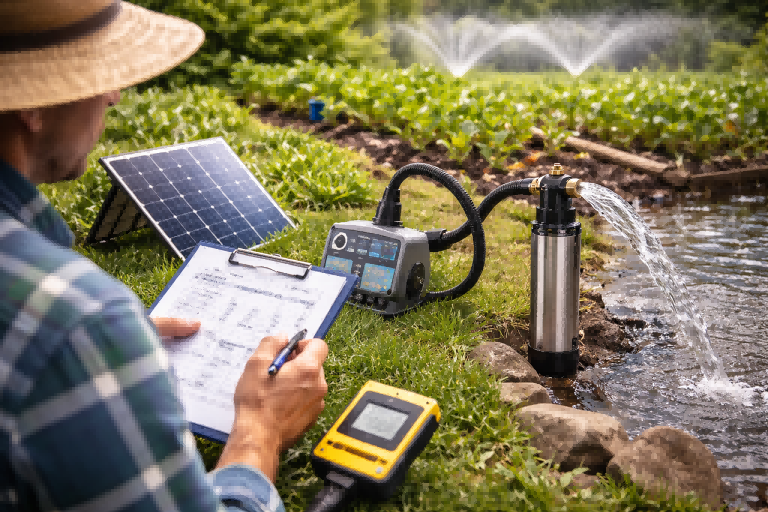
Getting these two numbers right is the secret to a perfect irrigation system.
It sounds technical, but it is simpler than you think.
Flow rate is the amount of water your garden needs.
Head is the work the pump has to do to deliver that water.
Thinking about a pump purchase without these figures is like buying a car without knowing how far you need to drive or how steep the hills are.
Let's break down how to find these numbers easily.
This guide will walk you through each step to ensure you select a pump that is not too big and not too small, but just right for your garden.
Calculating Your Flow Rate | How Much Water You Need
You guess how much water you need for your garden.
Your plants end up either drowned or thirsty.
This guessing game is inefficient and harms your garden's health.
**Calculate your garden's required flow rate by adding up the water usage of all sprinklers or emitters in your largest irrigation zone.
For a typical home garden, this is usually between 5 and 10 gallons per minute (GPM), or 20-40 liters per minute (LPM).
**
Your pump's primary job is to deliver a specific volume of water over a certain time.
This volume is your flow rate.
An oversized pump wastes energy and can damage your irrigation system with excess pressure.
An undersized pump fails to deliver enough water, leading to dry spots and stressed plants.
You must calculate the peak demand of your system.
This means you only need to consider the largest group of sprinklers or drippers that will be running at the same time.
This group is often called a "zone."
Step-by-Step Flow Rate Calculation
Your irrigation method is the biggest factor in this calculation.
Each method has a different water demand.
-
Drip Irrigation Systems: These are low-flow systems.
Each emitter has a specific flow rate, usually measured in gallons per hour (GPH) or liters per hour (LPH).
To find your total, count the number of emitters in your largest zone and multiply it by the flow rate of a single emitter.
Then, divide by 60 to convert the number to minutes. -
Sprinkler Systems: These are high-flow systems.
Each sprinkler head has a flow rate measured in gallons per minute (GPM) or liters per minute (LPM).
You can usually find this number printed on the sprinkler head or on the manufacturer's website.
Sum the GPM of all sprinkler heads that will operate together in your largest zone.
Sample Flow Rate Calculation
Let's look at two common examples for a home garden.
| Irrigation Type | Emitter/Head Count | Flow per Unit | Total Flow Rate (GPM) |
|---|---|---|---|
| Drip System | 120 emitters | 1 Gallon per Hour (GPH) | 2 GPM (120 x 1 / 60) |
| Sprinkler Zone | 4 rotary heads | 2.5 Gallons per Minute (GPM) | 10 GPM (4 x 2.5) |
The 20% Capacity Rule
Once you have your number, it's wise to add a safety margin.
A good rule of thumb is to choose a pump that can provide about 20% more flow than your calculated peak demand.
This extra capacity ensures the pump isn't running at its absolute maximum limit, which extends its lifespan.
It also gives you flexibility if you decide to expand your garden zone slightly in the future.
For a calculated need of 10 GPM, you should look for a pump that can comfortably deliver 12 GPM.
Understanding Total Dynamic Head | How Hard the Pump Must Work
You bought a new pump with a high flow rate.
But the water only trickles out of your sprinklers.
You forgot to calculate the total workload, known as the head.
**Total Dynamic Head (TDH) is the total pressure the pump must overcome.
It is calculated by adding the vertical lift from the water source, the friction loss in the pipes, and the pressure your sprinklers require.
**
Total Dynamic Head, or TDH, is the most critical factor after flow rate, yet it is the most frequently overlooked.
It measures the total resistance your pump has to fight against to deliver water.
A pump might be rated for 20 GPM, but if the TDH is too high, it might only deliver 5 GPM, or nothing at all.
Calculating TDH involves summing three separate components.
You will need a tape measure and some basic information about your equipment.
The Three Components of Head
-
Vertical Lift (Static Head): This is the vertical distance from the surface of your water source (like the water level in your well or tank) to the highest point in your irrigation system (your tallest sprinkler).
Use a tape measure to find this height.
Every foot of vertical lift adds a specific amount of work for the pump. -
Friction Loss: As water moves through pipes, fittings, and valves, it creates friction, which the pump must overcome.
This friction depends on the pipe's length, its diameter, and the flow rate.
Longer and narrower pipes create more friction.
You can use online calculators or standard charts to estimate this value.
A simple estimate for a garden system is to add about 1 to 2 feet of head for every 100 feet of pipe. -
Operating Pressure: Your irrigation emitters need a certain pressure to function correctly.
Sprinklers might require 30-40 PSI, while drip systems need only 10-20 PSI.
You must convert this pressure into feet of head.
The conversion is simple: 1 PSI = 2.31 feet of head.
Calculating Your Total Dynamic Head
Here is how you put it all together.
| Head Component | Your Measurement | Calculation (Example) | Result (in Feet of Head) |
|---|---|---|---|
| Vertical Lift | Well water level is 50 ft below sprinklers | 50 vertical feet | 50 ft |
| Friction Loss | 200 ft of 1-inch pipe | (200 / 100) x 5.0 (from a chart) | 10 ft |
| Operating Pressure | Sprinklers need 40 PSI | 40 PSI x 2.31 | 92.4 ft |
| Total Dynamic Head | Sum of the above | 50 + 10 + 92.4 | 152.4 ft |
In this example, you need a pump that can deliver your target flow rate (from the previous step) at a total head of at least 153 feet.
Choosing the Right Pump Type | The Best Tool for the Job
You have your numbers for flow and head.
But the market is full of different pump types.
Choosing the wrong one means inefficiency and potential failure.
**For most garden irrigation from a well, a solar submersible centrifugal pump with a plastic impeller is best.
It offers a great balance of high flow, good durability, and cost-effectiveness, making it a sustainable and reliable choice.
**
Now that you know your performance requirements, you can select the right type of pump.
For modern, off-grid, or eco-conscious gardening, solar submersible pumps are the top choice.
They are placed directly inside your well or water tank, which is more efficient because they push water up rather than pulling it.
The main decision comes down to the pump's internal design, which is suited for different conditions.
Let's compare the three most popular solar submersible pump types.
Solar Centrifugal Pump (Plastic Impeller)
This is the workhorse for most home gardens and small farms.
- How it Works: It uses one or more rotating plastic impellers to sling water outward with centrifugal force, creating high flow at a medium pressure.
- Best For: Gardens requiring 5-30 GPM, with wells up to about 80 meters (260 feet) deep.
Its high-strength plastic impellers are surprisingly wear-resistant and handle water with fine sand very well. - Advantages: It is lightweight, highly efficient, and the most economical option.
This provides the best balance of performance and price for general garden irrigation. - Limitations: It is not ideal for extremely deep wells or for water that is highly corrosive (acidic or alkaline).
Solar Screw Pump
This is the specialist for deep wells and low-flow needs.
- How it Works: It uses a single rotating stainless steel screw inside a rubber stator.
This action creates sealed pockets of water that are pushed steadily to the surface, generating very high pressure. - Best For: Very deep wells (over 80 meters / 260 feet) or gardens using drip irrigation that require low flow (1-5 GPM).
- Advantages: It can lift water from extreme depths with very high energy efficiency. It is also exceptionally resistant to sand and silt.
- Limitations: The flow rate is limited, so it cannot power a large sprinkler system.
Solar Centrifugal Pump (Stainless Steel Impeller)
This is the premium, heavy-duty solution.
- How it Works: It functions identically to the plastic impeller pump but uses SS304 stainless steel for all water-contact parts.
- Best For: Gardens with corrosive water (high acidity, alkalinity, or salt content) or for users who want the longest possible service life.
- Advantages: It offers extreme durability and resistance to corrosion, ensuring high reliability in harsh water conditions.
- Limitations: It is heavier and has a significantly higher initial cost, making it an investment for specific environmental challenges.
For over 90% of garden applications, the solar plastic impeller pump hits the sweet spot of performance, durability, and cost.
Conclusion
Size your pump by calculating flow rate and total head.
Then, choose a durable solar pump model to enjoy an efficient, long-lasting garden irrigation system.
Frequently Asked Questions
What GPM do I need for a garden hose?
A standard 5/8-inch garden hose can handle about 5 to 10 GPM (gallons per minute), depending on your water pressure.
How many sprinkler heads can a 1 HP pump run?
A 1 HP pump can typically run between 5 to 10 standard sprinkler heads, depending on the pump's specific flow and pressure rating.
Is a bigger water pump always better?
No. An oversized pump wastes energy, can cause "cycling" (rapid on/off), and wears out more quickly.
Proper sizing is crucial for efficiency.
What is the difference between a water pump and a booster pump?
A water pump moves water from a source (like a well).
A booster pump increases the pressure of water that is already flowing in a system.
How much does it cost to run an irrigation pump for an hour?
The cost depends on the pump's wattage and local electricity rates.
A 1 HP (746 Watt) pump costs about 10-15 cents per hour to run.
Solar pumps run for free.
How do I know if my irrigation pump is bad?
Signs of a bad pump include low or no water pressure, strange noises, the motor not starting, or the pump running continuously.