Struggling to get water where you need it?
Incorrect pump selection for height can lead to inefficiency, system failure, and wasted costs.
Understanding the limits is the first step.
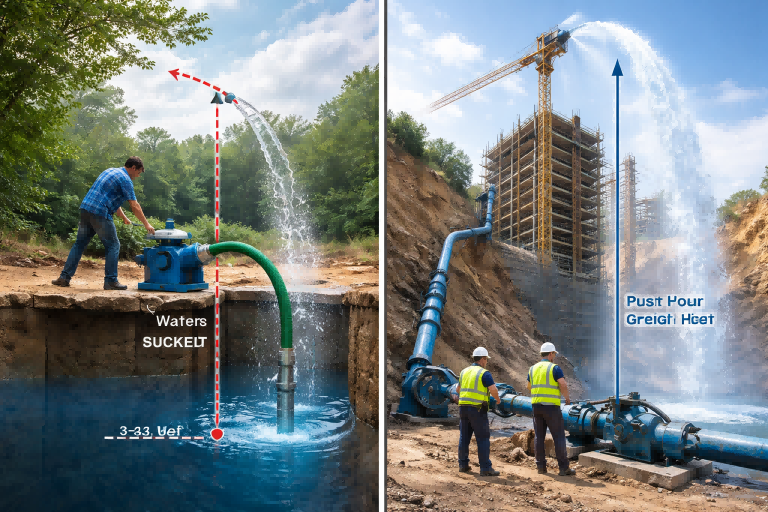
You can pump water hundreds or even thousands of feet high by pushing it with powerful pumps.
However, if you're sucking water up, you're limited by atmospheric pressure to about 33-34 feet at sea level.
Getting water to a higher elevation seems simple, but the physics behind it is surprisingly nuanced.
The answer to "how high?" isn't a single number; it's a dynamic interplay between the pump's design, the laws of physics, and the environment it operates in.
Whether you're pulling water from a shallow well or pushing it to the top of a skyscraper, the principles change dramatically.
Failing to grasp these core concepts is the most common reason for specifying the wrong equipment, leading to poor performance and premature failure.
Let's break down these critical factors so you can make informed decisions for any application, ensuring reliability and efficiency for your clients.
Pushing vs. Pulling: The Two Core Pumping Principles
You’re facing a new project, but the client’s water source and delivery point seem impossibly far apart vertically.
Choosing the wrong approach means you could install a system that fails to deliver a single drop.
Let’s clarify the two fundamental methods.
The method determines the limit.
"Pushing" water from below has a nearly unlimited height potential, dictated only by pump power.
"Pulling" or sucking water up is strictly limited by atmospheric pressure to a maximum of about 34 feet (10.3 meters).
To truly grasp pumping height, you must first understand that not all "lifting" is the same.
A pump works in one of two ways: it either pushes a column of water up from below, or it creates a vacuum to let the atmosphere's pressure push the water up from above.
This distinction is the single most important factor in determining the maximum achievable height.
One relies on mechanical force, while the other relies on a fixed law of physics.
Deep Dive: The Physics of Lift
Let's explore the science that governs these two methods.
Pushing Water (Discharge Lift)
When a pump is submerged or located at the bottom of the system (like a submersible well pump), it's all about brute force.
The pump uses its motor and impellers to directly pressurize the water and force it upwards through the pipe.
- How it Works: The pump adds energy directly to the water in the form of pressure.
This pressure overcomes the force of gravity and the friction within the pipes. - The Limit: The theoretical limit is determined by the power of the pump's motor and the efficiency of its hydraulic design.
With enough power, you can use multi-stage pumps (pumps with multiple impellers stacked together) to push water to extreme heights, like those needed for skyscrapers or deep-mine dewatering.
Modern systems can easily exceed 1,000 feet.
Pulling Water (Suction Lift)
When a pump is located above the water source (like many jet pumps or surface-mounted pumps), it works entirely differently.
It doesn't actually "pull" the water.
- How it Works: The pump works by pumping air out of the suction pipe, creating a partial vacuum.
The higher atmospheric pressure outside the pipe then pushes down on the surface of the water source, forcing water up into the pipe to fill the vacuum.
Your pump is simply creating the condition for the atmosphere to do the work. - The Limit: At sea level, the atmosphere exerts about 14.7 psi (pounds per square inch) of pressure.
This pressure is strong enough to support a column of water approximately 34 feet (10.3 meters) high.
No matter how perfect a vacuum your pump creates, you cannot "suck" water any higher than this, because that's the absolute limit of what atmospheric pressure can achieve.
In practice, the real-world limit is closer to 25 feet due to inefficiencies and friction.
| Pumping Method | Primary Force | Practical Limit | Common Pump Types |
|---|---|---|---|
| Pushing | Pump Motor Power | 1,000+ feet | Submersible, Booster |
| Pulling | Atmospheric Pressure | ~25 feet (at sea level) | Jet Pump, Some Centrifugal |
Key Factors That Determine Maximum Pumping Height
You've got a powerful pump, but your water pressure is still weak at the destination.
Underestimating the combined resistance from pipes, altitude, and even water temperature can cripple an otherwise strong system.
Understanding these variables is crucial for success.
The maximum height isn't just about the pump; it's a total calculation.
Real-world height is limited by the pump's power, plus losses from pipe friction, altitude, and water temperature.
A pump rated for 300 feet may only achieve 200 feet after these factors.
A pump's datasheet provides its ideal performance, but the real world is never ideal.
The final delivery height, often referred to as the "Total Dynamic Head," is a battle between the pump's power and a host of opposing forces.
Every foot of pipe, every bend, and every degree of temperature can chip away at your pump's potential.
Ignoring these factors is like planning a long road trip based only on your car's top speed, without considering traffic, hills, or fuel efficiency.
Let's break down each of these critical variables.
Pump Design and Drive Technology
The heart of the system is the pump itself.
Its mechanical design and the motor driving it are the primary determinants of its power.
- Motor Power & Speed: Measured in horsepower (HP) or kilowatts (kW), this is the raw energy source.
Higher power generally means a greater ability to overcome gravity and friction.
Motor speed, measured in RPM, also plays a crucial role.
High-speed motors, such as Permanent Magnet Synchronous Motors (PMSM), can generate more pressure and flow from a more compact unit. - Impeller Design: The impeller is the rotating component that transfers energy from the motor to the water.
Its diameter, shape, and material (e.g., durable AISI304 stainless steel) are engineered for specific flow and pressure characteristics.
Multistage pumps use a series of impellers to build pressure incrementally, allowing for extremely high heads. - Drive Technology (VFD): Modern pumps use Variable Frequency Drives (VFDs) to control motor speed.
This allows the pump to maintain a constant discharge pressure, even if the demand for water changes.
It also enables 'soft start' and 'soft stop' functions, which ramp the motor up and down gradually.
This reduces mechanical shock on the entire plumbing system and prevents electrical surges, significantly extending the life of the pump and pipes.
The Unseen Resistance: Pipe Friction Head
Water doesn't flow through pipes for free; it encounters friction.
This resistance effectively adds to the "height" the pump must overcome.
- Pipe Diameter: This is the most significant factor.
A narrower pipe forces the same amount of water through a smaller space, dramatically increasing velocity and friction.
Doubling a pipe's diameter can reduce friction loss by a factor of four or more. - Pipe Length: The longer the pipe, the more surface area the water rubs against, and the greater the total friction.
- Pipe Material: Smoother pipes (like PVC) create less friction than rougher pipes (like old galvanized iron).
- Fittings and Bends: Every elbow, valve, and tee in the system adds turbulence and creates more resistance, which must be calculated as equivalent feet of straight pipe.
Environmental Constraints: Altitude and Temperature
The operating environment can place firm limits on pump performance, especially for suction lift applications.
- Altitude: As you go higher in elevation, the air thins, and atmospheric pressure decreases.
For suction lift pumps, this directly reduces the maximum possible lift.
As a rule of thumb, you lose about 1 foot of suction lift for every 1,000 feet of elevation gain. - Water Temperature: Hot water has a higher "vapor pressure," meaning it turns into steam more easily under a vacuum.
When a suction pump creates a vacuum, hot water can begin to boil inside the suction line, a phenomenon called cavitation.
This creates vapor bubbles that collapse violently inside the pump, causing severe damage and completely halting the pumping action.
Therefore, the hotter the water, the lower the maximum practical suction lift.
| Factor | Impact on Pumping Height | Why It Matters |
|---|---|---|
| High Motor Power/Speed | Increases Potential Height | Provides the force needed to overcome gravity and friction. |
| Narrow Pipes | Reduces Achievable Height | Greatly increases friction loss, adding to the total head. |
| High Altitude | Reduces Suction Lift | Lower atmospheric pressure has less force to push water up. |
| Hot Water | Reduces Suction Lift | Water vaporizes easily under vacuum, causing damaging cavitation. |
Understanding Pump Types and Their Capabilities
You need a pump, but the market is flooded with options: submersible, jet, booster, centrifugal.
Choosing the wrong type for your specific height and flow requirements is a costly mistake.
Each is designed for a different job.
A pump's type directly reflects its intended use and height capability.
Submersible pumps push water from deep wells, easily reaching 100-400 feet.
Jet pumps pull water from shallow sources, limited to about 25 feet.
Booster pumps increase pressure within existing systems.
The term "pump" is a broad category, like the word "vehicle."
You wouldn't use a sports car to haul gravel, and you shouldn't use a shallow well pump to draw water from 200 feet deep.
Each pump type is a specialized tool, engineered with a specific combination of suction lift capability and discharge head potential.
Matching the pump's design to the application's demands for both vertical lift and water volume is the cornerstone of a reliable and efficient water system.
Let's examine the most common types and where they excel.
Deep Well Submersible Pumps
These are the champions of high-lift applications.
As the name implies, the entire unit—motor and pump—is submerged deep inside the well.
- Principle of Operation: Because the pump is below the water level, it is always in "push mode."
It never has to deal with suction lift limitations.
It uses its power to push the column of water above it all the way to the surface and into the pressure tank. - Capabilities: Standard residential models are commonly designed for total heads of 100 to 400 feet.
More powerful agricultural and industrial models can push water over 1,000 feet.
Their performance is a direct function of motor horsepower and the number of impellers (stages) they contain. - Best For: Deep wells (over 25 feet deep), boreholes, and any application requiring significant vertical lift from the source.
Jet Pumps
Jet pumps are surface-mounted and are classic examples of suction lift pumps.
They are commonly seen in older homes or for drawing water from shallow wells, lakes, or cisterns.
- Principle of Operation: A jet pump uses a clever trick.
It circulates a portion of the discharged water back down through an ejector, which creates a high-speed jet.
This jet creates a vacuum that draws more water from the well up into the pump. - Capabilities: Because they fundamentally rely on creating a vacuum, they are bound by the laws of atmospheric pressure.
A standard shallow well a jet pump can only lift water from a maximum depth of about 25 feet.
"Deep well" versions use a two-pipe system to place the ejector down in the well, allowing them to pull from depths of up to 100 feet, but with significantly reduced efficiency. - Best For: Shallow water sources where the vertical distance from the pump to the water is less than 25 feet.
Booster Pumps
Booster pumps are not designed to lift water from a source.
Instead, their job is to increase the pressure that is already present in a system.
- Principle of Operation: A booster pump is an inline pump that takes in water at a certain pressure and uses its spinning impellers to add more pressure on the outlet side.
They are essentially "push" pumps that work on an already flowing line.
Modern VFD booster pumps can intelligently adjust their speed to maintain a perfectly constant output pressure, regardless of a city's fluctuating supply or multiple taps opening and closing in a building. - Capabilities: The "height" a booster pump adds is measured in pressure (PSI or bar).
They can add anywhere from 20 to 100+ PSI to a system, which is equivalent to adding 46 to 231 feet of vertical head. - Best For: Homes and buildings with low municipal water pressure, pressurizing water from a storage tank, and providing consistent high pressure in commercial and industrial applications.
How to Read a Pump Curve for Height and Flow
You've reviewed the specs, but how will the pump actually perform on-site?
A pump curve chart looks complex, but it's the key to predicting real-world results.
Ignoring it is like buying a truck without knowing its towing capacity.
A pump curve is a graph that shows you the pump's performance trade-off.
It proves that as you pump water higher (increasing the head), the amount of water you can deliver (the flow rate) will decrease.
This chart is essential for proper sizing.
Every pump has a unique performance DNA, and the pump curve is its fingerprint.
This simple graph is the most critical tool for an engineer or system designer.
It moves beyond a single "max height" number and gives you a complete picture of the pump's capabilities across its entire operating range.
It allows you to answer the most important question: "For my required height, how much water will I actually get?"
Learning to read this chart ensures you select a pump that not only reaches the required height but also delivers the necessary volume of water, operating at its most efficient point.
Deconstructing the Pump Curve
A standard pump curve plots two primary variables on a graph.
The Vertical Axis: Total Head
This axis represents the total resistance the pump is working against.
It's measured in feet, meters, or pressure units like PSI.
"Total Head" is the sum of:
- Static Head: The actual vertical distance you are lifting the water.
- Friction Head: The equivalent resistance caused by friction in the pipes and fittings.
As you go higher up this axis, the pump is being asked to do more work.
The Horizontal Axis: Flow Rate
This axis represents the volume of water the pump can move.
It is typically measured in Gallons Per Minute (GPM), Liters Per Minute (LPM), or Cubic Meters per Hour (m³/h).
As you move to the right on this axis, the pump is delivering more water.
Reading the Curve
The curve itself shows the inverse relationship between head and flow.
- Start at Zero Flow: Find the point where the curve intersects the vertical (Head) axis.
This point is the "shut-off head."
It's the maximum pressure or height the pump can produce when the outlet is completely closed (zero flow).
The pump can't push water any higher than this. - Start at Zero Head: Find the point where the curve intersects the horizontal (Flow) axis.
This is the "max flow" or "run-out" point.
It represents the maximum volume of water the pump can move when there is virtually no resistance (e.g., pumping into an open tank at the same level). - Find Your Operating Point: The real magic happens in the middle of the curve.
First, calculate your system's Total Dynamic Head (Static Head + Friction Head).
Find that value on the vertical axis.
Then, move horizontally to the right until you intersect the performance curve.
From that intersection point, drop straight down to the horizontal axis.
The value you land on is the exact flow rate you can expect at that specific head.
The Efficiency Curve (BEP)
Many pump curves also include a second line or a shaded area representing efficiency.
The peak of this efficiency curve is called the Best Efficiency Point (BEP).
Ideally, you want to select a pump where your calculated operating point falls as close to the BEP as possible.
Operating at the BEP means you get the most water moved for the least amount of energy consumed, leading to lower electricity bills and a longer pump lifespan.
Operating too far to the left or right of the BEP leads to inefficiency, vibration, and premature wear.
Conclusion
The maximum pump height depends entirely on whether you are pushing water or pulling it.
While suction is limited by physics, modern pump technology provides powerful solutions for pushing water to incredible heights.
FAQs
What is the max suction lift for a pump?
At sea level, the theoretical max suction lift is about 34 feet (10.3 meters).
However, in practice, most pumps are limited to around 25 feet due to friction and pump inefficiencies.
Does altitude affect pump suction?
Yes, significantly.
For every 1,000 feet of elevation gain, you lose approximately 1 foot of potential suction lift because the atmospheric pressure is lower.
How high can a 1 HP pump push water?
This depends entirely on the pump's design.
A 1 HP high-pressure, low-flow booster pump might push water 300+ feet, while a 1 HP high-flow pump might only manage 80 feet.
Can a pump push water 1000 feet?
Yes.
Powerful, multi-stage submersible or surface-mounted pumps are specifically designed for this purpose in applications like mining, deep wells, and supplying water to skyscrapers.
Why is my pump not reaching its max height?
Common causes include excessive pipe friction from long or narrow pipes, air leaks in the suction line, a worn-out impeller, or operating at a high altitude.
Does a VFD pump increase height?
A VFD (Variable Frequency Drive) doesn't increase the pump's absolute maximum height.
Instead, it intelligently controls the motor's speed to maintain a constant target pressure (head) even as flow demand changes.
What is total dynamic head (TDH)?
TDH is the total resistance the pump must overcome.
It's calculated by adding the vertical lift (static head) to all friction losses from pipes and fittings (friction head).
How high can a solar water pump?
Advanced solar-powered submersible pumps can be very powerful.
Depending on the model and available sunlight, they can push water to heights of over 1,400 feet for agricultural or off-grid use.