Struggling with unreliable power for your water pump?
Off-grid water solutions often face high costs and inconsistent energy.
This dependency can limit your water supply and increase operational expenses.
The number of solar panels needed depends on the pump's wattage, daily run time, and your location's peak sun hours.
A 500W pump running for 6 hours a day (3,000 Wh) in an area with 5 peak sun hours would require at least 600W of solar panels.
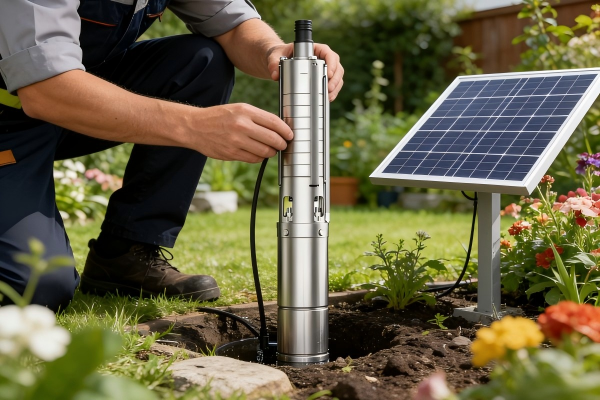
Choosing the right solar water pump is crucial for efficiency and reliability.
Your specific needs, like water depth and required flow rate, determine the best type of pump.
Factors such as water quality and application—from homes to farms—also play a huge role.
This guide will break down the most popular solar pump types.
We will explore their core technology and how to match them to your needs.
This ensures you can build a cost-effective and sustainable water system.
Understanding these options helps you invest wisely in a solution that lasts.
Solar Screw Pump: Low Flow, High Head
Need to pull water from a very deep well?
Traditional pumps often struggle to generate enough pressure for high-head applications.
This can leave you with an inadequate water supply for livestock or domestic use.
A solar screw pump excels in these situations.
It uses a unique mechanism to push water from great depths, providing a reliable, high-pressure water source even with low flow rates.
This makes it perfect for deep wells where other pumps fail.
Solar screw pumps are a specialized solution for challenging geologies.
They are a type of positive displacement pump, often called a progressing cavity pump.
This design is what allows them to generate significant pressure.
The core components are a metal rotor (the screw) and a rubber stator.
As the single-helix rotor turns inside the double-helix stator, it creates sealed cavities.
These cavities "progress" from the pump's inlet to its outlet, pushing the water column upward.
This mechanism is less dependent on rotational speed for creating pressure, unlike centrifugal pumps.
It delivers a consistent flow rate and can achieve very high heads—often exceeding 150 meters.
Where Screw Pumps Excel
The primary application for these pumps is in regions with deep water tables.
Think of arid areas in Africa, mountainous parts of Latin America, or remote outback stations.
They are ideal for:
- Domestic Water Supply: Providing household water from a deep borehole.
- Livestock Watering: Ensuring cattle and other animals have a consistent water source in vast pastures.
- Small-Scale Irrigation: Supplying water to targeted drip irrigation systems that require pressure but not massive volume.
Key Advantages and Limitations
Understanding the trade-offs is essential for making the right choice.
Screw pumps offer distinct benefits but also have limitations you must consider for your project.
| Feature | Advantage | Limitation |
|---|---|---|
| Sand Resistance | The rubber stator and slow operation make it highly resistant to abrasive sand, with a tolerance up to 0.5% sand content. | The rubber stator can wear over time and may need eventual replacement, especially in highly abrasive conditions. |
| High Head | Its design allows it to pump water from extreme depths, making it a go-to for deep well applications. | The flow rate is inherently low. It is not designed for applications needing high volumes of water quickly, like flood irrigation. |
| Efficiency | It maintains good efficiency across a range of speeds and depths, making it adaptable to varying sunlight conditions. | High friction within the pump can lead to slightly lower peak efficiency compared to a perfectly matched centrifugal pump. |
This pump's ability to handle harsh water conditions is a major selling point.
It can operate effectively in water that would quickly destroy other pump types.
This durability reduces maintenance and extends the system's operational life.
However, its limited flow means it's a specialist tool.
For large-scale farming or applications requiring high water volume, you will need a different solution.
Solar Plastic Impeller Pump: High Flow, Wear-Resistant
Need to move a lot of water for your farm or garden?
Many pumps struggle to deliver high volume without consuming massive amounts of power.
This makes large-scale irrigation expensive and difficult in off-grid locations.
A solar pump with plastic impellers offers a breakthrough.
This multi-stage centrifugal pump is engineered for high flow and medium head, making it ideal for agriculture.
Its lightweight, wear-resistant design provides an economical and efficient solution for moving large water volumes.
The solar plastic impeller pump is the workhorse of off-grid agriculture.
It uses a series of centrifugal impellers stacked on top of each other.
Each stage, consisting of an impeller and a diffuser, adds pressure to the water.
This multi-stage design allows the pump to achieve a useful balance of both flow rate and head.
The "plastic" in its name is key to its market position.
These impellers are not made from ordinary plastic.
They are typically constructed from high-strength, engineered polymers like Noryl.
This material offers excellent hydraulic performance and remarkable resistance to abrasion from fine sand.
The Power of Engineered Polymers
Why choose plastic over metal?
The decision comes down to application and cost.
- Wear Resistance: Engineered polymers are surprisingly durable against fine, abrasive particles. The material can flex slightly, deflecting particles that might chip or erode a rigid metal impeller. This makes them ideal for wells with sandy water.
- Cost-Effectiveness: Manufacturing polymer impellers is generally less expensive than casting and machining stainless steel. This results in a lower upfront cost for the end user, making solar pumping more accessible.
- Weight Reduction: Plastic impellers are significantly lighter than their metal counterparts. This reduces the pump's overall weight, making it easier and cheaper to transport, install, and service.
Ideal Applications and Performance
This pump is a popular choice across Africa and the Americas for good reason.
It hits the sweet spot for many common water needs.
| Application | Why It Works | Performance Metrics |
|---|---|---|
| Farm Irrigation | Delivers the high flow rates needed to water crops efficiently, supporting ranches and commercial farms. | Can deliver flow rates exceeding 15 m³/hour. |
| Pasture Water Supply | Quickly fills large troughs for livestock, ensuring a constant supply for large herds. | Achieves medium heads, suitable for wells up to 80-100 meters deep. |
| Home and Garden | Provides ample water for residential use, including lawn sprinklers and large gardens. | Excellent efficiency means it requires fewer solar panels for its output. |
The main limitation is its durability in certain environments.
While it resists sand well, it is not suited for highly corrosive water with aggressive pH levels.
The material can also degrade under the extreme pressure and heat found in very deep wells.
For those applications, a more robust material like stainless steel is necessary.
Solar Stainless Steel Impeller Pump: Premium Quality, Corrosion Resistance
Is your water source acidic or alkaline?
Corrosive water can rapidly destroy standard pumps, leading to costly replacements and system downtime.
This makes finding a durable water solution in these environments extremely challenging.
A solar pump with stainless steel impellers is the definitive answer.
This premium centrifugal pump is built with an SS304 stainless steel impeller and pump body.
It is specifically designed to withstand corrosive water, ensuring long service life and high reliability in the toughest conditions.
When durability is non-negotiable, stainless steel is the material of choice.
This pump model represents the high-end tier of solar water pumping solutions.
Like the plastic impeller version, it is a multi-stage centrifugal pump.
However, every component that touches water is upgraded for maximum resilience.
The use of SS304 stainless steel is the defining feature.
This material provides superior resistance to both acidic and alkaline water conditions that would quickly corrode lesser materials.
The Unmatched Durability of SS304
SS304 is a specific grade of stainless steel known for its excellent corrosion resistance and durability.
Let's break down why it's the premium choice.
- Chemical Resistance: SS304 contains high amounts of chromium (around 18%) and nickel (around 8%). The chromium creates a passive, self-repairing oxide layer on the surface that protects the iron from rust and corrosion caused by acids and alkalis.
- Structural Integrity: Stainless steel is incredibly strong and rigid. This allows the pump to operate under immense pressure in very deep wells without the risk of component failure or flexing, maintaining tight tolerances for high efficiency.
- Longevity: A stainless steel pump is a long-term investment. While the upfront cost is higher, its lifespan in a corrosive environment can be 3 to 5 times longer than that of a standard pump, delivering a superior return on investment.
Targeting High-Value and Niche Markets
This pump is not for every application.
Its features are tailored to specific, demanding situations.
| Market Segment | Reason for Choosing Stainless Steel | Geographic Examples |
|---|---|---|
| Special Water Conditions | Required for wells with low pH (acidic) or high pH (alkaline) water that would destroy other pumps. | Regions with acidic soil or industrial runoff. |
| Alkaline Soil Regions | The soil chemistry in some areas leads to highly alkaline groundwater, demanding corrosion-proof equipment. | Parts of Australia and the Americas are known for alkaline soil. |
| High-End Applications | Chosen for premium homes, wineries, and exclusive ranches where reliability and water purity are paramount. | Customers demanding the highest quality and longest-lasting equipment. |
The primary trade-off is cost.
The material and manufacturing processes for stainless steel are more expensive.
This places the pump in a higher price bracket.
It is also heavier than a plastic impeller pump, which can slightly increase shipping and installation costs.
However, for anyone dealing with aggressive water, this pump is not a luxury.
It is the only sensible and cost-effective choice for the long term.
BLDC Permanent Magnet Motor: Core Power, High Efficiency
What truly powers a high-performance solar pump?
Many people focus only on the pump head, but the motor is the system's heart.
An inefficient motor wastes precious solar energy, requiring more panels and increasing costs.
All three of these pump types are driven by a BLDC permanent magnet motor.
This advanced motor technology is the key to their performance, with efficiencies over 90%.
It is the core engine that reduces panel requirements, lowers operating costs, and ensures long-term reliability.
The motor is the single most important component for determining a solar pump's overall efficiency.
A Brushless DC (BLDC) permanent magnet motor is a major technological leap over older motor types.
It operates without the physical "brushes" used in traditional DC motors.
This design eliminates the friction, wear, and energy loss associated with brushes.
The result is a motor that is more efficient, more durable, and completely maintenance-free.
The Technical Advantages of BLDC Design
At the heart of this motor is a rotor made with powerful permanent magnets.
Typically, these are high-grade Neodymium Iron Boron (NdFeB) magnets, like the 40SH grade.
This powerful magnetic field interacts with the electromagnetic fields of the stator windings, which are controlled electronically.
This precise electronic control delivers several key benefits.
- Exceptional Efficiency: BLDC motors routinely achieve electrical-to-mechanical conversion efficiencies of over 90%. Traditional AC or brushed DC motors often operate at 60-75% efficiency. This 15-30% improvement has a massive impact.
- High Torque: They produce consistent, high torque across a wide range of speeds. This is crucial for a pump, as it allows it to start up reliably under load, even in low sunlight conditions.
- Compact and Lightweight: The high power density of permanent magnets allows for a much smaller design. A BLDC motor can be up to 47% more compact and 39% lighter than a traditional motor with the same power output.
Market Value and Strategic Impact
The high efficiency of a BLDC motor translates directly into real-world savings and performance gains.
This is not just a technical detail; it is a core part of the product's value proposition.
| Feature | Market Value | Impact for the User |
|---|---|---|
| Over 90% Efficiency | Reduces Solar Panel Costs: A more efficient motor requires less power to do the same amount of work. This means you can run the pump with a smaller, less expensive solar array, often by 20-30%. | Lower upfront system cost. |
| Brushless Design | Maintenance-Free Operation: With no brushes to wear out and replace, the motor is sealed for life and requires zero maintenance. | Eliminates a common point of failure and reduces long-term service costs. |
| High Power Density | Easier Installation: The smaller and lighter motor makes the entire pump unit less cumbersome to transport and install, especially in remote locations. | Lower shipping and labor costs during installation. |
| Electronic Control | Smart Performance: The motor is paired with an MPPT (Maximum Power Point Tracking) controller, which constantly adjusts the electrical load to extract the maximum possible power from the solar panels as sunlight changes. | More water pumped per day and better performance on cloudy days. |
The BLDC motor is the universal driver that elevates the performance of all pump types.
It ensures that whether you choose a screw, plastic impeller, or stainless steel impeller pump, you are starting with the most efficient and reliable core technology available.
This powerful and efficient motor is what makes the entire solar pumping system competitive.
Conclusion
The best solar pump system combines the right pump type with a high-efficiency motor and an intelligent controller, ensuring reliable, cost-effective water access for any off-grid application.
FAQs
How many watts does it take to run a water pump?
It varies greatly, from 100 watts for a small pump to over 1,500 watts for a large irrigation pump. Check the pump's specifications for its exact power rating.
Can I run a water pump directly from a solar panel?
Yes, DC solar pumps are designed to run directly from solar panels. An MPPT controller is used between them to maximize efficiency and protect the pump motor.
What size solar system do I need to run a well pump?
Calculate the pump's daily energy use (wattage x hours) and divide by your location's peak sun hours. Add a 25% margin to determine the required solar panel wattage.
How long will a 100 watt solar panel run a water pump?
A 100W panel can run a small 100W pump during peak sunlight. However, performance will vary greatly with sun intensity. It is often used for very small fountain or circulation pumps.
How do I calculate the solar panel and battery for a water pump?
First, determine the pump's daily watt-hour needs. For panels, divide this by peak sun hours. For batteries, divide the watt-hours by the battery voltage to get the required Amp-hours.
Do solar water pumps work on cloudy days?
Yes, they can work on cloudy days but at a significantly reduced flow rate. The MPPT controller helps extract as much power as possible from the low-light conditions.
Can a solar pump work at night?
Not directly from solar panels. To operate at night, the system must include a battery bank to store energy during the day or have a hybrid AC/DC controller for grid/generator backup.
Do I need a battery for my solar water pump?
For most agricultural and daytime use, no battery is needed. The pump runs when the sun shines. Batteries are added only if water is needed at night or during overcast periods.