A 1 HP motor rating alone gives neither a pumping distance nor a lifting capacity in litres per hour. A narrow pipe can consume most of the available head on a long run, while a larger pipe on the same route may deliver the required flow. You need the specific pump curve and the pipe’s inside diameter.
How many litres can a 1 HP pump deliver?
First choose a flow rate. For example, filling a 1,200-litre tank in 30 minutes requires 40 L/min, or 2,400 L/h (2.4 m³/h). Find 2.4 m³/h on the candidate pump’s curve and read the head available there. Verify that head covers the vertical rise, outlet pressure and pipe losses. The flow in this example is a target, not a rating shared by all 1 HP pumps.
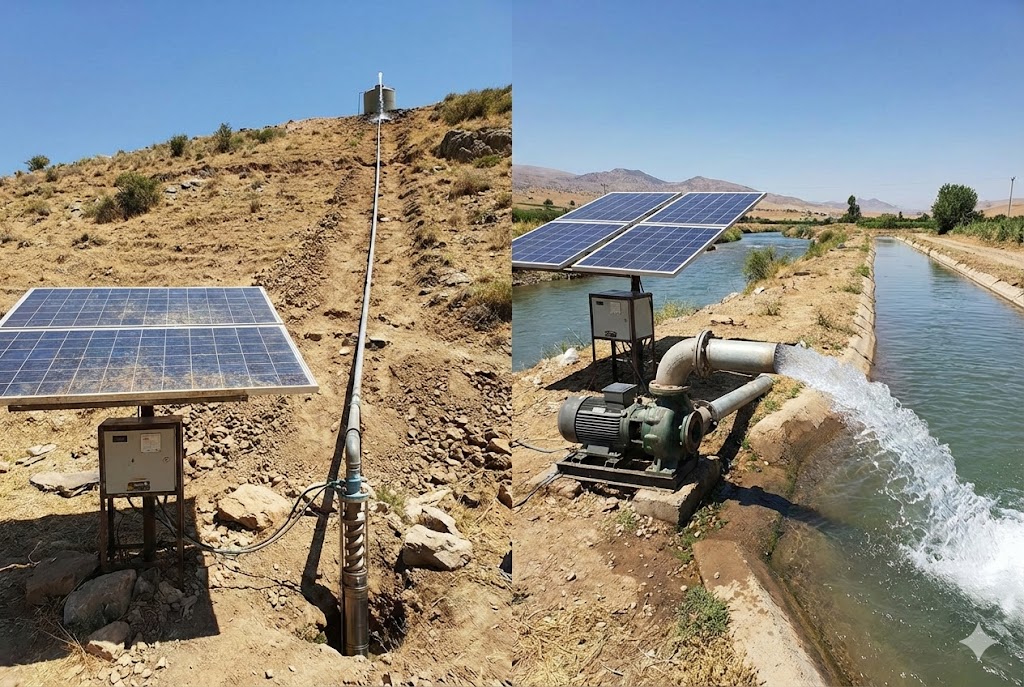
Worked example: estimating horizontal reach
Suppose the selected curve shows 32 m of head at 40 L/min. The source is open to the atmosphere, the outlet is 8 m above the water surface and needs 1 bar (10.2 m head). Allow 1.8 m for fittings at that flow. That leaves 12 m for straight-pipe friction (32 − 8 − 10.2 − 1.8).
- If your pipe-loss chart lists 3 m of loss per 100 m at 40 L/min, that budget covers roughly 400 m of straight pipe.
- If a smaller pipe’s chart lists 9 m per 100 m at the same flow, the budget covers only 133 m.
Both figures use assumed chart entries. Use the entries for the actual pipe material and inside diameter. On a suction-lift installation, also check the inlet conditions separately. An acceptable total head does not guarantee reliable priming.
Would a 2 HP pump reach farther?
Compare both curves at your design flow. Doubling motor horsepower does not automatically double distance or volume. See the 2 HP water-pump distance guide for that size, or ask RAFSUN to check the duty point with your pipe size, route, target flow and delivery pressure.