Struggling with pump selection?
The wrong RPM can cause inefficiency and premature failure.
Understanding RPM is key to choosing the right, long-lasting multistage pump for your needs.
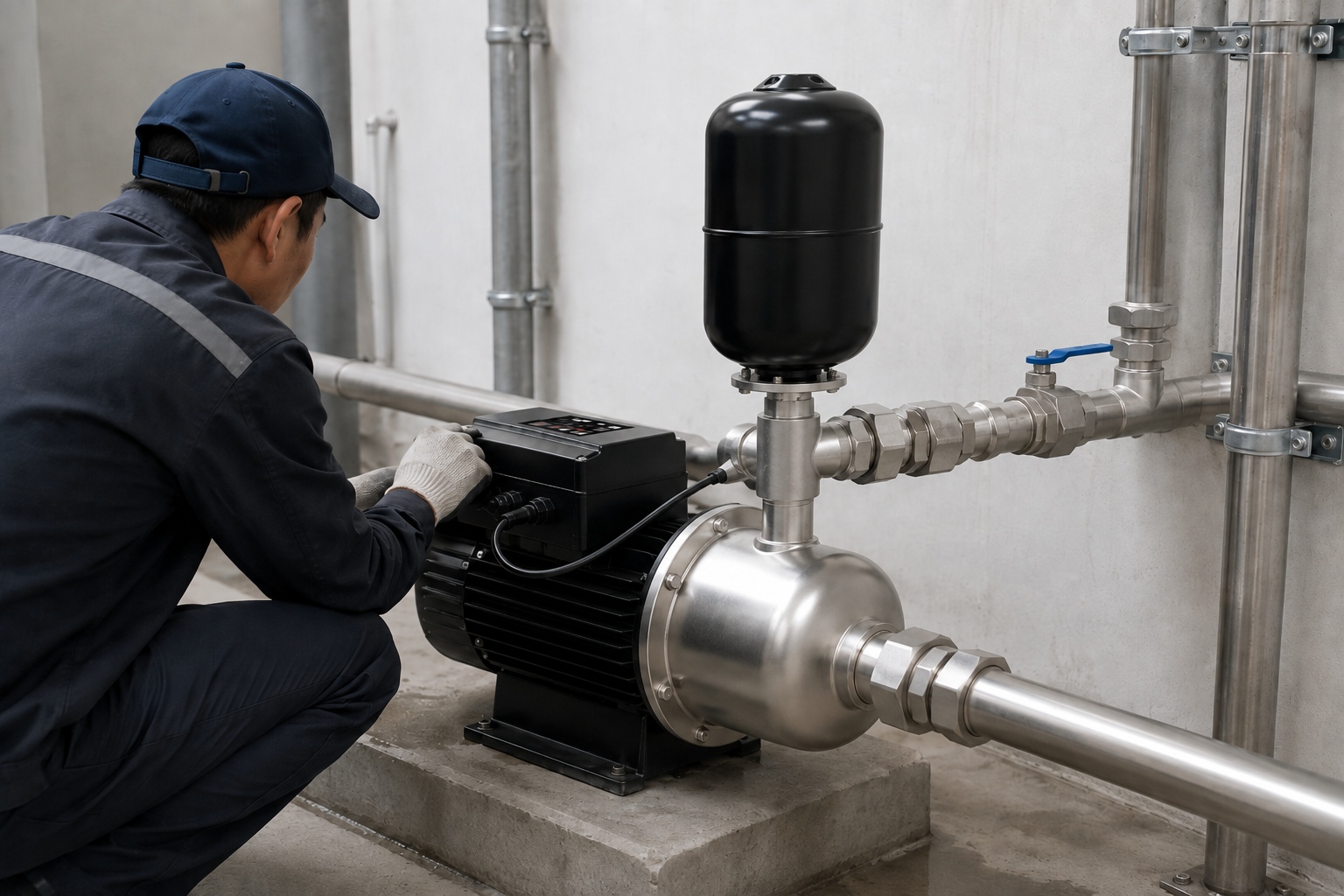
The RPM of a multistage pump, or its rotational speed, typically falls between 1450 RPM and 3500 RPM. This speed is determined by the electric motor driving the pump. It directly influences the pump’s flow rate, pressure output, and overall operational efficiency, making it a critical selection factor.
You now have a general understanding of the RPM range.
However, the difference between 1450 RPM and 3500 RPM is significant.
This choice impacts everything from your energy bill to how often you’ll need to perform maintenance.
Let’s explore what these numbers really mean for your application.
This will help you make a more informed and cost-effective decision.
Understanding Basic Pump RPM
Are you confused by all the technical specifications on a pump?
The RPM might just seem like another number on a data sheet.
This single value, however, dictates your pump’s performance, efficiency, and operational lifespan.
RPM, or Revolutions Per Minute, measures how fast the pump’s shaft and its attached impellers are spinning. A higher RPM generally produces greater flow and pressure. Conversely, a lower RPM often results in a longer pump life and quieter operation.
The Core of the Machine: The Motor
The pump itself does not have an inherent RPM.
Its speed is dictated entirely by the electric motor it’s coupled with.
In the world of standard AC motors, two main types define the pump’s speed.
Two-Pole vs. Four-Pole Motors
Most pumps use either a two-pole or a four-pole induction motor.
The number of poles, combined with the frequency of the electrical supply (50Hz or 60Hz), determines the motor’s synchronous speed.
- Two-Pole Motors: These are the high-speed options. At 50Hz, they run near 3000 RPM, and at 60Hz, they approach 3600 RPM.
- Four-Pole Motors: These are the standard-speed options. At 50Hz, they operate near 1500 RPM, and at 60Hz, they are close to 1800 RPM.
The actual operating speed, known as the asynchronous speed, is always slightly less than the synchronous speed due to a phenomenon called "slip." For example, a 3000 RPM motor might actually run at about 2900 RPM under load. This difference is usually between 2-5%.
How RPM Creates Performance
The impellers inside a multistage pump are what transfer energy to the water.
They act like spinning paddles.
When the motor rotates the shaft, the impellers spin rapidly.
This rotation flings the water outwards due to centrifugal force.
The faster the impellers spin (higher RPM), the more kinetic energy they impart to the fluid.
This increased energy translates directly into higher pressure (head) and a greater volume of water being moved (flow rate).
The relationship is not linear; it is governed by a set of principles known as the Pump Affinity Laws, which we will discuss later.
This fundamental connection shows why RPM is not just a number, but the very engine of the pump’s performance.
Key Factors for Choosing Pump RPM
Selecting the wrong pump RPM can be a costly mistake.
It can lead to wasted energy, frequent breakdowns, or a system that just doesn’t work.
Making the right choice requires balancing performance needs, efficiency, and long-term costs.
The ideal RPM depends on your specific application requirements for flow rate and pressure (head). You must also consider factors like efficiency, the pump’s expected lifespan, noise levels, and both the initial purchase price and long-term operational costs.
Choosing the correct speed for a multistage pump is a critical engineering decision.
It involves a trade-off between multiple competing factors.
A high-speed pump might deliver the performance you need, but it might also wear out faster and cost more to run.
Let’s break down the essential elements you must consider.
Application Requirements: Flow and Head
This is the most important factor.
What is the pump’s job?
You must first define your system’s required flow rate (e.g., in cubic meters per hour) and the total dynamic head (the pressure needed to move the water, measured in meters).
- High Head, Moderate Flow: Applications like boiler feed or high-pressure cleaning often require the high impeller tip speed provided by 3000/3600 RPM pumps.
- Moderate Head, High Flow: Large-scale water transfer or circulation systems might be better served by slower 1500/1800 RPM pumps that can move large volumes efficiently without excessive pressure.
Misjudging these primary requirements means the pump will either fail to perform or operate far from its most efficient point.
Efficiency and the Best Efficiency Point (BEP)
Every pump has a performance curve.
On this curve is a specific point where the pump operates most efficiently.
This is called the Best Efficiency Point (BEP).
Running a pump at or near its BEP is crucial for minimizing energy consumption.
A 3000 RPM pump and a 1500 RPM pump will have completely different performance curves and BEPs.
Often, a larger, slower 1500 RPM pump can be more efficient for a given duty point than a smaller, faster 3000 RPM pump.
While the faster pump might be smaller and cheaper to buy, its higher energy consumption could make it significantly more expensive over its lifetime, with energy costs accounting for up to 85% of a pump’s total life cycle cost.
Longevity, Wear, and Maintenance
Speed directly impacts the lifespan of a pump.
A pump running at 3000 RPM experiences significantly more wear on its components than one running at 1500 RPM.
| Component | Impact of High RPM (3000 RPM vs. 1500 RPM) |
|---|---|
| Bearings | Higher speeds increase load and heat, potentially reducing bearing life by over 50%. |
| Mechanical Seals | Increased rotational speed leads to more friction and heat, accelerating wear on seal faces. |
| Impellers/Diffusers | Higher fluid velocities can increase erosion and abrasion, especially with solids present. |
| Vibration | Higher speeds can amplify any existing imbalance, leading to increased vibration and stress on all parts. |
A pump operating at 1500 RPM generally requires less frequent maintenance and will have a longer overall service life.
For critical applications where downtime is not an option, a slower, more robust pump is often the superior choice.
The Role of Variable Speed Drives (VSD)
What if your system’s water demand changes throughout the day?
A fixed-speed pump is only efficient at one specific duty point.
This means you are wasting significant energy any time your demand is lower than the pump’s maximum design point.
A Variable Speed Drive (VSD), also known as a variable frequency drive (VFD), is an electronic controller that adjusts the motor’s speed. By changing the electrical frequency, a VSD allows you to run the pump at any RPM needed, ensuring optimal efficiency.
The introduction of VSD technology has fundamentally changed how we approach pump selection and operation.
Instead of being locked into a fixed speed like 1500 or 3000 RPM, you gain the flexibility to match pump output precisely to system demand.
This is a transformative advantage for many applications.
How VSDs Achieve Speed Control
A VSD sits between the main power supply and the pump motor.
It takes the standard fixed-frequency AC power (e.g., 50Hz) and converts it.
It first converts the AC power to DC power.
Then, it inverts the DC power back into a new AC signal with a variable frequency.
Since the motor’s speed is directly proportional to the frequency of the power supplied, changing the frequency changes the RPM.
A VSD can typically adjust a motor’s speed from about 20% to 100% of its nominal rating.
The Power of the Pump Affinity Laws
The benefits of VSDs are best explained by the Pump Affinity Laws.
These laws describe the relationship between pump speed and its performance.
- Flow is directly proportional to speed. If you reduce the pump speed by 20% (to 80% of its original RPM), the flow rate also drops to 80%.
- Pressure is proportional to the square of the speed. If you reduce the pump speed by 20% (to 80%), the pressure drops to (0.8)^2, or 64% of the original pressure.
- Power is proportional to the cube of the speed. This is the most important law for energy savings. If you reduce the pump speed by 20% (to 80%), the power required drops to (0.8)^3, or just 51.2% of the original power.
This cubic relationship means that even a small reduction in speed leads to massive energy savings.
Reducing pump speed by just 10% can result in energy savings of nearly 27%.
For applications with fluctuating demand, VSDs can often reduce energy consumption by 30-50% or more.
When is a VSD the Right Choice?
While VSDs offer incredible benefits, they are not always necessary.
The decision depends on your system’s operational profile.
| System Type | Fixed Speed Pump Recommendation | VSD Pump Recommendation |
|---|---|---|
| Constant, Unchanging Demand (e.g., boiler feed) | Often suitable and more cost-effective. | May be overly complex and expensive. |
| Variable Demand (e.g., building water supply) | Inefficient, wastes energy. | Highly recommended for significant energy savings. |
| Systems Requiring Soft Start/Stop | Can cause pressure surges (water hammer). | Provides smooth acceleration, protecting the system. |
| Systems with Multiple Duty Points | Requires multiple pumps or control valves. | A single VSD pump can efficiently meet all demands. |
By investing in a VSD, you are not just buying a pump.
You are buying an intelligent pumping system that adapts to your needs, saves you money, and protects your entire plumbing infrastructure.
Conclusion
Choosing the right pump RPM is a balance of performance, efficiency, and longevity.
VSD technology offers a flexible solution, delivering massive energy savings for variable demand systems.
FAQs
What happens if the pump RPM is too high?
Excessively high RPM increases wear on bearings and seals, raises energy use, and can cause cavitation if the suction conditions are not ideal, leading to premature pump failure.
Can pump RPM be changed?
Yes, the RPM of a pump can be changed by using a Variable Speed Drive (VSD), which adjusts the frequency of the power supplied to the motor.
What is the normal RPM for a water pump?
For water pumps, common speeds are around 1450/1750 RPM (4-pole motors) for general transfer and 2900/3500 RPM (2-pole motors) for high-pressure applications.
How does RPM affect pump flow?
Flow rate is directly proportional to the pump’s RPM. Doubling the RPM will roughly double the flow rate, assuming the system can handle the increased flow.
Is higher RPM better for a pump?
Not necessarily. Higher RPM provides more pressure and flow but at the cost of increased energy consumption, faster wear, and more noise. The "better" RPM depends entirely on the application’s specific requirements.
Does RPM affect pump pressure?
Yes, pressure (head) is proportional to the square of the RPM. A small increase in speed results in a much larger increase in the pressure the pump can generate.